
Introduction
Your general ledger says one thing. Your bank statement says another. Which number do you trust when you're deciding whether to make payroll, extend credit to a customer, or take on new inventory?
Many growing businesses hit this exact wall. Balances drift across bank accounts, merchant platforms, subledgers, and spreadsheets—and the gap often stays hidden until month-end close stalls and cash decisions get risky.
Account reconciliation services compare those records, investigate differences, document adjustments, and restore reporting you can rely on.
This guide walks through what reconciliation involves, which accounts it covers, how the process works step by step, when outsourcing makes sense, and what to look for in a provider.
Key Takeaways
- Reconciliation confirms internal records match independent statements and supporting schedules.
- Apply it to bank, credit card, AP, AR, inventory, fixed assets, and intercompany accounts.
- Explain every difference and require independent review before you close.
- Outsourced support improves accuracy and audit readiness without adding headcount.
What Is Account Reconciliation and What Does It Cover?
Account reconciliation is the process of comparing two sets of financial records to confirm they agree, and if they don't, figuring out why. The New York State Office of the State Comptroller defines the process as comparing different data sets, identifying and investigating differences, and taking corrective action when necessary.
That comparison usually happens between your general ledger and an outside source: a bank statement, a vendor statement, a merchant platform report, or an internal subledger.
Not every difference is an error. A deposit in transit or an outstanding check is a normal timing difference; it clears on its own once the bank catches up. A duplicate entry or a missing transaction is a genuine error that needs correcting.
Main Account Types That Require Reconciliation
- Bank and cash accounts — deposits, withdrawals, fees, transfers, and outstanding payments
- Credit card and expense accounts — charges, reimbursements, receipts, and employee spending
- Accounts payable — invoices, payments, credits, and vendor statements
- Accounts receivable — invoices, collections, credits, and unapplied cash
- Balance sheet accounts — fixed assets, inventory, payroll, prepaids, accruals, and intercompany balances that must tie to the general ledger
Reconciliation needs shift depending on your business model. A SaaS company reconciling subscription revenue faces different questions than a franchise operator reconciling location-level royalties, an e-commerce brand tracking inventory and payment-platform settlements, or a distillery aging inventory across multiple production years.
Bank reconciliation is just one piece of the larger reconciliation picture, not the whole job. Plenty of businesses stop there and miss discrepancies sitting in accounts payable, receivables, or intercompany accounts.
How the Account Reconciliation Process Works
The exact steps vary by account risk, transaction volume, and complexity, but the core workflow stays consistent across almost every reconciliation.
- Gather the records. Pull the general ledger or trial balance, external statements, subledger reports, invoices, and receipts for the period, plus prior reconciliations.
- Confirm the opening balance. The current period should start with last period's approved ending balance. Unresolved prior differences need to be closed out first. Carrying them forward just compounds the problem.
- Compare balances and transactions. Match amounts, dates, descriptions, and reference numbers across both records.
- Identify and classify differences. Common categories include:
- Timing differences (outstanding checks, deposits in transit, unsettled payments)
- Missing or duplicated transactions, coding errors, bank fees, or sync issues between systems
- Unusual or potentially unauthorized activity that needs escalation, not a routine adjustment
- Investigate unresolved items. Get supporting evidence, contact the right stakeholder, and decide whether an item needs a journal entry or ongoing tracking.
- Document everything. Record the account, period, source records, reconciling items, explanations, preparer, reviewer, and approval date.
- Review and close. An independent reviewer signs off only once balances agree or every remaining item has a documented explanation. A quick example: Your books show cash of $24,500. The bank statement shows $24,150 — a $350 gap.

- $50 monthly service fee the bank charged but you had not recorded
- $300 deposit made on the last day of the month that had not posted yet Record the fee and treat the deposit as in transit, and both balances land at $24,450.
Why Account Reconciliation Matters for Growing Businesses
Reconciled records are the foundation everything else sits on. If your balance sheet, income statement, and cash position aren't reliable, every decision built on them is a guess. Reconciliation ties directly to cash-flow visibility. Verified balances tell you what's actually available, what's coming due, and whether collections are keeping pace with obligations. Skip it, and you're managing cash based on numbers that might be wrong. Fraud control is part of the picture too. The ACFE's 2024 Report to the Nations names account reconciliation among the controls that actively detect occupational fraud, alongside management review and monitoring. The same report found that lack of internal controls was the most-cited organizational weakness, appearing in 32% of fraud cases. Regular reconciliation reviews tend to surface:

- Duplicate payments to vendors
- Missing or delayed deposits
- Unusual transfers between accounts
- Recurring process weaknesses nobody flagged before Audit readiness improves as well. Consistent reconciliations leave behind organized support, review evidence, and a documented adjustment trail — exactly what auditors and lenders ask for. When reconciliations are current, month-end close moves faster. That gives leadership a clearer runway for decisions on hiring, inventory, expansion, or financing.
Common Discrepancies and Best Practices
Most reconciliation differences trace back to a short list of causes:
- Data-entry mistakes and duplicate or missing transactions
- Timing differences between when a transaction happens and when it clears
- Incomplete documentation or missing invoices
- Bank or processor fees nobody recorded
- Integration failures between accounting systems and bank feeds
- Incorrect account coding, currency conversions, or intercompany mismatches
- Occasionally, fraud
Resolving them means tracing each item back to source documentation. Correct the ledger when the business made the error, record legitimate timing differences, and escalate anything suspicious rather than quietly adjusting it away.
A Practical Control Framework
The Journal of Accountancy recommends standardizing reconciliation policies and templates across the company, and directing more effort toward higher-risk accounts rather than treating every account equally. Building on that:
- Frequency by risk — reconcile high-volume or high-risk accounts more often than low-activity ones.
- Standard templates and ownership — keep every reconciliation consistent regardless of who prepared it.
- Prep vs. review — separate preparation from review wherever staffing allows; add supervisory review on small teams.
- Aging differences — root-cause recurring items instead of carrying them forward month after month.
- Documentation and access controls — retain support and restrict access for sensitive financial data.
- Automated matching — automate repetitive matches, and keep human judgment for exceptions and anything unusual.
When Should You Use Account Reconciliation Services?
Bring in outside reconciliation support when any of these patterns show up:
- Reconciliations are consistently late or skipped
- Balances don't tie, and nobody's sure why
- The same cleanup issues keep reappearing month after month
- Leadership doesn't fully trust the management reports
- Your entire close process depends on one person
- Internal staff don't have time for meaningful review, only data entry
Common Service Models
| Service Model | Best For |
|---|---|
| Recurring reconciliation support | Bank, credit card, subledger, and balance sheet accounts on an ongoing basis |
| Catch-up bookkeeping and cleanup | Businesses preparing for tax filing, financing, an audit, or a major milestone |
| Controller-level oversight | Review, internal controls, close coordination, and process design |
| Reporting-connected reconciliation | Cash-flow insight, ERP implementation, or broader process improvement |
When evaluating a provider, look for:
- Experience with your stack (QuickBooks, Xero, NetSuite, Acumatica) and your industry's complexity
- A defined process for gathering records, investigating exceptions, and getting review approval
- Clear communication on scope, frequency, deliverables, and open items
- Capacity to scale past basic transaction matching as your needs get more complex
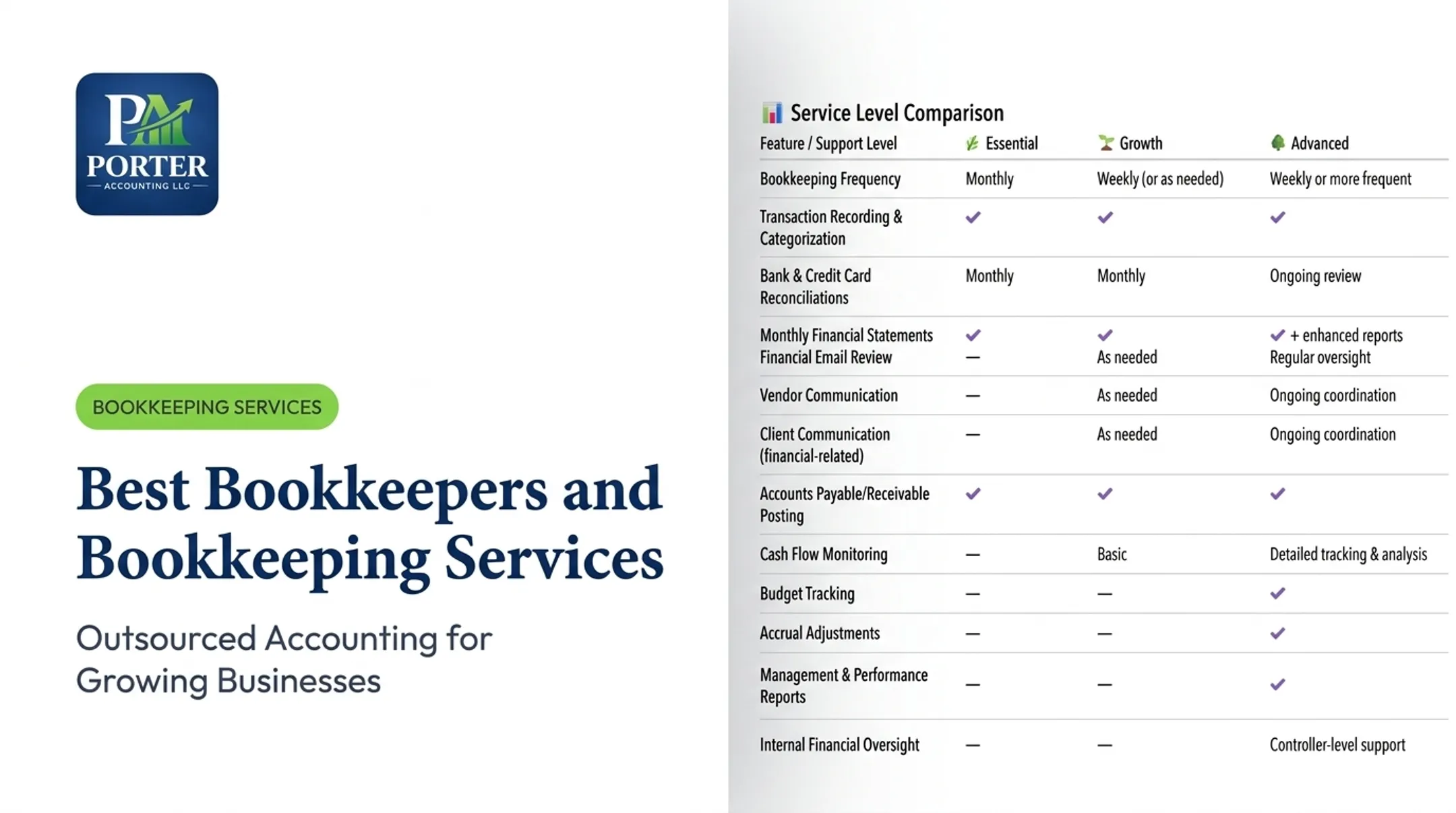
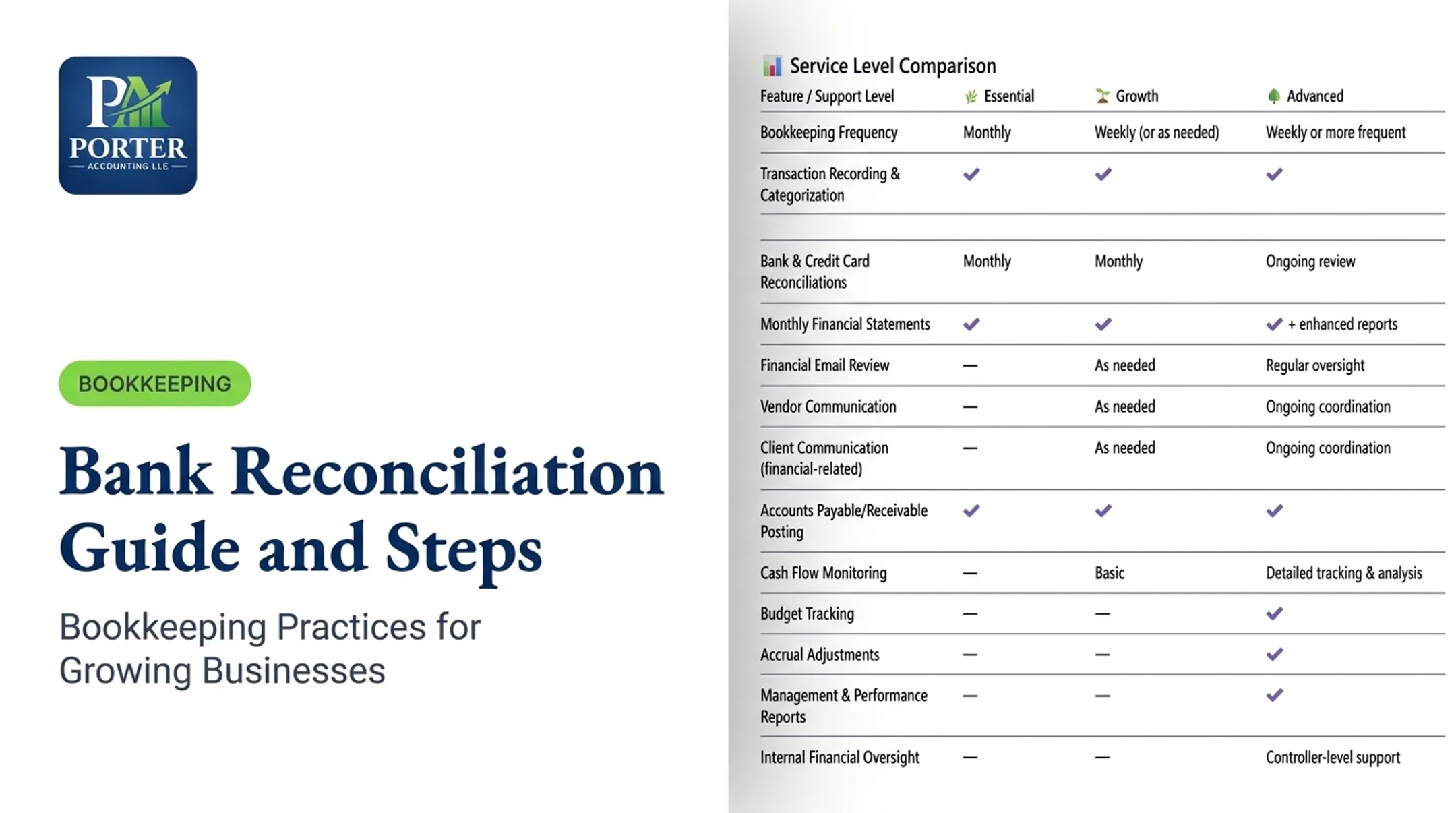
Those criteria matter most when you need a partner who can cover cleanup, ongoing reconciliations, and senior oversight in one place. Porter Accounting LLC works as a virtual accounting and advisory partner for growing U.S. businesses, spanning monthly reconciliations, catch-up cleanups, controller-level oversight, and fractional CFO support.

Thao Porter, the firm's Accounting Leader, has over a decade of experience across SaaS, manufacturing, CPG, retail, and franchise businesses. Her depth includes GAAP reporting, ASC 606 revenue recognition, ERP implementations, and audit readiness.
Typical starting points:
- Monthly Bookkeeping from $850/month, including bank and credit card reconciliations
- Controller Services from $100/hour for oversight, close coordination, and internal controls
- Fractional CFO Services from $150/hour for cash-flow monitoring and broader financial guidance
If your books are hard to trust or your close keeps slipping, talk through what reconciliation and broader accounting support should look like for your business.
Beyond Bookkeeping: Reconciliations as the Base for GAAP Reporting and Audits
Reconciliation is where bookkeeping ends and financial reporting begins. Once bank and card accounts tie out, the next layer is balance sheet reconciliations for accruals, prepaids, deferred revenue, and debt, and that is typically where a controller takes over review and sign-off. Those reconciled balances are what GAAP financial statements are built on, and for subscription or contract businesses, a deferred revenue reconciliation is also the backbone of ASC 606 compliance. When an external audit or lender review comes up, the reconciliation binder is usually the first thing requested. Our year-end close and audit readiness guide shows how monthly reconciliations roll into an audit-ready file.
Conclusion
Account reconciliation protects your cash, verifies your records, and gives you numbers you can actually make decisions with. Treat it as an ongoing control, not a month-end checkbox.
The approach that works:
- Reconcile the right accounts at the right frequency
- Explain every difference instead of ignoring it
- Document the work
- Bring in experienced support when capacity or complexity outpaces your team
Porter Accounting LLC works from that same principle: clarity in your numbers, confidence in your decisions. We start with accurate reconciliations and build up to controller-level close, GAAP reporting, audit readiness, and fractional CFO guidance as your business needs them.
Frequently Asked Questions
What is account reconciliation?
Account reconciliation is the process of comparing internal accounting records against external statements or supporting schedules to identify, explain, and correct any differences.
What are the main types of account reconciliation?
Common types include bank, credit card, accounts payable, accounts receivable, balance sheet, fixed asset, inventory, payroll, and intercompany reconciliation. Which ones apply depends on your business model.
Who performs account reconciliations?
Bookkeepers, staff accountants, controllers, or outsourced accounting professionals typically prepare reconciliations. An independent reviewer should then check and approve the work.
Can you provide an example of account reconciliation?
Your books show $24,500 and the bank statement shows $24,150. After you record an unrecorded $50 bank fee and a $300 deposit in transit, both sides adjust to $24,450 and are documented as reconciled.
Do auditors review account reconciliations?
Yes. External auditors typically request reconciliations for cash and other significant balance sheet accounts, along with the support and evidence of review. Keeping them current each month makes audit preparation far simpler.
What does "reconcile the transaction" mean?
It means matching a specific transaction between two records, confirming the amount and details align, and resolving or documenting any discrepancy that turns up.