
Without that answer, small business finances get messy fast. Many owners struggle with mixed personal and business spending, shoeboxes of missing receipts, bank accounts that haven't been reconciled in months, and no real sense of whether the business is actually profitable. Then tax season arrives, and everything gets reconstructed under pressure.
This guide walks through what bookkeeping actually is, how to set up a system that fits your business, the recurring workflow that keeps books current, common mistakes to avoid, and how to know when it's time to bring in professional help.
Key Takeaways
- Organized bookkeeping gives you clean records for taxes, clearer cash-flow awareness, and better day-to-day decisions.
- Start with separate business finances, the right chart of accounts, a consistent method, and a document-storage system.
- Record often, reconcile regularly, and review reports—don't wait for tax season.
- Software automates data entry, but you still need to review entries and flag anything unusual.
- DIY works for simple businesses; growth or complexity often calls for a bookkeeper, accountant, or advisor.
What Is Bookkeeping and Why Does a Small Business Need It?
Bookkeeping is the process of recording, categorizing, and organizing every financial transaction your business generates: sales, expenses, payments, purchases, payroll, loans, and owner activity. It is the foundation the rest of your finances rest on.
Without reliable books, tax filings, cash decisions, and growth plans all rest on guesswork. Solid records show what you earned, what you owe, and whether you can afford the next hire or purchase.
Bookkeeping vs. Accounting: What's the Difference?
Bookkeeping creates the raw records. Accounting takes those records and turns them into reporting, tax filings, internal controls, and strategic guidance. Bookkeeping is data collection; accounting is data interpretation. You need accurate books before any analysis means anything.
The Five Account Categories You'll See Everywhere
Every transaction in your business fits into one of five buckets:
- Assets – what your business owns (cash, equipment, receivables)
- Liabilities – what your business owes (loans, credit cards, unpaid bills)
- Equity – the owner's stake in the business
- Income – money earned from sales or services
- Expenses – costs of running the business
These five always balance around one equation: Assets = Liabilities + Equity.
Cash vs. Accrual, Single vs. Double Entry
Two timing methods show up most often:
- Cash method – Record income when you receive it and expenses when you pay them. Common for sole proprietors without inventory.
- Accrual method – Record income when earned and expenses when incurred, so activity lands in the right period.
According to IRS Publication 334, businesses where inventory is a material income factor generally must use accrual for purchases and sales, though qualifying small business taxpayers have some flexibility.
Separately, double-entry bookkeeping posts each transaction to two accounts as equal and opposite entries. That is the standard once you move past the simplest single-entry records.
Profit Isn't the Same as Cash in the Bank
This trips up more new owners than almost anything else. You can show revenue, or even profit, on paper while client payments are still outstanding. Cash can also leave for loan principal, equipment, or inventory without hitting a typical expense line.
Accurate books help you:
- Monitor margins before they slip
- Catch overdue invoices early
- Plan hiring and purchases from real cash position, not guesses
How to Set Up a Bookkeeping System
Getting the setup right the first time saves hours of cleanup later.
Separate Your Finances First
Open a dedicated business bank account and card before you record a single transaction.
Decide how owner contributions and withdrawals get logged, and document any business expense you accidentally pay from a personal account. Mixed finances are one of the most common reasons books become unreliable.
Build a Chart of Accounts That Fits
Your chart of accounts should mirror your actual business, not a generic template. A service business needs far fewer categories than one carrying inventory. Examples:
- Service businesses: income by service line, contractor expenses, software subscriptions
- Inventory-based companies: inventory asset accounts, cost of goods sold, sales revenue by product line
- Franchises: royalty expense, location-by-location income tracking
- Businesses with payroll: payroll expense, payroll tax liability, employee benefits
Choose Your System and Method
Compare options based on transaction volume, invoicing needs, payroll, inventory, reporting, and growth plans, not just price. A spreadsheet might handle a handful of monthly transactions. Cloud software like QuickBooks or Xero makes more sense once you're issuing invoices, tracking receivables, or running payroll.
Businesses with inventory, multiple locations, subscriptions, or complex contracts often need more structure than a simple service business. Professional guidance on method selection helps you avoid rework later. Porter Accounting LLC's ERP Implementation and Accounting System Setup service builds charts of accounts and workflows in QuickBooks, Xero, NetSuite, or Acumatica to match how a business actually operates.
Create a Document Trail
Keep invoices, receipts, bills, deposit records, and payroll reports organized and backed up. The IRS generally recommends keeping records for three years. Keep them six years if unreported income exceeds 25% of gross income, and four years for employment tax records, per IRS guidance on recordkeeping.

The Bookkeeping Routine: Record, Reconcile, and Review
Setup gets you started. The routine is what keeps your books accurate and ready for decisions.
The Weekly Rhythm: Record and Categorize
Import or enter transactions regularly, attach receipts, and categorize each item as it comes in. Don't let uncategorized or duplicate entries pile up. They're much harder to sort out three months later than three days later.
Accounts receivable and payable need their own attention:
- Issue accurate invoices and track due dates
- Follow up on overdue balances before they age too far
- Record bills as they arrive, not when they're paid
- Schedule vendor payments without treating unpaid bills as cash already in hand
Reconciliation: Catching Errors Before They Snowball
Bank reconciliation means comparing your bookkeeping records against your actual bank and credit card statements, line by line. SCORE recommends reconciling monthly and reviewing statements for timing differences, bank fees, and possible errors or fraud. Skipping this step is how small discrepancies turn into big, confusing ones.
Reports Worth Reading Monthly
Don't just file reports away—read them. The core set includes:
- Profit and loss statement: income and expenses over a period
- Balance sheet: assets, liabilities, and equity at a point in time
- Cash-flow report: where cash actually went
- AR and AP aging reports: what's overdue on both sides
- Budget-versus-actual: how results compare to your plan
Use them to evaluate pricing, plan payroll or inventory buys, and spot cash shortfalls early. They also help you decide when to delay or accelerate spending.
Bookkeeping Best Practices, Tax Readiness, and Common Mistakes
A few habits separate businesses with clean books from those scrambling every April.
Best practices:
- Record transactions close to when they happen, not weeks later
- Capture receipts digitally instead of stuffing them in a drawer
- Use consistent categories all year, not just at tax time
- Back up records and secure account access
Bookkeeping supports tax preparation, but it doesn't decide what's deductible on its own. Confirm specifics with a qualified tax professional.
Those same habits protect cash flow. In an Intuit QuickBooks survey, 43% of small business owners said cash flow was a problem, and 71% still relied on pen-and-paper or spreadsheets alongside software—raising the odds of missed entries and cleanup work later.

Common mistakes to avoid:
- Mixing personal and business transactions
- Missing cash or payment-processor activity
- Misclassifying owner draws as business expenses
- Ignoring inventory or fixed-asset tracking
- Recording revenue without accounting for refunds or chargebacks
Monthly checklist:
- Reconcile all accounts
- Review your P&L
- Inspect balance-sheet accounts
- Check receivables and payables aging
- Confirm payroll and tax records are current
- Note follow-up items before closing the books
When Should You Do Your Own Bookkeeping or Hire Help?
There's no universal answer. It depends on where your business actually stands.
Signs DIY Still Works
- Low monthly transaction volume
- Straightforward service model with no inventory or employees
- Limited payment channels
- Consistent weekly time to review the books
Signs You Need Support
- Books are months behind
- Reconciliations never quite tie out
- Tax deadlines are approaching and records aren't ready
- Payroll or inventory is now material to the business
- You can't explain why reported numbers look the way they do
Choosing the Right Level of Help
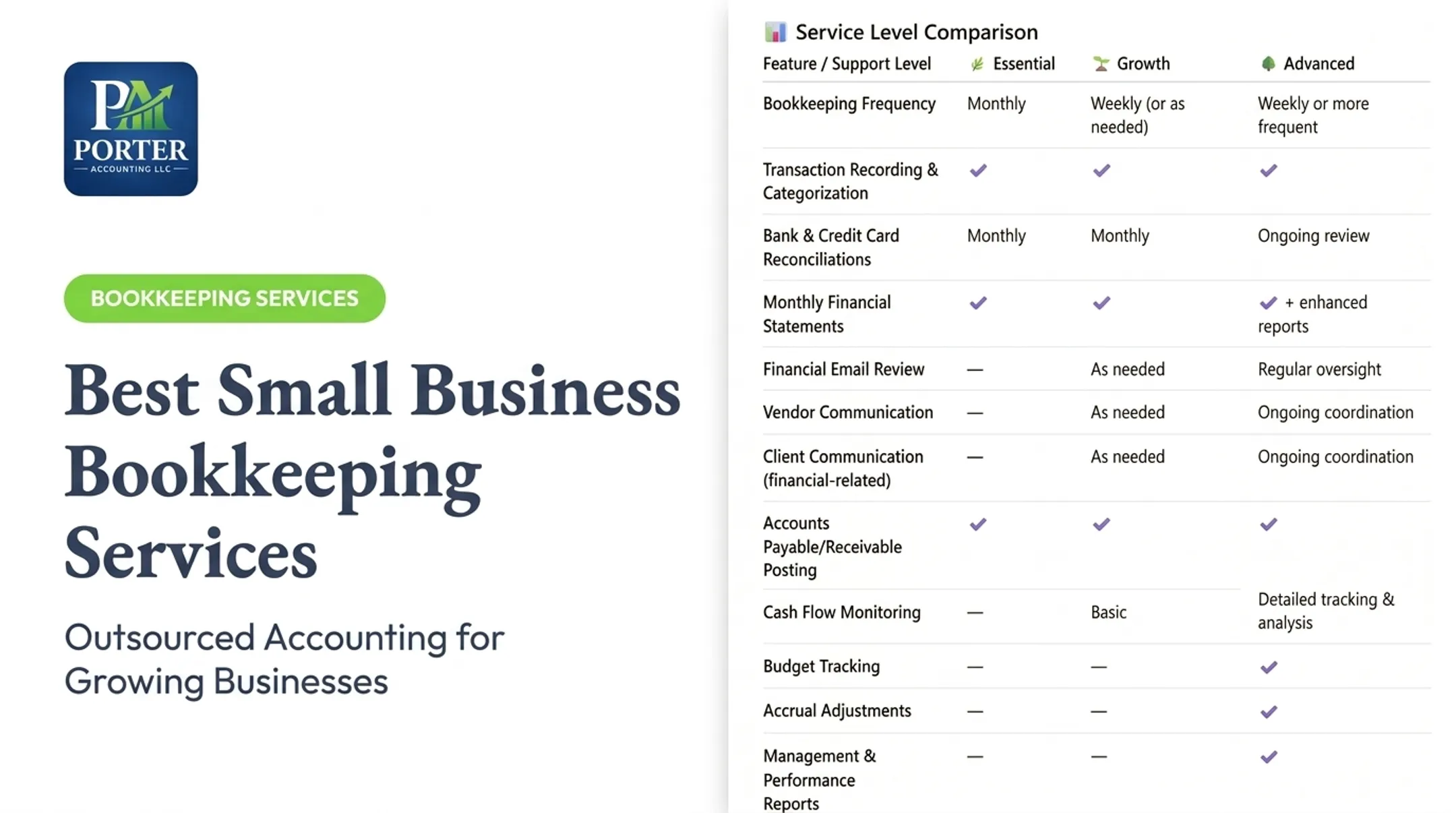
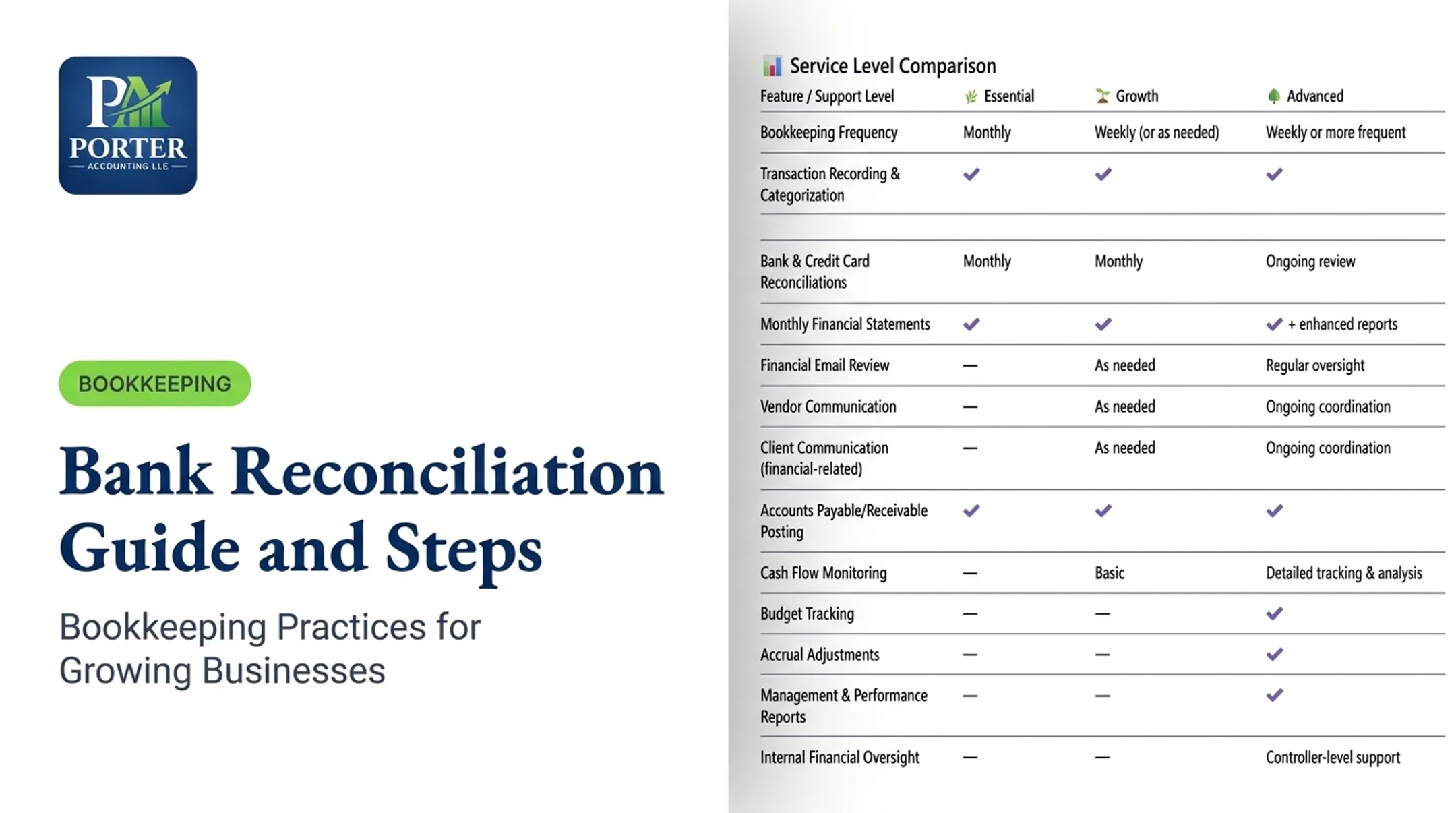
Support scales with need. A bookkeeper handles transaction processing and reconciliations. An accountant takes on reporting and tax-related work. A controller or fractional CFO builds systems, controls, forecasting, and higher-level financial strategy.

For growing US businesses, Porter Accounting LLC offers that range without a full-time finance hire:
- Monthly Bookkeeping: from $850/month for transaction recording, reconciliations, and monthly statements, up to $2,100/month with financial analysis, budget tracking, and cash-flow monitoring
- Catch-Up & Clean-Up Bookkeeping: corrects errors and organizes overdue records, typically 1.5× the standard monthly rate
- Controller Services: from $100/hour, for month-end and year-end close oversight, accrual adjustments, and reporting accuracy
- Fractional CFO Services: from $150/hour, for forecasting, budgeting, and KPI tracking
When you evaluate any provider, ask about industry and software experience, what's in scope, how often books are reviewed, and whether support can scale as you grow.
When Good Books Become the Starting Point
The habits in this guide are enough for many small businesses, but they are the foundation of a finance function, not the whole thing. The shift usually happens when someone outside the business starts relying on your numbers. A bank may ask for accrual-basis GAAP financial statements instead of a cash-basis P&L, an investor may want revenue recognized under ASC 606, or a larger customer or partner may require an audit. Each of those needs clean books first, then controller-level review and adjustments on top. Our guide to preparing financial statements explains what that next step looks like.
Frequently Asked Questions
What are the basic principles of bookkeeping?
Accurate, timely transaction recording; consistent categorization; separating business and personal finances; regular reconciliation; and organized, retrievable documentation. Skipping any one of these tends to undermine the rest.
What is bookkeeping for tax purposes?
Bookkeeping organizes the income, expenses, assets, payroll, and supporting documents used to prepare tax filings. Confirm specific tax treatment and filing obligations with a qualified tax professional.
What is the best bookkeeping software for a sole proprietor?
It depends on your transaction volume, invoicing needs, payroll, and budget. Compare current US-available options like QuickBooks, Xero, Wave, or FreshBooks, and confirm compatibility with your bookkeeper or accountant.
What are common mistakes sole proprietors make?
Mixing personal and business finances, losing receipts, skipping reconciliations, misclassifying expenses, neglecting estimated tax payments, and waiting until tax season to update records.
Does a sole proprietor need an accountant or bookkeeper?
A simple business can often manage routine bookkeeping independently. Professional help becomes more valuable as transactions, tax requirements, payroll, or cleanup needs grow more complex.
When should a small business switch from cash to accrual bookkeeping?
Consider switching when you carry meaningful receivables, payables, or inventory, sell prepaid or subscription services, or expect a lender or investor to ask for GAAP statements. Confirm tax implications with your tax professional before changing methods.
How much do bookkeepers typically charge?
Pricing varies by transaction volume, service scope, and whether cleanup or payroll work is involved. Request quotes that clearly define deliverables so you're comparing like for like.