
Introduction
Running a small business means wearing every hat: sales, operations, hiring, and somehow, keeping the books current. Most owners weren't trained for that last part, and it shows.
A SCORE survey found that 40% of small-business owners call bookkeeping and taxes the worst part of running their company. That's not surprising when you're reconciling accounts at 10 p.m. after a full day of running the business.
Outsourced bookkeeping gives you ongoing financial support without the cost or commitment of building an in-house accounting department. This guide covers what these services actually include, the benefits worth knowing about, how to tell if outsourcing fits your business, and what to look for when choosing a provider.
Key Takeaways
- Outsourced bookkeeping usually covers categorization, reconciliations, AP/AR, payroll coordination, and recurring reports.
- A strong provider improves financial visibility so owners can make clearer, faster decisions.
- Compare providers on industry experience, security controls, communication, and exact scope inclusions.
- Pricing scales with transaction volume, account count, payroll complexity, and cleanup needs.
What Are Outsourced Bookkeeping Services for Small Businesses?
Outsourced bookkeeping means hiring an external professional or firm to maintain your financial records and handle recurring bookkeeping tasks. Most providers work through secure cloud-based accounting systems and remote collaboration.
Bookkeeping vs. Accounting
People often use these terms interchangeably, but they are not the same thing.
- Bookkeeping maintains the financial foundation: recording transactions, reconciling accounts, keeping the ledger accurate.
- Accounting builds on that foundation with report interpretation, tax coordination, controller oversight, forecasting, and strategic guidance.
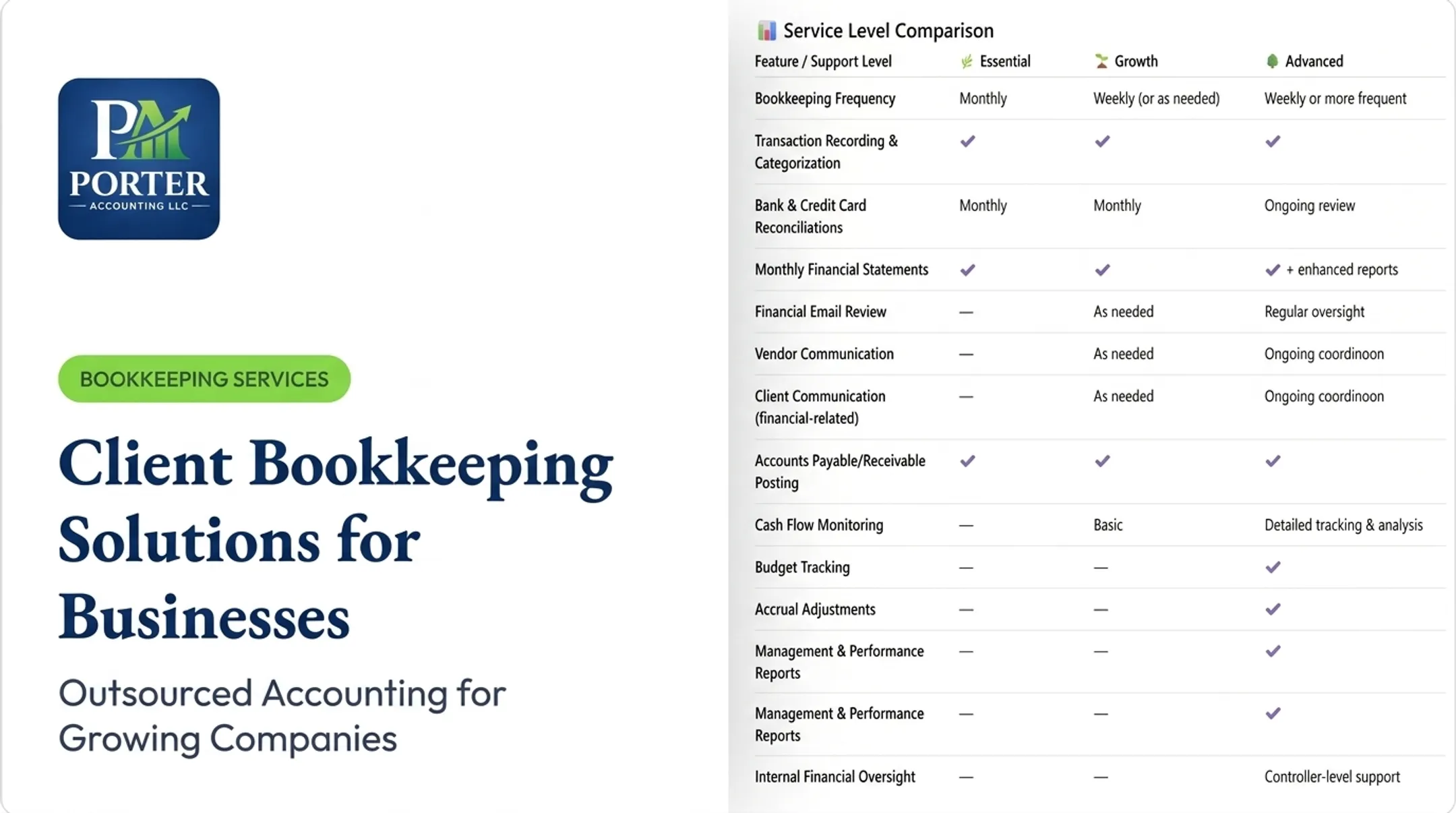
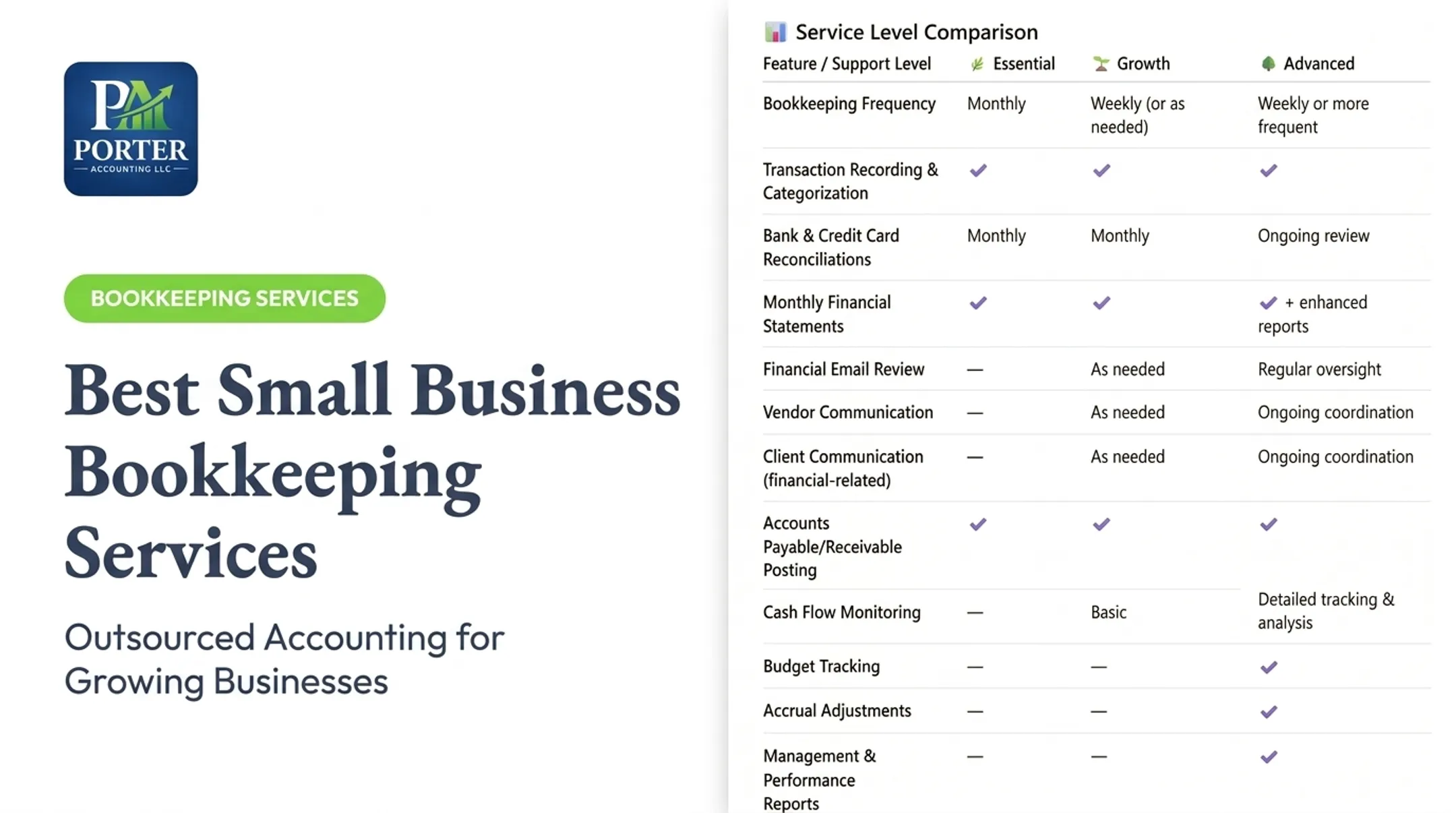
Porter Accounting LLC structures this as a progression. Its Essential plan starts at $850/month for core bookkeeping, while the Advanced plan (starting at $2,100/month) adds financial analysis, budget tracking, and controller-level oversight.

How the Arrangement Actually Works
A provider receives controlled access to your bank feeds, credit cards, and accounting software. They maintain your books on an agreed schedule, reconcile accounts, and deliver reports.
This is not the same as handing over unrestricted control of your finances. Your business should retain approval authority over bank accounts, payments, and investments at all times. A legitimate provider works within defined access, not around it.
Working Alongside Your Existing Team
Most small businesses already have some financial support in place, whether that's a CPA at tax time, a payroll provider, or an admin who handles invoicing. Outsourced bookkeeping should fit around these relationships, not replace them.
Document who does what. Without clear boundaries, you end up with duplicated work, or worse, gaps where nobody is watching a critical task.
What Services Are Included in Outsourced Bookkeeping?
Scope varies by provider, but most engagements cover a similar core set of activities before layering on specialized support.
Core Recordkeeping and Reconciliation
Transaction recording and categorization covers income, expenses, transfers, credit-card activity, and merchant deposits. Entries are organized against an industry-appropriate chart of accounts.
Regular bank, credit-card, and payment-platform reconciliations matter more than they get credit for. They surface:
- Missing transactions
- Duplicate entries
- Timing differences between your books and the bank
- Unusual or unauthorized activity
AP and AR Support
Providers typically organize bills, track outstanding invoices, and monitor receivables. That work prepares the information you need to pay vendors or follow up with customers, without handing the provider automatic control over disbursements. Payment decisions stay with you.
Porter Accounting's Collections Support add-on, for example, follows up on overdue customer balances through reminder emails and phone calls, but payment authority stays with the business.
Recurring Financial Reporting
This is where bookkeeping starts paying for itself. Standard reports include:
- Profit and loss statements
- Balance sheets
- Cash-flow reports
- Management reports tailored to your specific decisions
Commonly Added Services
Availability varies by provider and engagement, but frequently added services include:
- Payroll coordination and payroll-tax tracking
- Sales-tax tracking
- Year-end tax-preparation support
- Budget assistance and cash-flow forecasting
- Bookkeeping cleanup for overdue or messy books
Industry-Specific Needs
Basic bookkeeping isn't always enough. Some businesses need more specialized structure:
- E-commerce and CPG brands need inventory and margin tracking, not just transaction logging.
- Franchises need location-level reporting, plus clear treatment of royalty and franchise-fee accounting.
- Construction businesses need project or job-cost tracking, per CFMA's industry accounting guidance.
- SaaS companies need revenue-recognition support under ASC 606, which governs how subscription revenue gets recorded.
Porter Accounting LLC supports revenue recognition under ASC 606 for SaaS, manufacturing, construction, CPG, retail, and franchise clients. That work requires more technical depth than standard monthly bookkeeping.
Why Should a Small Business Outsource Bookkeeping?
Get Your Time Back
Every hour spent reconciling accounts is an hour not spent on customers, sales, or hiring. Delegating recurring financial administration frees owners to focus on the parts of the business only they can run.
Make Better Decisions With Current Numbers
Accurate, timely books mean you can actually evaluate:
- Profitability by product, service, or location
- Cash commitments and upcoming obligations
- Aging receivables and inventory levels
- Where spending is actually going
Stale books can't answer any of these questions in real time.
Access Experience Without a Full-Time Hire
Outsourcing gives you access to experienced financial support without the fixed cost of a full-time employee. That said, outsourcing isn't automatically cheaper. Compare the provider's expertise and scope against what an in-house hire would actually cover before assuming you're saving money.
Strengthen Internal Controls
Small organizations are particularly exposed to fraud risk. The ACFE's 2024 Report to the Nations found that organizations with fewer than 100 employees had a median fraud loss of $141,000. That figure stems largely from fewer checks and balances and less segregation of duties than larger organizations have.

Documented processes, regular reconciliations, and defined access controls directly address that gap.
Stay Tax and Audit Ready
Organized, current records make tax season and audits far less painful. Bookkeeping support does not automatically include tax advice, tax filing, audit opinions, or legal advice. Confirm what's actually in scope before assuming coverage.
If a lender, investor, or customer has asked for audited financials, plan for a step beyond monthly bookkeeping. Auditors expect accrual-basis records, completed balance sheet reconciliations, supporting schedules, and quick answers to their request list. Porter Accounting LLC provides audit readiness and preparation support and works alongside your external auditors; the audit opinion itself always comes from an independent CPA firm.
Scale as You Grow
Many businesses start with monthly bookkeeping or a cleanup project, then add reporting, controller support, or fractional CFO guidance as complexity increases. Porter Accounting's tiered plans reflect this: Essential for straightforward books, Growth for weekly support, and Advanced for controller-level oversight without hiring one outright. When the business needs a part-time controller to own the close, or its first set of GAAP statements for a lender, a fractional controller is the usual next step. Our guide to preparing financial statements explains what that reporting involves.
Is Outsourced Bookkeeping Right for Your Business?
Signs It's Time
A few practical red flags suggest outsourcing is overdue:
- Books are consistently behind by weeks or months
- You're doing bookkeeping late at night instead of running the business
- Reconciliations are incomplete or skipped entirely
- Cash flow is genuinely unclear month to month
- Invoices are aging without follow-up
- Tax and reporting deadlines create recurring stress Cash flow struggles aren't unique to disorganized businesses, either. The Federal Reserve's 2025 Report on Employer Firms found that 51% of firms cited uneven cash flows as a financial challenge, and 56% struggled to meet operating expenses.

Businesses That Benefit From Specialized Support
Outsourced specialists tend to deliver the most value for:
- Startups establishing sound processes from day one
- Multi-unit franchise operators needing location-level P&Ls
- SaaS companies managing subscription revenue recognition
- E-commerce and CPG brands with inventory complexity
- Manufacturers and construction firms with job costing needs
- Retailers preparing for growth, fundraising, or an audit
When to Dig Deeper Before Signing
Some situations call for extra evaluation. If your business handles highly sensitive data, relies on extensive in-person paperwork, faces unusual regulatory requirements, or needs daily on-site finance leadership, confirm those needs up front. Not every outsourced arrangement is built for that level of support.
How to Choose and Onboard an Outsourced Bookkeeping Provider
Assess Relevant Experience
Look for experience matching your specific business, not general bookkeeping familiarity:
- Your revenue model and industry
- Inventory complexity, if applicable
- Number of locations or entities
- Payroll structure
- Accounting basis (cash vs. accrual)
- Current software and systems
Ask the Right Interview Questions
Before signing anything, get clarity on:
- Scope: what's included, what's explicitly excluded, and what triggers cleanup fees
- Reporting: frequency, format, and turnaround time
- Communication: channels used, response-time expectations, and backup coverage if your bookkeeper is out
- Review procedures: how work gets checked before it reaches you
- Coordination: how the provider works with your existing CPA or tax preparer
Verify Security and Access Controls
Ask specifically about:
- How access is granted and removed when the engagement ends
- Whether permissions are role-based rather than blanket access
- How documents are shared and protected
- Whether payment approval stays exclusively with your authorized personnel
These questions align with recognized standards like SOC 2 controls and the security principle of least privilege: grant only the access needed to do the job, nothing more.
A Practical Onboarding Path
- Discovery and scope definition — define exactly what's included
- Secure access setup — connect systems with appropriate permissions
- Document collection — gather historical records and open items
- Chart-of-accounts review — confirm it fits your business, not a generic template
- Opening-balance assessment — verify starting numbers are accurate
- Cleanup plan — address backlog before recurring work begins
- Transition to monthly close — settle into the ongoing rhythm
Establishing a Working Rhythm
Put three operating tools in writing so the engagement stays predictable:
- A service agreement that locks scope, turnaround, and fees
- A month-end checklist both sides follow
- Scheduled cash-flow check-ins, plus a named escalation contact when something looks off

Porter Accounting LLC supports growing U.S. businesses that need more than basic bookkeeping, with monthly plans starting at $850 and advanced support available when cleanup, controller-level close, GAAP reporting, ASC 606 revenue recognition, audit readiness, or cash-flow insight is part of the engagement. If your books need attention, Porter Accounting LLC can review your current setup and pinpoint the gaps.
Frequently Asked Questions
What is outsourced accounting?
Outsourced accounting means hiring an external provider to handle some or all of your financial functions. It's broader than outsourced bookkeeping and often includes reporting interpretation, controller oversight, and strategic guidance.
How do I know when my small business should outsource bookkeeping?
Common signs include overdue books, limited owner time, unclear cash flow, recurring errors, and growth-related complexity. If you can't produce a reliable financial report on demand, it's time.
What does an outsourced bookkeeper typically do?
Core work includes transaction categorization, account reconciliations, AP/AR support, and recurring financial reports. Payroll coordination, forecasting, and similar add-ons vary by provider.
How much do outsourced bookkeeping services cost for a small business?
Pricing depends on transaction volume, number of accounts, payroll complexity, cleanup needs, and reporting frequency. Porter Accounting's plans start at $850/month for Essential bookkeeping and scale up based on business complexity.
Is outsourced bookkeeping secure?
Reputable providers use secure access, role-based permissions, and protected document sharing. Confirm that payment approval controls stay with your authorized business personnel, not the provider.
Can an outsourced bookkeeper work with my CPA or tax preparer?
Yes. Organized monthly books and clear role boundaries give your CPA, auditor, or internal finance team a clean handoff—without rework or duplicated effort.