s](https://file-host.link/website/porteraccountingandadvisory-uiw1h1/assets/blog-images/5d00e503-5324-49d8-9159-3820a5e226c7/1790031304375944_95e8f64153ab4007b401d52090e7a43c/2x_360.webp)
The right bookkeeping service depends on more than price. Transaction volume, accounting method, industry rules, and how much financial guidance you actually want all shape which provider fits. A SaaS company chasing investors needs something very different from a single-location service business trying to stay reconciled.
This guide compares leading US bookkeeping providers and gives you a framework to evaluate cost, scope, scalability, and long-term value—so you're not just picking the cheapest name you found on Google.
Key Takeaways
- Compare scope, expertise, and communication before price; the cheapest option often means the least support.
- Growing or specialized businesses may need accrual accounting, inventory tracking, or controller-level oversight.
- Verify current pricing, contract terms, and included services directly with each provider.
- Choose a partner who helps you understand cash flow and profitability so you can act on the numbers.
Overview of Small Business Bookkeeping Services
Small business bookkeeping is the ongoing recording, categorization, reconciliation, and reporting of financial transactions. That covers income, expenses, bank activity, payables, receivables, and payroll-related entries.
That's the baseline. Many providers now bundle bookkeeping with broader outsourced accounting support:
- Financial reporting beyond basic profit-and-loss statements
- Cleanup work for businesses that fell behind
- Cash-flow analysis and forecasting
- Internal controls to prevent errors or fraud
- Controller or fractional CFO guidance for strategic decisions
How Business Complexity Changes What You Need
Not every business needs the same level of support:
- Simple service businesses typically need monthly categorization, reconciliations, and basic reports.
- E-commerce and CPG companies often require inventory, cost of goods sold, and payment-processor reporting.
- SaaS companies frequently need accrual accounting, GAAP reporting, ASC 606 revenue recognition, and audit-readiness support.
- Franchises and multi-location businesses usually need unit-level reporting, royalty accounting, and consolidated visibility.
According to NerdWallet's 2025 bookkeeping cost analysis, the typical business pays around $300 a month for outsourced bookkeeping. Complexity, transaction volume, and cleanup needs can push that number up quickly.

Those cost drivers are why the comparison below focuses on provider fit rather than brand recognition: service depth, industry expertise, software flexibility, and the ability to scale with you. Pricing and features for third-party providers change often, so confirm current details before signing anything.
Top Small Business Bookkeeping Services in the US
This is a practical comparison, not a strict ranking. Each provider serves a different type of business well.
Porter Accounting LLC
Porter Accounting LLC is a virtual accounting and financial advisory partner built for growing businesses across the United States. The firm was founded to give owners experienced financial support without the overhead of a large accounting firm.
Its offerings go beyond basic transaction entry:
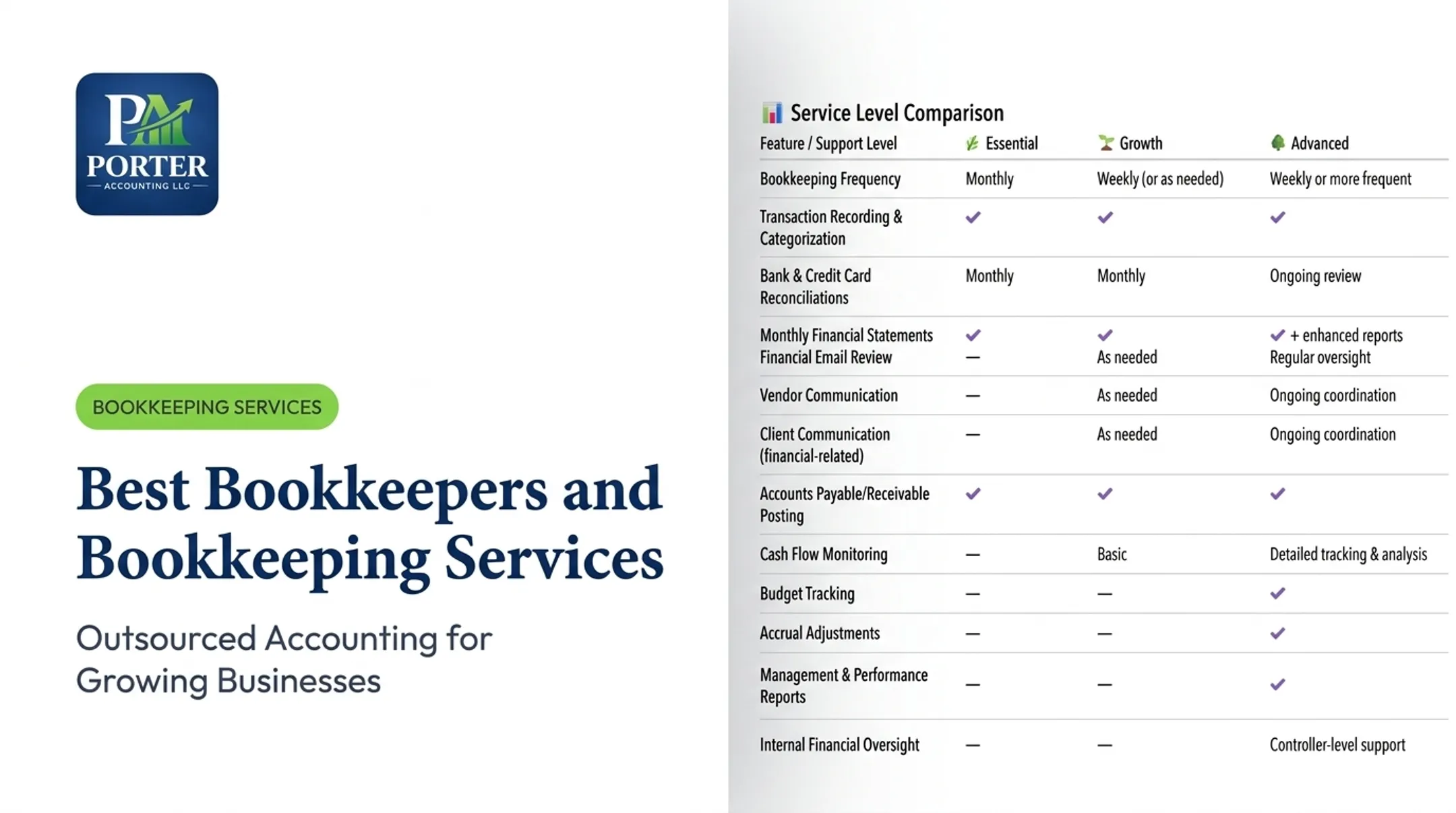
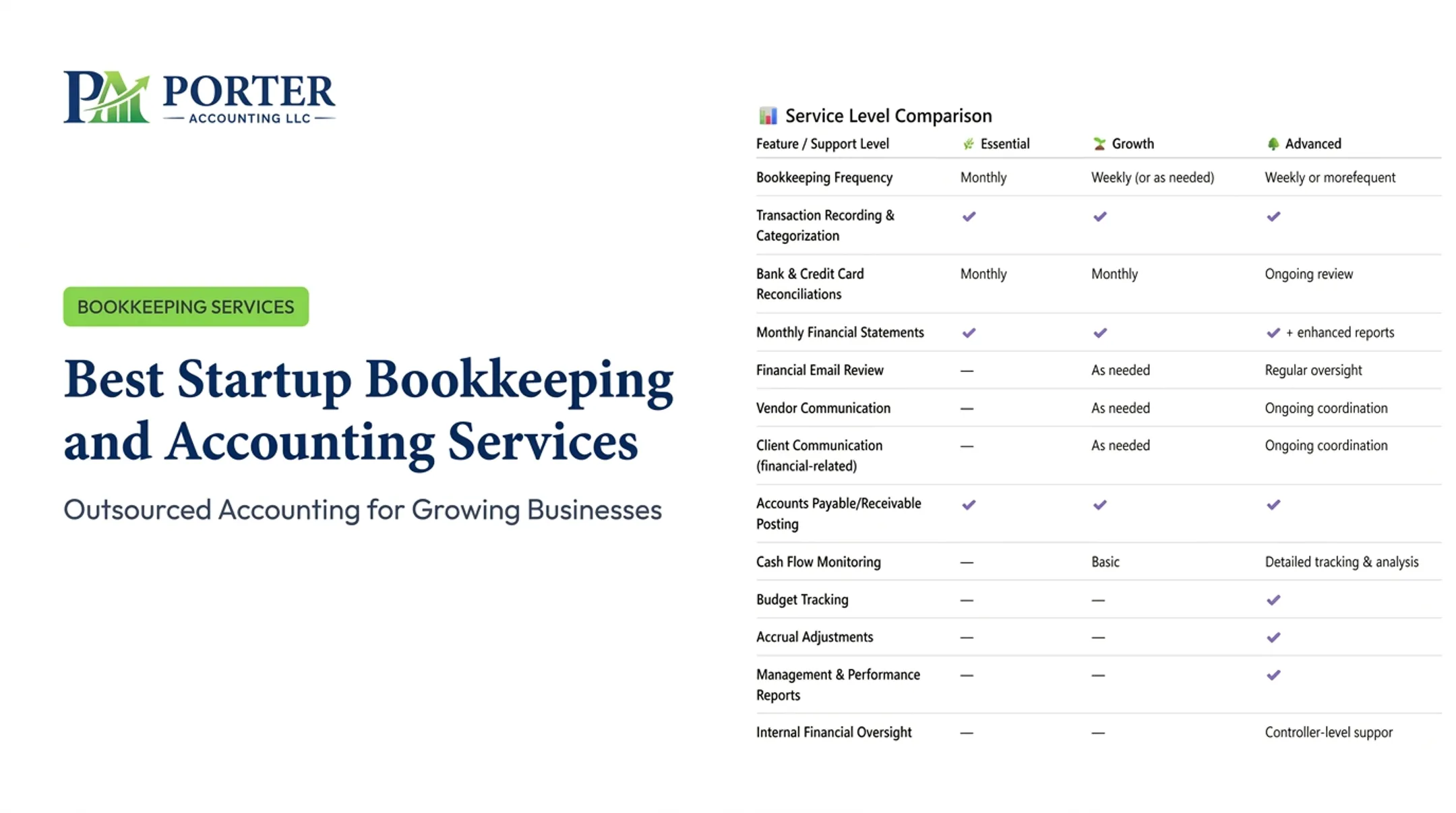
- Monthly bookkeeping across three tiers (Essential, Growth, Advanced)
- Catch-up and cleanup bookkeeping for overdue books
- Financial reporting and customized management dashboards
- Cash-flow forecasting and budgeting
- Controller and fractional CFO services
- ERP setup for QuickBooks, Xero, NetSuite, and Acumatica
- Revenue recognition (ASC 606), GAAP statements, and audit prep
Accounting Leader Thao Porter, MSA, brings over a decade of experience across SaaS, manufacturing, construction, CPG, retail, and franchise businesses. That technical background matters when a client needs proper revenue recognition or is preparing for an audit.
Comparison snapshot:
| Detail | Information |
|---|---|
| Best for | Growing US businesses needing bookkeeping plus reporting, cleanup, or higher-level guidance |
| Pricing | Essential from $850/month, Growth from $1,300/month, Advanced from $2,100/month; controller work from $100/hour, CFO work from $150/hour |
| Service model | Virtual nationwide, with in-person appointments around Santa Rosa, San Francisco, San Jose, and Windsor, California |
| Differentiator | Bookkeeping plus cleanup, reporting, controller/CFO support, and technical accounting (ASC 606, GAAP, audit prep) in one firm |
Final pricing depends on transaction volume, account count, payroll complexity, and cleanup scope—confirm specifics directly with the firm.
Pilot
Pilot positions itself as a bookkeeping, controller, and CFO service built for startups and small businesses, and it says it's trusted by more than 3,500 growth-stage companies. Its startup-focused offering leans heavily toward VC-backed SaaS companies navigating fundraising.
Pilot runs three tiers. Essentials handles cash-basis accounting only and caps out at $100,000 in monthly expenses. Core supports cash or accrual accounting and can pull in payroll, AP, and inventory data. Custom pricing applies for businesses needing full AP/AR, payroll administration, or CFO advisory work, according to Pilot's official pricing page.
Comparison snapshot:
| Detail | Information |
|---|---|
| Best for | Startups and VC-backed companies, particularly in SaaS |
| Pricing | Essentials from $99/month; Core and Custom pricing vary by scope |
| Watch-outs | Subscriptions run annually with an onboarding fee equal to one month of bookkeeping; AP/AR isn't included by default, and Pilot doesn't support foreign entities |
Bookkeeper360
Bookkeeper360 offers bookkeeping and accounting built around QuickBooks and Xero, with workflow tools like Gusto, Expensify, and Bill.com layered in. It serves ecommerce, SaaS, services, healthcare, real estate, and nonprofit clients.
Two plans exist: Monthly, which includes a monthly P&L and balance sheet, and Weekly, which adds weekly reporting on top. Both support cash or accrual accounting. Forbes Advisor named Bookkeeper360 the best online bookkeeping service for Xero users and gave it a 4.7-star rating in its research.
Comparison snapshot:
| Detail | Information |
|---|---|
| Best for | Xero and QuickBooks users wanting bundled payroll, tax, and CFO add-ons |
| Pricing | Monthly plan from $399/month, Weekly from $599/month; onboarding/prior bookkeeping projects start at $1,000 |
| Watch-outs | Minimum commitment terms aren't publicly disclosed—ask directly before signing |
Xendoo
Xendoo runs weekly bookkeeping with monthly reporting and 24/7 dashboard access, backed by US-based support via chat, phone, video, or email. It supports ecommerce integrations and offers migration help for businesses moving between QuickBooks Online and Xero.
Pricing scales with monthly expenses:
- Essential: $395/month, up to $50,000 in monthly expenses, cash basis
- Growth: $695/month, up to $75,000 in expenses, cash or modified accrual
- Scale: $995/month, up to $125,000 in expenses, custom chart of accounts
Catch-up bookkeeping starts at $295/month for backlogged books. Businesses exceeding $125,000 in monthly expenses or needing full accrual accounting need a custom plan.
Comparison snapshot:
| Detail | Information |
|---|---|
| Best for | Ecommerce and growing businesses wanting tiered, expense-based pricing |
| Pricing | Starts at $395/month; annual billing offers a discount |
| Watch-outs | Multi-entity support isn't clearly documented—confirm if you operate more than one entity |
Merritt Bookkeeping
Merritt keeps things simple: $250 a month, one flat rate, no tiers, no contracts. Catch-up work is $200 per backlog month. Books live in QuickBooks, and a human enters the transactions rather than relying purely on automation.
This works well for businesses that mainly need reconciliations and recurring records—not a full outsourced finance department. Payroll isn't included as a stated service, and tax filing, AP, AR, and accrual accounting aren't part of the published scope.
Comparison snapshot:
| Detail | Information |
|---|---|
| Best for | Businesses wanting straightforward, low-cost recurring bookkeeping |
| Pricing | Flat $250/month; catch-up work at $200/month per backlog month |
| Watch-outs | Single-platform (QuickBooks only); may need a separate CPA for tax filing |

How We Chose the Best Bookkeeping Services
This evaluation prioritizes business outcomes over brand recognition or headline pricing. We looked at six factors:
- Scope and accounting depth — reconciliations, financial statements, AP/AR, payroll coordination, inventory, cleanup, and CFO-level advisory
- Industry experience — relevant work with SaaS, franchises, e-commerce, CPG, construction, or professional services
- Software and data ownership — which platforms are supported and whether you retain access to your accounting file if you switch providers
- Reporting cadence — monthly versus weekly updates, close timelines, and whether you get a dedicated contact
- Pricing transparency — published rates, overage charges, cleanup fees, and cancellation terms
- Reliability of evidence — current provider pages, dated pricing, and documented service terms rather than vague marketing claims
The SBA notes that owners can choose a CPA, a bookkeeper, or an online service. CPAs generally cost more and offer more tailored support, so match the provider type to your complexity—not just the monthly rate.

Common Selection Mistakes
Even a strong shortlist falls apart when buyers skip the checks above. Watch for these traps:
- Choosing based on the lowest monthly price without checking what's excluded
- Overlooking cleanup costs for backlogged books
- Assuming payroll or tax filing is automatically included
- Not confirming whether the provider supports accrual accounting
- Failing to ask who actually reviews the work before it's delivered
Before you sign, ask:
- What's included at this price?
- Who performs and reviews the bookkeeping?
- How fast are questions answered?
- Which reports do I receive, and how often?
- How is data access secured, and what happens if I leave?
When You Need More Than a Bookkeeping Service
Most of the providers above are built around monthly bookkeeping, and several cap their plans at cash or modified accrual accounting. That works until someone outside the business needs to rely on your numbers. A bank covenant may call for accrual-basis GAAP financial statements, an investor may expect subscription revenue recognized under ASC 606 rather than when cash arrives, or a first audit may require reconciliations and schedules ready before fieldwork starts. If any of those are on your 12-month horizon, ask each provider who owns the month-end close, who reviews accruals, and whether they offer controller services or only transaction entry. SaaS and subscription businesses can use our SaaS accounting and ASC 606 guide to see what revenue recognition support should include.
Conclusion
The best small business bookkeeping service matches your accounting complexity, industry, software, and growth plans. Compare the full engagement scope, not just the advertised monthly price. Before you commit, confirm:
- Cleanup terms and onboarding scope
- AP/AR handling and payroll coverage
- Reporting cadence and deliverables
- Contract flexibility and exit terms
For US businesses that need bookkeeping paired with financial guidance—including cleanup, process improvement, cash-flow clarity, controller-level close, GAAP reporting, audit readiness, and fractional CFO decision support—Porter Accounting LLC offers a practical alternative to both DIY software and oversized accounting firms. If you're comparing providers, reach out to map scope, fit, and what your books need next.
Frequently Asked Questions
What is a good simple accounting system for a small business?
Look for software with bank feeds, reconciliation, invoicing, core financial reports, and user permissions that match how you keep books. Confirm the fit with a bookkeeper or accountant before you commit.
Is there a cheaper alternative to QuickBooks?
Platforms like Wave (free or $19/month) or spreadsheets work for very simple businesses. Compare total cost, integrations, reporting depth, and scalability rather than subscription price alone before switching.
What do bookkeepers charge per hour?
Rates vary by location, experience, and complexity. BLS wage data shows median hourly pay for bookkeeping clerks around $22.81—that figure is employee wages, not what outsourced providers bill for cleanup or advisory work, which typically runs higher.
How much does an online bookkeeper cost?
Most online bookkeepers bill hourly, as a flat monthly fee, or by transaction volume. Your price usually tracks transaction volume, payroll needs, cleanup work, and how often you need reports.
What is the best accounting method for a small business?
It depends on your entity type, inventory needs, and whether lenders or investors require GAAP-compliant statements. Cash accounting suits simpler businesses; accrual suits those with inventory or growth plans. Get professional advice before deciding.
What accounting services do small businesses typically need?
Core services usually cover bookkeeping, bank reconciliation, financial reporting, accounts payable/receivable, payroll support, and tax coordination. Many firms also offer cleanup, controller support, cash-flow analysis, and fractional CFO guidance.