
This is where the conversation around outsourced bookkeeping changes. It's no longer just about offloading data entry. It’s about gaining financial accuracy, real-time cash flow visibility, and the insights needed to make confident decisions. This shift is driven by five key trends that are reshaping what businesses should expect from their financial partners.
This article breaks down these trends, the forces behind them, and what it all means for your operations. We'll explore the signals you should watch over the next few years to ensure your financial foundation is built for growth, not just for tax time.
Key Takeaways
- Outsourced bookkeeping is evolving from a back-office task into a strategic financial operations and advisory role.
- While automation and AI are boosting efficiency, human expertise and clear internal controls are more critical than ever.
- Pricing for services depends on transaction volume, reporting complexity, cleanup needs, and the level of financial guidance required.
- A quality provider must offer secure systems, transparent communication, and reporting that actively supports business decisions.
- Growing U.S. businesses need to assess if they require basic bookkeeping, a full accounting function, controller support, or fractional CFO guidance.
Key Trends in Outsourced Bookkeeping for 2026
Outsourced bookkeeping in 2026 is shifting toward automation, industry specialization, and faster financial visibility. The goal is practical: cleaner books, clearer cash insight, and support that helps owners make decisions—not just close the month.
Automation is expanding, but human oversight remains central
Automation is taking over repetitive bookkeeping work. Bank feeds, receipt capture, and AI-powered categorization cut manual entry. According to a 2025 report from CPA.com on AI in accounting, firms are seeing time savings of 30% to 70% on bank reconciliations and month-end close.
Automation still does not replace professional judgment. Bookkeepers and accountants still need to:
- Investigate flagged exceptions and unusual transactions
- Confirm that records match how the business actually operates
- Apply industry knowledge an algorithm cannot replicate
When you evaluate a provider, ask about the technology stack and the review process. How do they check accuracy? What does the audit trail look like? Who can access your data, and how are corrections handled?

Outsourced bookkeeping is becoming more specialized by industry
Generic bookkeeping falls short for businesses with complex operating models. Industry specialization drives more accurate reporting and more useful insight.
Common examples include:
- SaaS companies: ASC 606 revenue recognition for subscription contracts
- Franchises: Location-level P&Ls to track unit performance
- E-commerce and CPG brands: Inventory tracking and margin analysis
- Wineries and distilleries: Production-cost accounting and inventory aging
A specialized provider builds a better chart of accounts, delivers reports leadership can use, and spots issues faster because they already know the model. Before you sign, ask about their experience with your revenue model, inventory process, and reporting needs.
Monthly bookkeeping is evolving into continuous financial visibility
Cloud accounting platforms and integrated payment and payroll systems make financial data available in near real time. Waiting weeks after month-end for basic reports is no longer the standard.
Timely reconciliations and recurring reports support decisions on:
- Managing cash reserves
- Timing new hires or major purchases
- Adjusting pricing or collections
- Evaluating expansion opportunities
At minimum, expect a reconciled general ledger, P&L, balance sheet, and cash-flow reports. A stronger partner also flags AR/AP status and explains material variances before they become surprises.
Providers are offering flexible levels of support as businesses scale
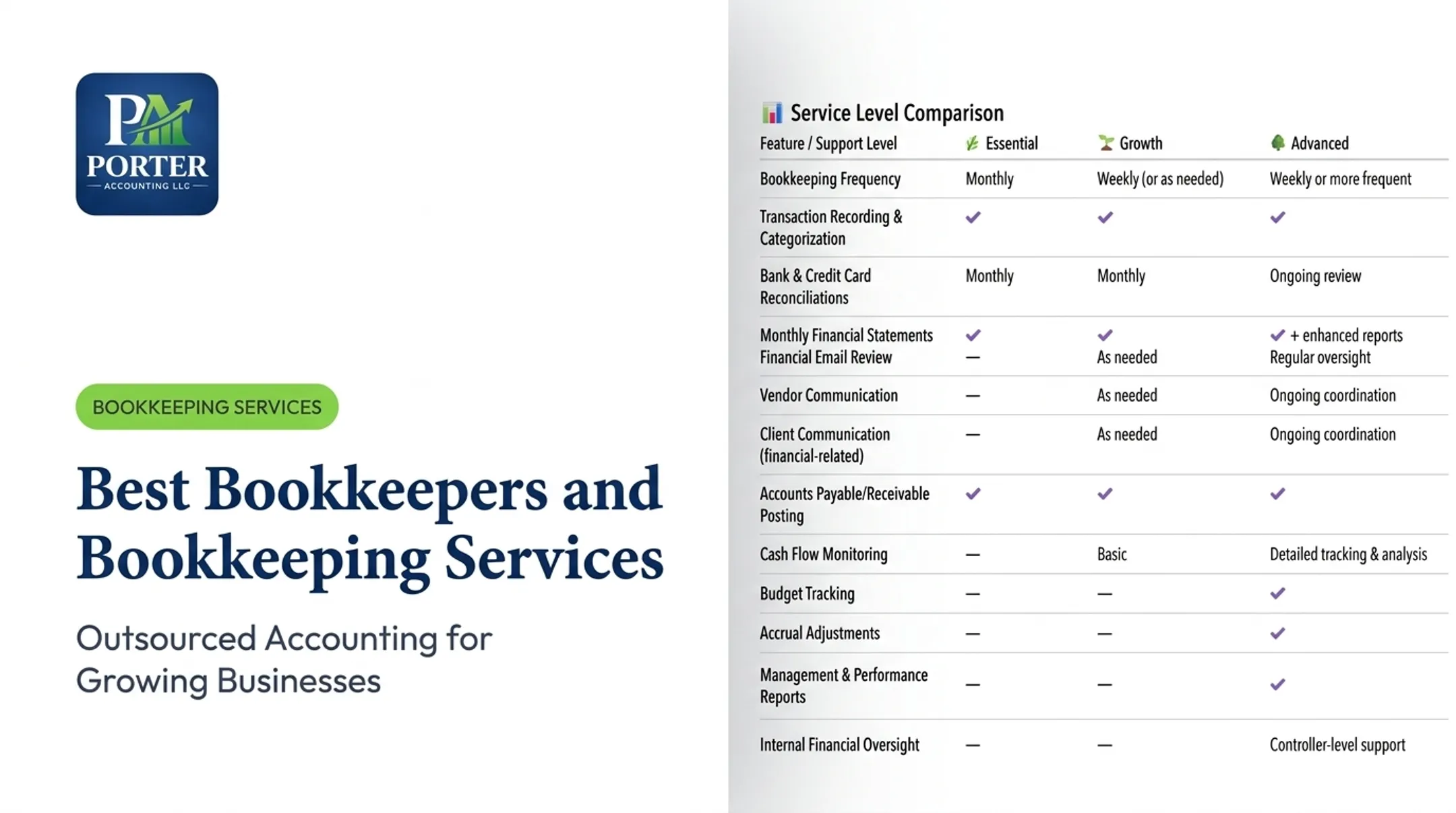
Growing companies outgrow fixed service packages. Needs change, and bookkeeping support should scale with them. Leading providers now tier services like this:
- Basic bookkeeping: Transaction recording and reconciliations
- Full-service bookkeeping: AP/AR management and payroll coordination
- Catch-up and cleanup: One-time projects to repair messy books
- Controller support: Stronger close, budgeting, and internal controls
- Fractional CFO / advisory: Forecasting, KPIs, and capital planning
- Technical accounting and reporting: GAAP financial statements, ASC 606 revenue recognition, and audit preparation
That model lets you avoid hiring a full internal finance team too early while still adding senior help when growth demands it.
Many firms start with monthly bookkeeping from a partner like Porter Accounting LLC, then add controller oversight or fractional CFO support during rapid growth or fundraising.
Security, controls, and accountability are becoming buying criteria
Handing over financial data requires real trust. You are sharing bank, payroll, customer, and vendor information. Buyers are looking past price and checking a provider's security posture and internal controls.
Practical safeguards should include:
- Least-privilege access to systems
- Multifactor authentication on all accounts
- Secure file-sharing portals (not email)
- Documented approval workflows
- Separation of duties to reduce fraud risk
- Backup coverage when your primary contact is out
The business owner should retain final control over treasury functions, payment approvals, and signing authority. Your outsourced bookkeeper facilitates the work—they do not decide.
What’s Driving These Outsourced Bookkeeping Trends
Technology, talent shortages, and rising business complexity are reshaping what companies expect from their financial providers.
First, technology has made remote collaboration and integrated bookkeeping practical for day-to-day finance work. Cloud-based accounting platforms are now the standard, and AI is becoming more embedded in daily workflows.
Second, hiring pressures make outsourcing an attractive alternative to building an in-house team. A 2025 survey of finance leaders found that 51% reported having understaffed departments, with 81% stating it took at least four months to fill a senior accountant role. Outsourcing fills that gap with fractional talent—without a full-time hire’s cost or timeline.

Third, business complexity is increasing. Higher transaction volumes, multiple sales channels, and complex contracts all require deeper bookkeeping, cleaner categorization, and clearer reporting.
Finally, leadership teams expect more. Financial data is no longer just for satisfying tax requirements. Leaders need it to guide pricing, hiring, and cash decisions—which means a provider who can explain the numbers and flag trends early.
How These Trends Are Impacting Businesses
The evolution of outsourced bookkeeping affects your operations, financial decisions, and even your team structure—not just your accounting inbox.
Operational Impact
Implementing a professional bookkeeping service brings discipline. Standardized close calendars, automated data collection, and clear approval workflows reduce bottlenecks.
Expect some upfront implementation work:
- Cleaning up historical records
- Confirming the chart of accounts
- Connecting your systems
Measure success by monthly close speed, unreconciled items, and correction volume.
Business and Financial Impact
Accurate, timely books are the foundation for reliable cash-flow forecasting, margin analysis, and smarter growth decisions. But bookkeeping alone doesn't guarantee insight. The provider must be able to translate reports into clear commentary and actionable recommendations.
This is the gap Porter Accounting LLC aims to fill. We support growing U.S. businesses with virtual bookkeeping, financial reporting, and process improvement. When a client's needs extend beyond basic bookkeeping, we provide cash-flow insights, controller services, GAAP reporting, ASC 606 support, and fractional CFO guidance to help them turn financial data into confident decisions.

Workforce and Governance Impact
Outsourcing can complement, not just replace, an internal team. It can add review, specialized expertise, or controller-level oversight alongside an existing bookkeeper.
Clarify which responsibilities stay in-house:
- Payment approvals
- Financial policy decisions
A regular communication cadence with a named point of contact keeps the provider looped in on operational changes and preserves your visibility.
When outsourced bookkeeping should grow into a finance function
The trends above point in one direction: bookkeeping is becoming the base of a wider finance function. The signal to add the next layer is usually external. A lender asks for accrual-basis statements, an investor wants a monthly reporting package, or a first audit gets scheduled and the team realizes nobody owns the reconciliations and supporting schedules. At that point, the outsourced provider needs to handle a controller-level close and audit preparation, working alongside your external auditors, not just keep transactions current. Our year-end close and audit readiness guide outlines what that preparation looks like.
Future Signals for Outsourced Bookkeeping
Outsourced bookkeeping will keep shifting through 2026. Watch these four signals as you plan:
- Smarter AI: Systems that detect anomalies, suggest corrections, and draft initial management commentary, with a human reviewing material judgments.
- Deeper integrations: Tighter links across accounting, payroll, billing, inventory, and CRM so financial data lives in one connected system.
- Forecasting over history: Real-time cash forecasts, scenario planning, and industry-specific dashboards taking priority over backward-looking reports.
- Security as standard: Vendor due diligence, cybersecurity protocols, and documented internal controls as baseline requirements for any reputable provider.
Review your bookkeeping model each year against transaction volume, system complexity, and growth plans so the setup still fits how you operate.
Conclusion
Outsourced bookkeeping in 2026 has become a technology-enabled financial partnership, not just a handoff for data entry. A shoebox of receipts no longer gets the job done. Growing businesses now need expertise and modern systems that build a resilient financial foundation.
The best results come from matching a provider’s expertise, systems, and communication style to your business’s actual needs. Whether you need basic bookkeeping, controller oversight, or strategic advisory, reliable records and clear financial insight are what give growing businesses confidence in their decisions. The first step is assessing what level of support you need to move forward. If you want one partner that can take you from clean monthly books to controller-level close, GAAP reporting, and audit-ready financials, talk with Porter Accounting LLC about where your business is today.
Frequently Asked Questions
How much does outsourced bookkeeping typically cost?
Pricing varies by transaction volume, bank accounts, payroll complexity, and cleanup needs. Most providers use tiered monthly plans, so request a defined proposal rather than a generic quote. Basic plans often start around $850/month.
What hourly rate should a bookkeeper charge?
Rates depend on experience, location, and work complexity. Basic data entry costs less; controller-level support costs more. Many firms prefer fixed-fee monthly arrangements over hourly billing for predictability.
What does an outsourced bookkeeper do?
Core duties include transaction categorization, bank reconciliations, AP/AR support, and monthly financial statements. Scope can also cover payroll coordination and cleanup projects. Controller, tax, and CFO work typically requires additional expertise.