
The Federal Reserve's 2024 Small Business Credit Survey found that 56% of small employer firms cited paying operating expenses and 51% cited uneven cash flow as ongoing challenges. Both problems get worse when the books aren't current.
Client bookkeeping solutions solve this by combining trained bookkeeping professionals, repeatable processes, and accounting technology with real human review. It's not just software. It's not just a person entering transactions. This guide covers what's included, why businesses use these solutions, industry-specific considerations, delivery models, how to pick a provider, and what implementation actually looks like.
Key Takeaways
- Accurate, current books are the foundation for cash-flow management, tax prep, and confident decision-making
- Match your bookkeeping solution to transaction volume, entity structure, industry complexity, and internal finance capacity
- Software automates data entry, but humans still handle reconciliations, judgment calls, and unusual transactions
- Evaluate cleanup capability, close procedures, and scalability—not just the monthly price tag
What Are Client Bookkeeping Solutions?
A client bookkeeping solution keeps financial records current, organized, reconciled, and genuinely useful for running the business. That requires three things working together: trained people, a defined workflow, and accounting software configured correctly.
People, Process, and Technology
Software alone can't tell you why a $4,200 deposit doesn't match any invoice. A person has to investigate. Good bookkeeping solutions pair automated data capture with a defined process:
- Source documents and bank/card feeds pull transactions into the system
- A bookkeeper codes each transaction to the right account
- Reconciliations catch duplicates, missing entries, and timing differences
- A reviewer signs off before books close for the month
- Management reports go out on a set schedule
Bookkeeping vs. Controller and CFO Work
These services stack in layers:
- Bookkeeping keeps the ledger accurate and current
- Controller services add close-process ownership, internal controls, and reviewed financial statements
- Fractional CFO work uses those numbers for forecasting, budgeting, and strategic decisions
Each layer builds on the one below it. You can't forecast cash flow accurately if the underlying books are wrong.
Delivery Models
Businesses typically choose one of four setups:
- In-house — full control, but costly to staff and hard to scale quickly
- Virtual/outsourced — a remote team handles bookkeeping using cloud software
- Hybrid — internal staff handle day-to-day entry; an outside provider reviews and closes
- Software-only — automated categorization with no dedicated reviewer (riskiest for growing companies)
The right model depends on transaction volume, number of entities or locations, and how much internal review capacity actually exists.
What Services Are Included in Client Bookkeeping Solutions?
"Bookkeeping" covers more ground than most owners expect. A complete solution typically includes several distinct workstreams.
Transaction Recording, AP, and AR
Every deposit, bill, transfer, and owner draw needs to land in the correct account. That includes:
- Revenue and expense coding
- Accounts payable — invoice collection, approval workflows, vendor records, and payment tracking
- Accounts receivable — invoicing, receipt application, aging reports, and follow-up on unpaid balances
Accurate AR records drive cash-flow visibility. Aging reports that match real collection status show which invoices will fund operations this month and which need follow-up.
Reconciliations and Payroll
Bank, credit card, and loan reconciliations aren't busywork. They're how you catch duplicate charges, missing entries, and fraud before they compound. Payroll bookkeeping adds another layer:
- Importing payroll data and recording wages and employer taxes
- Reconciling payroll clearing accounts
- Coordinating with the payroll provider
Note: Bookkeeping support is not the same as running payroll or giving tax advice. Those remain separate services, even when they touch the same accounts.
Month-End Close and Industry-Specific Reporting
A proper close produces a reviewed general ledger, income statement, balance sheet, cash-flow summary, and explanations for any material variance. What "complete" means shifts by industry:
- SaaS companies: revenue under ASC 606, tied to performance obligations on subscription contracts rather than cash received
- Franchises: location-level P&Ls and royalties reconciled to gross sales (not net profit)
- E-commerce and CPG brands: inventory and gross-margin tracking, including capitalized production overhead
- Craft beverage producers: production-cost visibility across aging cycles, with fixed overhead allocated on normal capacity
Porter Accounting LLC structures monthly bookkeeping around these workstreams:
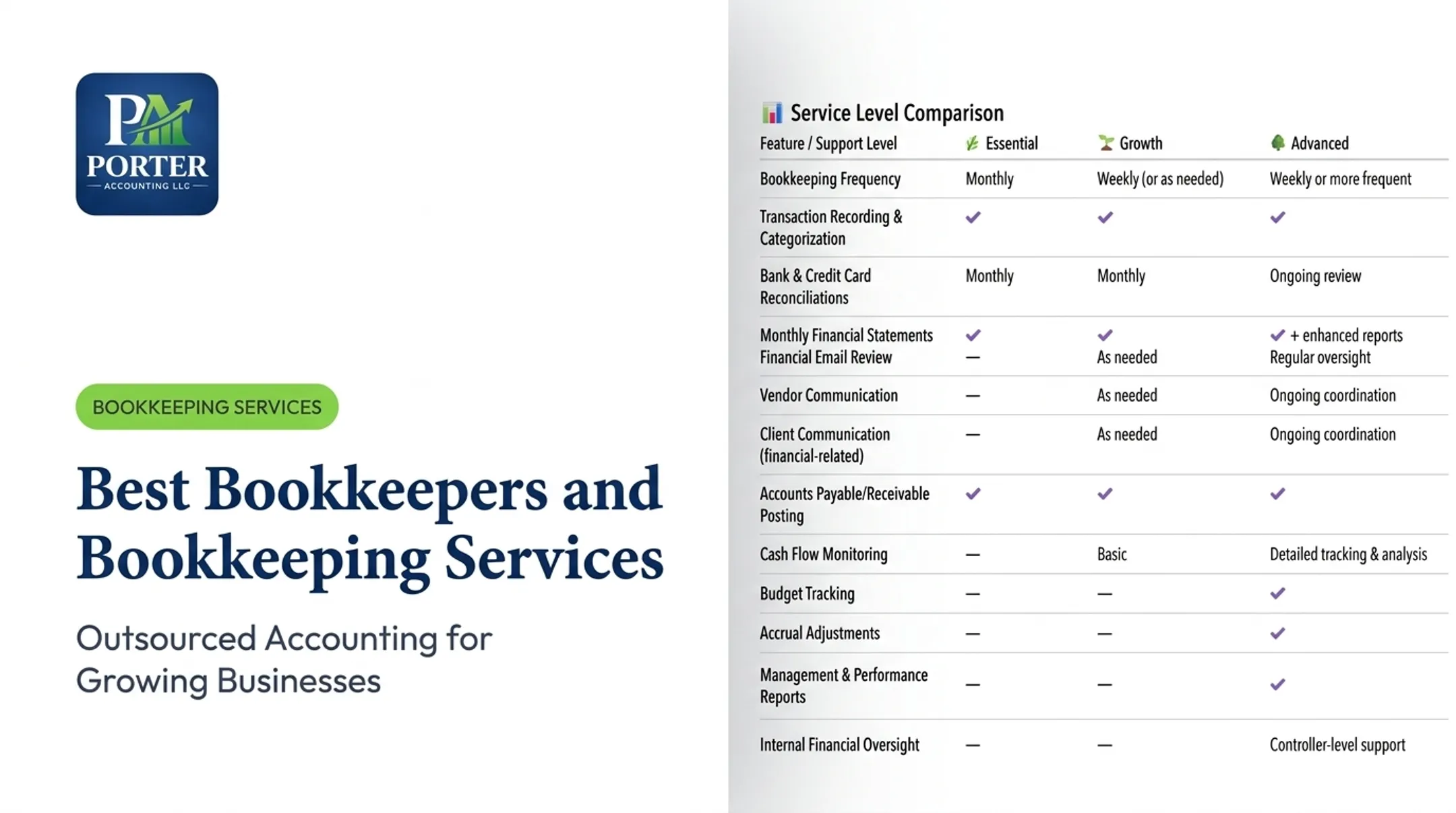
- Essential Plan (from $850/month): transaction recording, reconciliations, and monthly statements
- Growth Plan ($1,300/month): weekly bookkeeping plus vendor communication
- Advanced Plan ($2,100/month): month-end close oversight, accrual adjustments, budget tracking, cash-flow monitoring, and audit prep, closer to in-house controller support

Why Do Businesses Use Client Bookkeeping Solutions?
Owners don't hire bookkeeping help because they enjoy paying for it. They hire it because the alternative costs more.
What Reliable Books Actually Enable
Current, reconciled books let you see profitability by product or location, understand your real cash position, and know exactly who owes you money. That same data supports:
- Tax preparation and lender requests
- Investor reporting and audit readiness
- Budgeting, forecasting, and acquisition planning
The U.S. Chamber of Commerce notes that delayed access to quality financial information is one of the clearest signs a business has outgrown its current bookkeeping setup. Outsourcing can eliminate the overhead of hiring, training, and equipping in-house staff.
Warning Signs You've Outgrown Your Current Setup
- Reports arrive weeks after month-end, if at all
- The same accounts sit unreconciled month after month
- Cash differences show up with no clear explanation
- Invoicing is inconsistent or payroll doesn't match the ledger
- You're spending more time fixing records than reading them
The Real Cost of Poor Bookkeeping
Cleanup fees are the visible cost. The invisible ones hurt more:
- Decisions made on inaccurate margins
- Cash-flow risks nobody saw coming
- Lenders or investors who lose confidence when the numbers don't add up
A 2004 Journal of Accountancy analysis pointed out something still true today: a single transposed digit in a spreadsheet formula can render an entire report unusable, with no obvious warning sign.
When to Move Beyond Basic Bookkeeping
Some businesses reach a point where bookkeeping alone isn't enough. That's usually when:
- You need someone to own the close process, not just execute it
- Multi-entity or multi-location reporting gets too complex to track manually
- You need financial modeling or executive-level interpretation of results, not just historical data
- A lender, investor, or customer asks for accrual-basis GAAP financial statements or audited results
- Subscription or multi-element contracts mean revenue has to follow ASC 606 rather than cash receipts
This is where controller services and fractional CFO services come in. Porter Accounting LLC offers both, with controller services starting at $100/hour and fractional CFO work starting at $150/hour. Both extend the same virtual model that handles day-to-day bookkeeping, and they carry the books forward into GAAP financial statements, ASC 606 revenue schedules, and audit preparation when those needs arrive.

How to Choose and Implement the Right Bookkeeping Solution
Match the provider's capability to your actual complexity. The lowest monthly rate rarely delivers that fit.
Start With a Needs Assessment
Before evaluating anyone, get clear on:
- Entity structure and number of locations
- Transaction volume and current software
- Industry-specific requirements (inventory, subscriptions, payroll)
- Reporting cadence you actually need
- How much internal review capacity exists today
Provider Evaluation Checklist
Run any candidate through this list:
- Relevant industry experience — have they worked with businesses like yours?
- Cleanup capability — can they fix a backlog, or only maintain clean books?
- Software compatibility — do they work in your existing platform?
- Defined deliverables — what exactly do you get, and by when?
- Data security — access controls, encryption, backup procedures
- Clear task ownership — who owns reconciliations, AR follow-up, and close?
Assessing the Technology Stack
Look past the core ledger platform. Evaluate:
- Bank feed reliability
- Payroll and payment integrations
- Receipt capture tools
- User permission controls
- How easily you can export your own data if you switch providers
Automation should eliminate repetitive entry. It should not replace the person who investigates exceptions that do not fit the pattern.
Implementation Steps
- Diagnostic review — assess current books and identify gaps
- Scope and responsibility mapping — decide who owns what
- Historical cleanup — correct past errors before moving forward
- Chart-of-accounts review — align accounts and configure the system
- Data migration — move history and validate opening balances
- Workflow documentation — lock reporting setup and handoffs
Agree on service standards upfront: close deadlines, reconciliation frequency, report format, and how issues get escalated.
What This Actually Costs
Pricing varies widely based on complexity. NerdWallet's 2025 analysis puts typical small-business bookkeeping at roughly $300 or more per month:
- Basic packages: about $250–$350
- Mid-range services: $500–$700
- Premium or advisory support: $1,000-plus
Where you land depends on transaction volume, account complexity, cleanup needs, and whether you need basic data entry or higher-level oversight.
Porter Accounting LLC's tiers sit in that upper band: Essential at $850/month, Growth at $1,300/month, and Advanced at $2,100/month. Controller support starts at $100/hour and fractional CFO work at $150/hour for teams that need more than monthly bookkeeping. One-time catch-up cleanup is typically priced at 1.5 times the standard monthly rate.

If your bookkeeping is solid but you need more from it, such as a reliable close, reporting lenders will accept, or books that are ready for an auditor's first request list, talk with Porter Accounting LLC about the right mix of bookkeeping, controller, and advisory support for your stage.
Frequently Asked Questions
How much do bookkeeping services cost for small businesses?
Professional bookkeeping for small businesses often starts around $850 per month and scales with transaction volume, account complexity, and cleanup needs. Payroll, inventory, and higher-level reporting all push the price up, so get a scope-based quote rather than assuming a flat rate.
Does a small business need a bookkeeper?
Very simple, low-volume businesses can sometimes manage their own books. Once payroll, multiple accounts, growing transaction volume, or recurring reconciliation problems enter the picture, a bookkeeper typically pays for itself in saved time and fewer errors.
Can I find an online accountant for my LLC or corporation?
Yes. Virtual accounting professionals support remote U.S. businesses without requiring in-person meetings. Confirm software compatibility, data security practices, and that the provider can handle your specific entity and reporting needs before signing on.
What is the best bookkeeping and accounting software for small businesses?
There's no universal winner; it depends on transaction volume, inventory needs, subscriptions, and payroll integrations. QuickBooks and Xero suit most small businesses, while NetSuite fits higher-volume or multi-location operations. Professional setup matters as much as the platform itself.
Is a CA higher than a CPA?
No. CA and CPA are separate professional designations tied to different countries' licensing systems, not a ranked hierarchy. For a U.S. business, focus on verifying relevant CPA credentials, experience, and services rather than comparing titles across jurisdictions.