
Many business owners hit this wall without realizing it. They're current on data entry but still can't answer simple questions: What's our real cash position next quarter? Are we recognizing revenue correctly? Why don't the numbers match what the bank shows?
Virtual bookkeepers and outsourced accounting services solve the first problem, managing financial records remotely through cloud-based systems. More advanced providers go further, handling reporting, cleanup, internal controls, cash-flow visibility, and strategic decision support.
This guide compares five providers and breaks down how to choose one based on your business stage, industry complexity, existing software, reporting needs, and budget.
Key Takeaways
- Virtual bookkeeping runs through cloud accounting platforms like QuickBooks and Xero, not spreadsheets or manual ledgers.
- Providers fall into two service tiers: basic transaction bookkeeping, or full-service accounting with controller or CFO support.
- Industry expertise matters: SaaS revenue recognition, inventory-heavy CPG, and franchise royalty accounting each need different skill sets.
- Pricing depends on transaction volume, service scope, reporting cadence, and add-ons like payroll or tax.
- The right provider delivers cleaner books, decision-ready reporting, and secure data handling as you grow.
Overview of Virtual Bookkeeping and Accounting Services in the U.S.
Virtual bookkeeping means managing your financial records remotely. That includes recording and categorizing transactions, reconciling bank and credit-card accounts, tracking expenses, and supporting accounts payable and receivable.
Most providers deliver recurring reports monthly, though some offer weekly service.
That's the entry point. Beyond it, the market splits into distinct service tiers:
- Bookkeeping — transaction-level recording and reconciliation
- Accounting — GAAP-compliant financial statements, accrual adjustments, and technical treatment like revenue recognition
- Controller services — oversight of the close process, reporting accuracy, and internal controls
- Fractional CFO support — forecasting, budgeting, KPI tracking, and strategic financial guidance
Matching a provider's actual capabilities to your needs prevents paying for CFO-level judgment when you only need clean books, or outgrowing a basic bookkeeper before your next funding round.
Virtual services appeal to U.S. businesses because they provide access to experienced accounting professionals without the overhead of a full in-house finance department. Cloud tools support real-time collaboration, document sharing, and faster reporting turnaround than mailing paperwork ever did.
That said, plenty of small businesses still aren't fully digitized. A recent Intuit survey found that 71% of small-business owners use accounting software, yet the same share still relies on pen and paper or spreadsheets for at least some financial tasks, according to QuickBooks' 2025 small-business financial literacy research.

That gap is exactly where a lot of cleanup engagements begin.
The five providers below each bring different strengths, including specialized accounting expertise, software compatibility, cleanup support, startup scalability, and broader outsourced finance capabilities.
Top Virtual Bookkeepers and Accounting Services for U.S. Businesses
Before you compare providers, score each one against the factors that separate a strong fit from a costly mismatch:
- Service depth and business-stage fit
- Industry expertise relevant to your business model
- Accounting software compatibility
- Reporting quality and cadence
- Support model (dedicated contact vs. shared team)
- Pricing transparency
- Scalability and verified customer feedback
Always confirm current pricing and feature availability directly with the provider before signing anything. Published rates change, and promotional pricing rarely reflects your actual ongoing cost.
Porter Accounting LLC
Porter Accounting LLC is a virtual accounting and financial advisory partner built for growing businesses that have outgrown basic bookkeeping.
Services span monthly bookkeeping, GAAP financial statement preparation, cleanup, process improvement, controller oversight, and fractional CFO support. Work is delivered virtually across the United States, with in-person appointments available in parts of Northern California and Palm Coast, Florida.
The firm's accounting leadership comes from Thao Porter, MSA, who brings over a decade of experience supporting SaaS, manufacturing, construction, consumer packaged goods, retail, and franchise businesses.
Her background covers GAAP reporting, ASC 606 revenue recognition, ERP implementations across QuickBooks, Xero, NetSuite, and Acumatica, and audit-readiness preparation.
Revenue recognition is a common blind spot for growing companies, especially subscription businesses.
FASB's ASC 606 standard requires recognizing revenue when a performance obligation is satisfied, not simply when cash arrives, according to the Financial Accounting Standards Board's Topic 606 guidance. Getting this wrong distorts financial statements and can derail due diligence.
| Feature | Details |
|---|---|
| Best for | SaaS, franchises, e-commerce/CPG, craft beverage producers, mid-market firms without in-house finance leadership |
| Core services | Bookkeeping, GAAP reporting, cleanup, controller, fractional CFO, ERP setup |
| Software supported | QuickBooks, Xero, NetSuite, Acumatica |
| Delivery model | Virtual nationwide; in-person by appointment in select California and Florida areas |
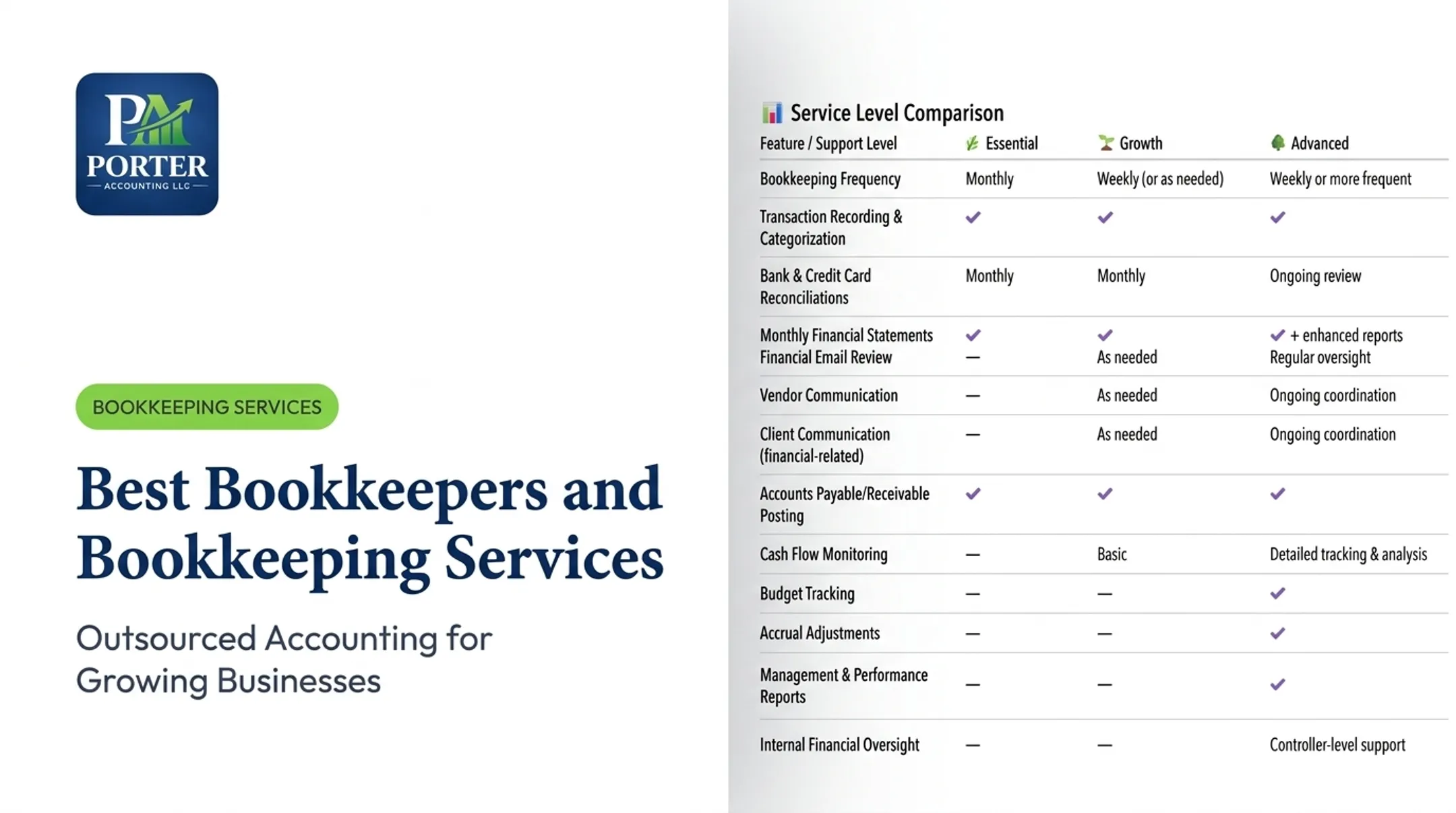
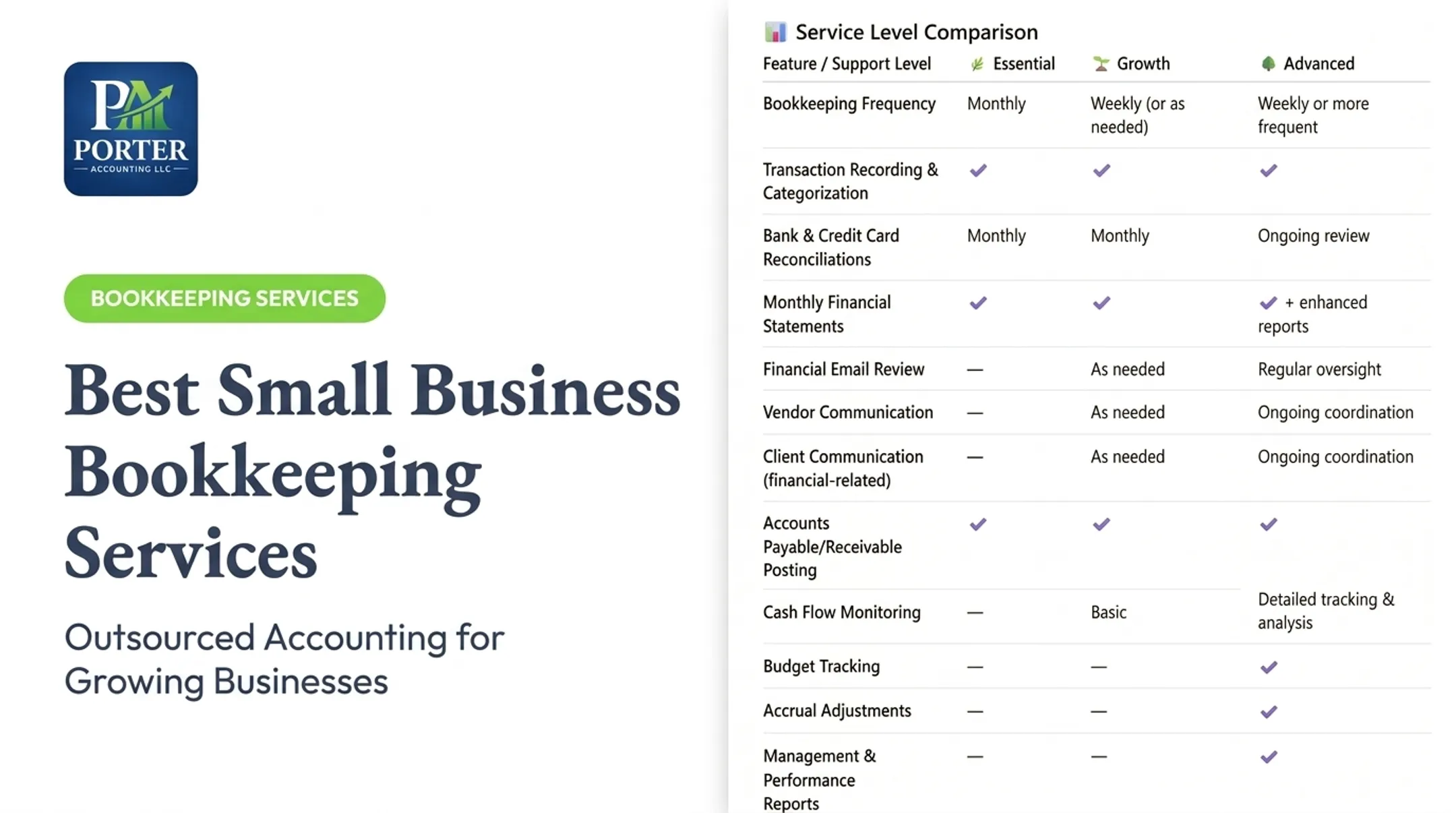
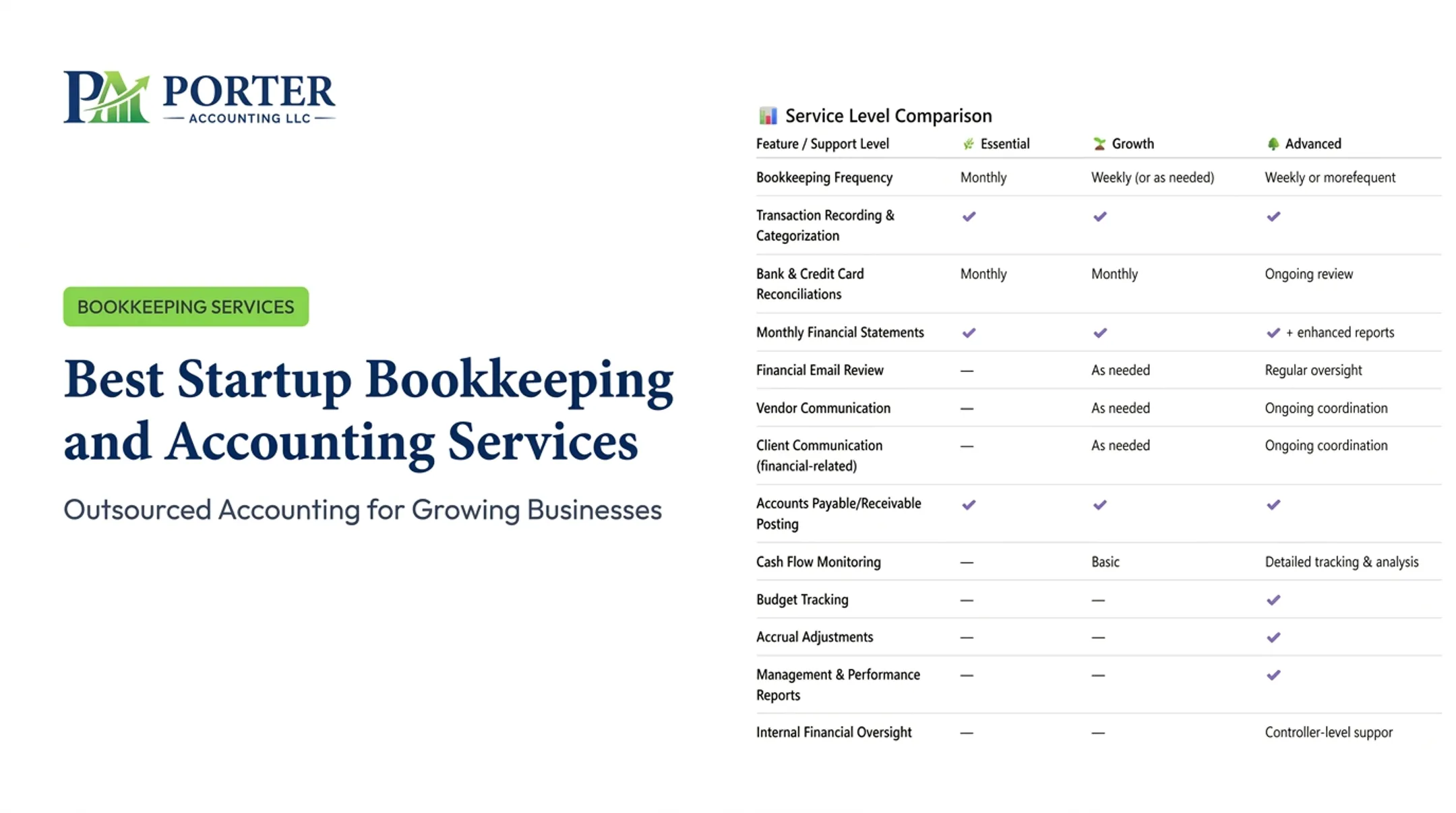
| Pricing | Essential from $850/month, Growth from $1,300/month, Advanced from $2,100/month; controller services from $100/hour; fractional CFO from $150/hour |
Bookkeeper360
Bookkeeper360 offers bookkeeping, tax strategy, payroll, and fractional CFO services, working primarily with QuickBooks and Xero. Clients get a dedicated bookkeeper backed by a broader team rather than a solo contact.
Published pricing starts at $399/month for monthly reporting or $599/month for weekly service, including cash or accrual accounting, P&L and balance sheet reports, and a KPI dashboard.
Onboarding and prior-period cleanup start at $1,000 per project. Add-ons include payroll administration from $200/month, sales tax filing from $125/month, and fractional CFO service from $2,000/month.
A note on reviews: independent platforms show mixed signals. G2 lists a 3.8/5 rating from a small sample size, and Trustpilot notes the company hasn't actively solicited reviews recently, which limits how representative the feedback is.
| Feature | Details |
|---|---|
| Best for | Businesses wanting QuickBooks/Xero-based bookkeeping with add-on flexibility |
| Core services | Bookkeeping, payroll, sales tax, fractional CFO |
| Software integrations | QuickBooks, Xero |
| Support model | Dedicated bookkeeper backed by a team |
| Pricing | From $399/month (monthly) or $599/month (weekly); onboarding from $1,000 |
| Limitations | Add-on fees stack quickly; limited independent review volume |
QuickBooks Live
QuickBooks Live plugs directly into QuickBooks Online, which makes it a natural fit for businesses already committed to that platform.
Intuit offers two tiers: Expert Assisted, which coaches you through your own books without working in them, and Full-Service Bookkeeping, where a dedicated bookkeeper catches up past records and manages ongoing entries.
Guided setup covers chart-of-accounts creation and bank connections but explicitly excludes payroll setup and desktop-to-online migration. Tax preparation, filing, and advice are not included in either tier; those are sold separately through QuickBooks Live Expert Tax.
Expert Assisted runs free for 30 days, then $59/month. Full-Service pricing shifts to a rate based on your average monthly QuickBooks expenses after the first month, according to Intuit's QuickBooks Live support documentation.
| Feature | Details |
|---|---|
| Best for | Existing QuickBooks Online users wanting integrated bookkeeping support |
| Core services | Guided coaching (Assisted) or dedicated bookkeeping and catch-up (Full-Service) |
| Software required | QuickBooks Online |
| Support model | Coaching or dedicated bookkeeper, depending on tier |
| Pricing | Assisted: free 30 days, then $59/month. Full-Service: expense-based after month one |
| Limitations | No tax prep, no payroll setup, no advisory or CFO-level services |
Pilot
Pilot focuses heavily on startups and venture-backed companies, positioning its bookkeeping as producing "investor-ready" financials. A dedicated U.S.-based bookkeeper handles monthly closes, and the firm says it can support accrual accounting from day one, along with monthly inventory updates pulled from inventory systems.
Pricing scales with monthly expenses. Essentials starts at $99/month for businesses under $100,000 in monthly expenses on a cash basis. Core adds accrual capability and integrations at a higher starting point. Onboarding costs the equivalent of one month of bookkeeping.
Tax is a separate line item. Pilot's starter tax package runs $750/year for qualifying pre-revenue businesses. CFO-level support is available through three tiers: Basic at $1,750/month, Essentials at $3,150/month, and Custom at $5,250/month, billed annually.
Pilot is explicit about what it doesn't do: it's not a public accounting firm, and it doesn't provide audit, assurance, or GAAP-certification services.
| Feature | Details |
|---|---|
| Best for | Venture-backed startups needing investor-ready, accrual-capable books |
| Core services | Bookkeeping, tax (separate), controller, CFO tiers |
| Software approach | Proprietary platform plus bank/credit-card integrations |
| Support model | Dedicated U.S.-based bookkeeper |
| Pricing | Essentials from $99/month; CFO plans from $1,750–$5,250/month; onboarding = one month's fee |
| Limitations | No audit or assurance services; tax priced separately |
inDinero
inDinero packages bookkeeping, tax, and CFO advisory into a single outsourced finance function, staffed by a team that includes CPAs and controllers.
It targets company sizes from early-stage startups to organizations exceeding $500 million in revenue, and integrates primarily with QuickBooks Online and NetSuite.
Three tiers structure the offering:
- Essential from $750/month for straightforward structures and day-to-day bookkeeping
- Growth from $1,250/month, with controller-managed accrual accounting for more established companies
- Executive custom-priced, adding revenue recognition support and budget analysis
That breadth makes inDinero a fit for businesses that would otherwise hire a controller and a CFO separately. Higher tiers cost more than bookkeeping-only competitors, in line with the added scope.
| Feature | Details |
|---|---|
| Best for | Scaling or mid-market businesses needing bookkeeping through CFO in one engagement |
| Core services | Bookkeeping, tax, controller, CFO advisory |
| Software integrations | QuickBooks Online, NetSuite (other ERPs by experience) |
| Support model | Team including CPAs and controllers |
| Pricing | Essential from $750/month; Growth from $1,250/month; Executive custom |
| Limitations | Higher tiers priced for complexity, not ideal for very small, simple businesses |

How We Chose the Best Virtual Bookkeepers and Accounting Services
The lowest monthly price, familiarity with a specific software brand, or a limited-time promo shouldn't drive this decision alone. A cheap plan that can't handle accrual accounting or revenue recognition will cost more later in cleanup fees and missed deadlines.
We weighed providers across three areas: service scope, operational fit, and financial scalability.
Service scope and accounting complexity. Does the provider handle only categorization and reconciliation, or can it manage accrual accounting, GAAP reporting, revenue recognition, inventory, multi-entity reporting, and audit readiness?
Documentation quality matters too. An AICPA study cited by the Journal of Accountancy found inadequate documentation was the most common audit issue firms encounter. Clean, well-supported books matter long before an audit ever happens.
This is where many businesses first notice the difference between a virtual bookkeeper and a virtual accounting team. A bookkeeper keeps transactions current; audit readiness also needs balance sheet reconciliations with support, accrual and deferred revenue schedules, documented controls, and someone who can answer an auditor's request list without rebuilding the year. If an audit, a lender review, or investor diligence is on your calendar, ask each provider whether it offers controller-level close and audit preparation, and whether it will work alongside your external auditors. Our year-end close and audit readiness guide lists what that preparation usually includes.
Operational fit. Before you commit, confirm:
- Software integrations and client-portal workflows
- Data security practices and document retention policies
- Who owns your data if you switch providers
- Reporting cadence and whether you get a dedicated contact or a rotating team
Financial fit and scalability. Look for transparent base pricing, disclosed cleanup and onboarding fees, transaction thresholds that trigger price increases, and clear contract terms. Can the provider grow with you from bookkeeping into controller or CFO support?

Questions to ask during provider interviews:
- Who performs the work, and who reviews it before it reaches you?
- What's the process for correcting errors once identified?
- What reports do I receive, and how often?
- How is sensitive financial data protected and backed up?
- What happens to my data and records if I switch providers?
Conclusion
There's no single "best" virtual bookkeeper. The right choice depends on your business's complexity, industry, growth stage, reporting needs, and existing software. Strategic guidance matters more than the lowest number on a pricing page.
For U.S. businesses that have outgrown basic bookkeeping, Porter Accounting LLC offers experienced accounting leadership without large-firm overhead. That includes organized books, controller-level close, reliable GAAP reporting, ASC 606 revenue recognition, audit readiness, cash-flow clarity, and stronger internal controls.
If you're evaluating your current setup, cleaning up messy books, or considering virtual controller or fractional CFO support, reach out to Porter Accounting LLC. We can walk through where your books stand today and what a clearer path forward looks like.
Frequently Asked Questions
How much do virtual bookkeepers charge?
Pricing varies by transaction volume, reporting frequency, and service scope. Basic startup bookkeeping often starts around $99/month, while full accounting with controller-level oversight can reach $2,100/month or more. Tax, payroll, and CFO work are usually billed separately.
What does a virtual bookkeeper do?
A virtual bookkeeper remotely records transactions, reconciles bank and credit card accounts, tracks expenses, and supports AP and AR. An accountant prepares GAAP statements and handles technical issues like revenue recognition. A fractional CFO focuses on forecasting and strategic guidance.
Is virtual bookkeeping legitimate?
Yes, when the provider uses qualified professionals, secure cloud accounting systems, and documented workflows with clear engagement terms. Verify their experience, references, data-security practices, and process for reviewing and correcting work before signing on.