
None of those numbers are wrong. They're just answering different questions.
The real cost depends on your transaction volume, payroll complexity, number of accounts, industry, reporting expectations, and whether your books need cleanup before anyone can even start. Whether you're comparing hourly rates, monthly packages, or an in-house salary, the pricing model itself changes what you're actually paying for.
This guide breaks down current U.S. benchmarks across every pricing model, explains what drives costs up or down, and helps you build a realistic budget instead of guessing.
Key Takeaways
- Outsourced bookkeeping typically runs $250–$700+/month, with premium or complex services reaching $1,000+
- Median in-house pay is about $50,670/year, and benefits plus taxes push total cost well above salary
- Cleanup and catch-up work is usually billed separately—often $300–$500 per month of backlog
- Cost climbs with transaction volume, payroll complexity, inventory, and reporting frequency
- The cheapest quote isn't always the cheapest outcome if it leads to errors or owner rework
How Much Does Bookkeeping Cost? Pricing Overview
There's no universal bookkeeping price—and an hourly rate isn't the same product as an all-inclusive monthly package. One bills for time; the other bundles a defined scope. Comparing them is like lining up a taxi meter against a subscription car service.
Misunderstanding these differences creates real budget risk:
- Underbudgeting because a low hourly rate hides a high total bill
- Unexpected invoices when "unlimited support" turns out to have limits
- Cleanup work billed separately from what you assumed was included
- Paying for advisory or reporting features a simple business doesn't need
Typical Cost Categories
Current U.S. pricing typically falls into these structures:
- Freelance/hourly bookkeeping: About $43/hour average on marketplaces like Upwork, with listings often $43–$80+ by experience (NerdWallet summary of market rates).
- Monthly outsourced/virtual bookkeeping: Basic $250–$350/month, mid-range $500–$700/month, premium $1,000+/month.
- Published provider examples: Bench from ~$199/month, QuickBooks Live ~$300/month, Ignite Spot up to ~$1,750/month (Forbes Advisor, 2026).
- In-house bookkeeper salary: BLS median $50,670/year (~$24.36/hour as of May 2025)—before benefits, taxes, software, and management time.
- Cleanup/catch-up work: Usually billed separately; cost tracks backlog length and record quality.
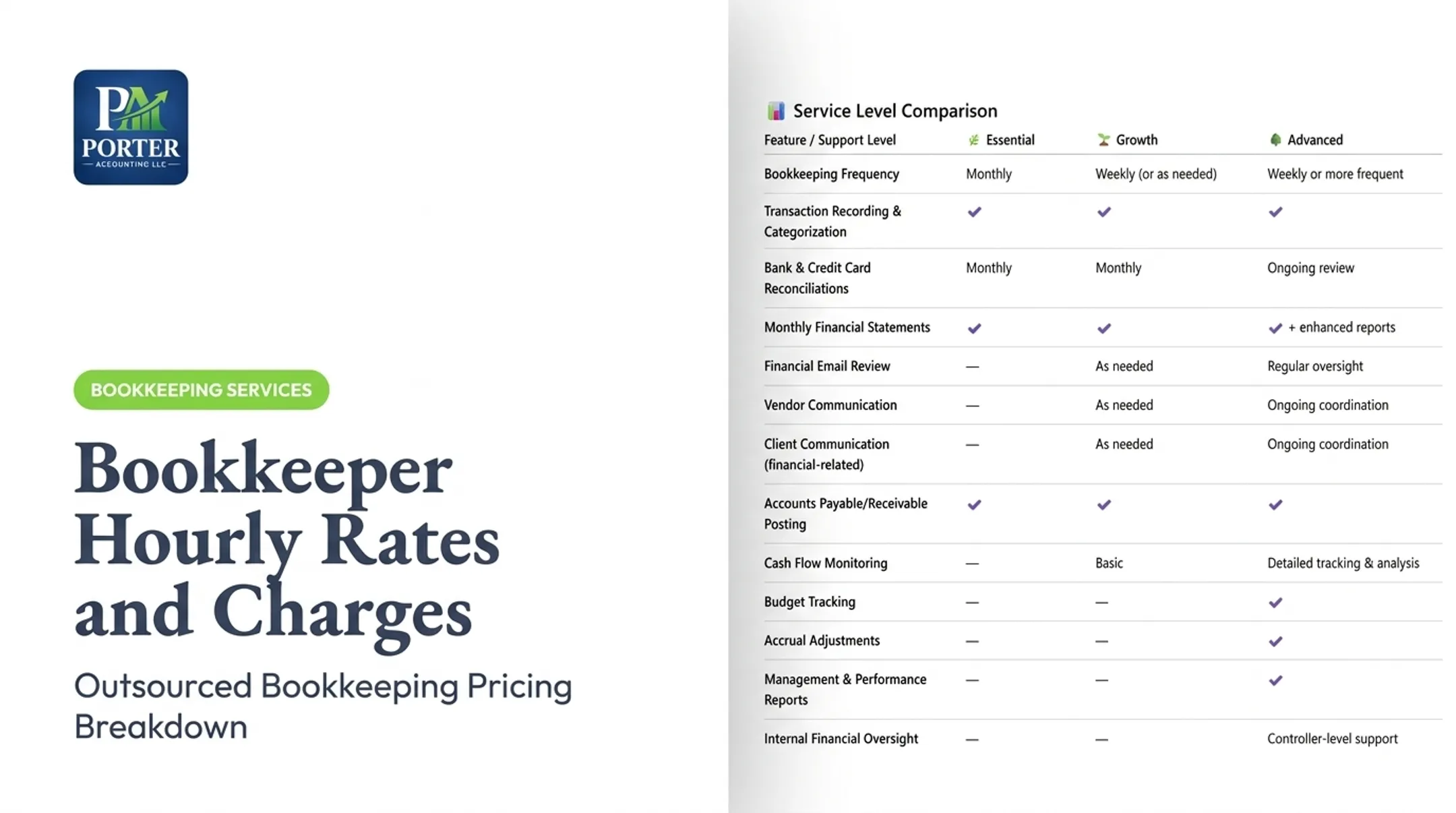
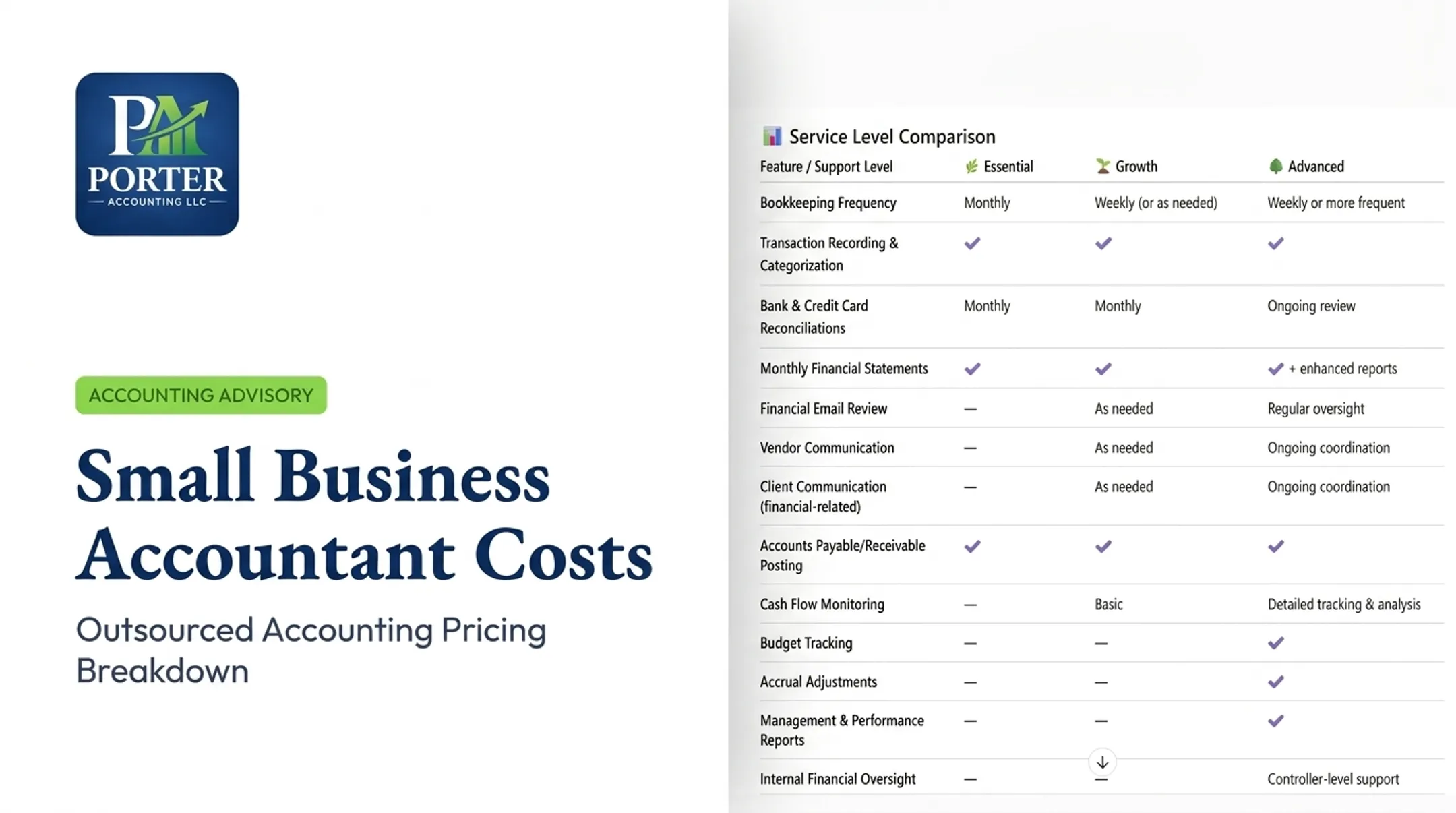
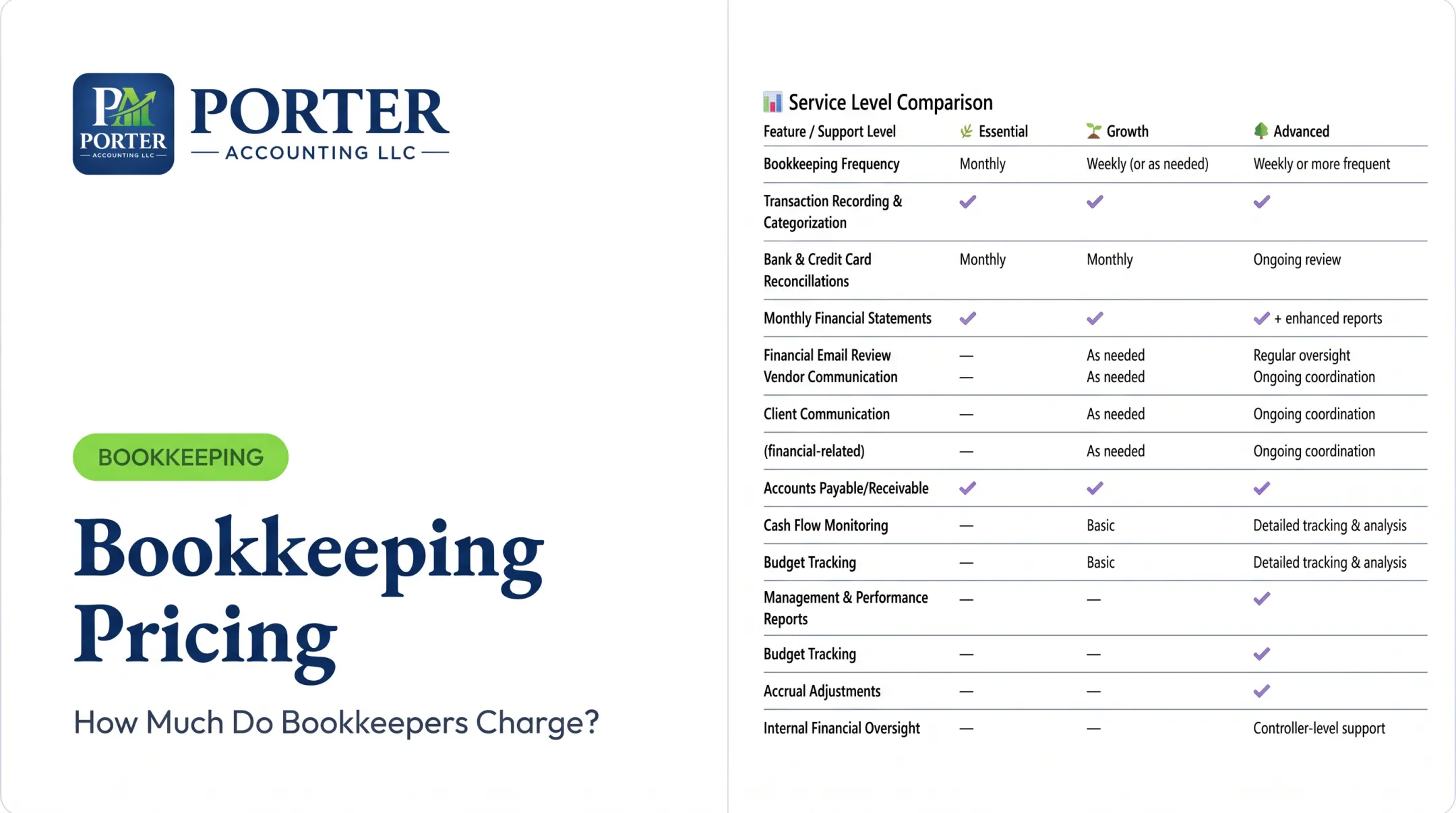
For comparison, Porter Accounting LLC monthly bookkeeping starts at $850/month (Essential), then $1,300/month (Growth) and $2,100/month (Advanced) as volume and oversight needs rise.

How Pricing Models Compare
Each pricing model fits a different situation. Picking the wrong one for your circumstances is where most budget surprises start.
| Model | How It Works | Best Fit |
|---|---|---|
| Hourly | Billed for time recorded | Undefined scope, consulting, uncertain cleanup |
| Fixed monthly | Flat fee for defined scope | Ongoing categorization, reconciliation, recurring reports |
| Project/fixed fee | One quoted amount | Catch-up, onboarding, system migration |
| Value-based bundle | Package price tied to perceived value | Bundled recurring services, higher-touch advisory |
Hourly pricing works when the scope is genuinely unclear, like a first-time cleanup project where nobody knows how many hours the mess will take to untangle. Ask upfront how estimates are built, how time is tracked, and what happens if hours run over. Without that clarity, hourly billing can spiral.
Fixed monthly pricing brings predictability. You know the number every month. That only holds if the contract spells out scope limits before extra charges kick in:
- Transaction limits and account counts
- Payroll scope and reporting deliverables
- Included meetings or support requests
Project or fixed-fee pricing uses one quoted amount for defined work such as catch-up, onboarding, or system migration. You lock the price when the deliverable is clear.
Value-based bundles price packaged recurring or advisory work around perceived client value rather than hours. The CPA Journal describes value pricing as a fit for services that are hard to measure in hourly increments, such as process improvement or financial strategy.
Price structure is only half the decision. Who delivers the work changes both cost and control.
Comparing Delivery Models
- In-house employee: Highest fixed commitment (BLS median salary plus employer costs); strongest direct control
- Freelance/part-time: Flexible for irregular or limited work; quality and scope vary by contractor
- Virtual/online service: Predictable recurring cost, often $199–$399/month to start; remote delivery
- Local firm: Quote-based on volume and complexity; no single national average exists
Key Factors That Affect Bookkeeping Costs
Bookkeeping price tracks five drivers: transaction volume, industry complexity, service scope, the condition of your existing books, and the provider’s expertise and support model.
Business Size, Transaction Volume, and Number of Accounts
More sales, purchases, bank accounts, payment processors, vendors, and monthly transactions mean more hours of work. Bookkeeper.com's published tiers show this scaling clearly: 50-75 transactions runs about $275/month, 100 transactions moves to $399-$499, and 200 transactions climbs to $599-$759.

Here's the counterintuitive part: a low-revenue business with many small transactions across several accounts can cost more to maintain than a higher-revenue business with simple, consolidated activity. Volume drives cost more than revenue does.
Industry and Accounting Complexity
Some industries need specialized processes that go beyond basic categorization:
- SaaS: deferred revenue recognition under ASC 606
- E-commerce and CPG: inventory-aware books and margin tracking
- Construction: job costing across labor, materials, and overhead
- Franchises: royalty calculations and location-level reporting
- Manufacturing: multi-step inventory valuation
Sage explains that SaaS payments often arrive upfront but must be recognized over the subscription period, adding a layer of complexity that simple point-of-sale accounting doesn't require.
Service Scope and Reporting Frequency
Basic categorization and reconciliation is one thing. Accounts payable, accounts receivable, payroll coordination, month-end close, accrual accounting, and cash-flow tracking are another.
Weekly or near-real-time reporting generally demands more ongoing work than a monthly close. The right cadence depends on how fast your business needs to make decisions, not on what sounds impressive.
Condition of the Existing Books
Unreconciled accounts, misclassified transactions, missing documentation, and prior-period errors turn a simple onboarding into a full cleanup project. Before accepting a recurring quote, ask:
- Is cleanup included, capped, or billed separately?
- How many prior periods need review?
- What happens if errors surface after the engagement starts?
Provider Expertise, Technology, and Support
Credentials, software knowledge, integration experience, internal review processes, and communication expectations all affect price. A provider offering only basic recordkeeping charges differently than one equipped for reporting, process improvement, and cash-flow insight.
Providers like Porter Accounting LLC price above pure transaction logging when the engagement includes internal controls, financial analysis, and controller-style oversight for growing businesses that have outgrown basic bookkeeping.
Cost Breakdown of Bookkeeping
The advertised monthly or hourly rate rarely covers the full cost of accurate, decision-ready books. Several line items usually sit outside that headline number.
Initial Assessment and Onboarding
This is typically a one-time fee, though terms vary by provider. It covers reviewing prior records, connecting accounting systems, establishing procedures, and defining the monthly close process. Scope and cost rise when prior books are incomplete or multiple systems need linking.
Historical Cleanup and Catch-Up Work
Cleanup is usually one-time or project-based and should be scoped separately when records are incomplete. SDO CPA's published ranges show how backlog length drives cost:
- 1-3 months backlog: $300-$500
- 4-6 months: $500-$1,500
- 7-12 months: $1,500-$3,500
- Over one year: $3,500-$8,000+
S-corps, partnerships, and payroll complexity can add another 30%-50%. At Porter Accounting LLC, Catch-Up & Clean-Up Bookkeeping is typically priced at 1.5x the regular monthly rate, scoped by complexity rather than a flat backlog formula.

Recurring Bookkeeping
The recurring fee covers transaction recording, reconciliations, document organization, routine payables or receivables, payroll coordination, and standard monthly reports. Inclusions differ by provider, so read the fine print. Monthly bookkeeping with Porter Accounting LLC starts at $850/month, with scope set by transaction volume and complexity.
Reporting, Advisory, and Higher-Level Accounting Support
Financial analysis, cash-flow forecasting, GAAP reporting, controller oversight, and fractional CFO support require expertise beyond basic bookkeeping and may be billed as recurring or periodic work. Porter Accounting's Controller Services start at $100/hour, and Fractional CFO Services start at $150/hour, covering budget tracking, KPI monitoring, and financial strategy. Technical work such as ASC 606 revenue recognition or a one-time audit preparation project is quoted separately based on scope.
Software, Integrations, and Add-On Services
Add-on pricing varies by service. Accounting software subscriptions, payroll platforms, receipt-capture tools, inventory systems, and sales-tax support are often excluded from base pricing. Confirm what's bundled before you sign.
Low-Cost vs. High-Cost Bookkeeping and How to Estimate the Right Budget
A lower price can fit simple, organized books. A higher price is justified when complexity, reporting demands, or the cost of bad information raise the stakes.
Lower-Cost Bookkeeping
Typically fits businesses with:
- Limited accounts and low transaction volume
- Straightforward, single-stream revenue
- Organized source documents already in place
- Basic reconciliation needs, minimal reporting
Trade-offs to expect:
- Less frequent review
- Fewer bundled services
- More owner involvement
- Extra charges for work outside the standard scope
Higher-Cost Bookkeeping
Commonly justified by:
- Multiple entities or locations
- Inventory or job-costing requirements
- Payroll complexity
- Revenue-recognition rules (SaaS, subscriptions)
- Investor or lender reporting deadlines
- Extensive cleanup backlog
What you gain at this level:
- Reliable financial statements
- Faster close cycles
- Stronger internal controls
- Less time your team spends chasing numbers
A Practical Budgeting Process
- Define the purpose: Tax support, compliance, monthly statements, cash-flow management, and lender reporting each need a different level of depth
- Gather your numbers: Transaction volume, bank and credit-card accounts, entities, employees, payroll frequency, sales channels, inventory, and cleanup status
- Ask providers to itemize: Separate recurring bookkeeping, cleanup, software, payroll, and advisory so you can compare quotes fairly
- Balance price against outcomes: Weigh cost against accuracy, timeliness, communication, and room to scale
Growing businesses that need a tailored mix of bookkeeping, cleanup, reporting, and cash-flow guidance—not a one-size-fits-all package—can use a consultation with Porter Accounting LLC to match scope to real complexity.

What Most People Miss When It Comes to Bookkeeping Cost
The monthly rate is only part of what you pay. These gaps are where bookkeeping costs climb:
- Focusing on the advertised price alone and ignoring what the scope leaves out
- Skipping owner time spent supervising, correcting errors, or gathering documents
- Assuming cleanup, tax prep, payroll, or advisory work is included in basic bookkeeping
- Choosing the cheapest provider without checking reconciliation practices, close timelines, or industry experience
- Failing to plan for growth, extra entities, new locations, or changing reporting needs
Budgeting for the Work Beyond Bookkeeping
Many of the biggest accounting costs are event-driven rather than monthly. A bank loan that requires annual GAAP financial statements, a first audit, an equity raise, or a new subscription pricing model can each add a burst of controller and technical accounting work on top of routine bookkeeping. Owners who budget only for the monthly fee tend to pay for that work in a rush, which usually costs more. If one of those events is on the next twelve months' calendar, add a line for close oversight and audit preparation support, and start earlier than feels necessary. Our year-end close and audit readiness guide shows what that work typically involves so you can scope it before quotes come in.
Conclusion
Bookkeeping costs vary because the work itself varies. Provider model, transaction volume, industry complexity, record quality, and how much financial insight you need all shape the final number.
A useful budget separates recurring bookkeeping from cleanup, software, payroll, and advisory expenses instead of lumping everything into one guess. The right price is the one that delivers accurate, timely, usable financial information—without paying for services you don't need. When your needs grow past bookkeeping, Porter Accounting LLC can add controller-level close, GAAP reporting, audit readiness, and fractional CFO guidance without a change of provider.
Frequently Asked Questions
How much do QuickBooks bookkeepers charge?
Pricing varies by transaction volume and scope, but QuickBooks Live starts around $300/month, while Bench's QuickBooks-specific support starts at $55/hour and up. Software costs are typically separate from bookkeeping service fees.
Is it worth it to hire a bookkeeper?
Hiring makes sense when it saves owner time, reduces errors, and delivers timely financial reporting your business actually needs. A simple, organized business with enough owner time and knowledge may manage fine with DIY methods.
How much does bookkeeping cost per month for a small business?
Basic outsourced service generally runs $250–$350/month. Full-service or growing-business plans usually cost $500–$700/month. Complex or premium engagements can reach $1,000+/month depending on scope.
What factors make bookkeeping more expensive?
Costs rise as scope expands. Common drivers include high transaction volume, payroll complexity, inventory, multiple entities or locations, cleanup backlog, frequent reporting, and advisory or controller-level support.
Does bookkeeping pricing include GAAP financial statements or audit prep?
Usually not at entry-level tiers. Basic plans cover recording, reconciliations, and standard reports. Accrual adjustments, GAAP statements, and audit preparation are typically part of higher tiers or billed as controller or project work, so confirm scope in writing.
Is it cheaper to hire an in-house bookkeeper or outsource bookkeeping?
In-house employment costs much more than salary alone once benefits, payroll taxes, and equipment are added. Outsourced monthly service often costs less for part-time recurring support, while in-house makes sense when you need sustained full-time capacity.