
Fees vary based on service type, billing model, business complexity, transaction volume, industry requirements, the current condition of your books, credentials, and how much financial insight you actually need. A retail shop with clean records and a handful of accounts pays differently than a multi-location franchise juggling payroll across three states.
This article breaks down hourly rates, monthly fees, and one-time project pricing, then walks through what drives those numbers up or down — so you can judge whether a quote actually fits your business.
Key Takeaways
- Bookkeeping, tax prep, controller, and fractional CFO work price by responsibility level.
- Messy books, payroll, inventory, multiple entities, and multistate sales tax drive fees up most.
- Hourly rates commonly run $50–$500 by role; monthly retainers range from under $100 to $7,500+.
- The cheapest quote isn't the lowest cost if it skips cleanup, reporting, or ongoing oversight.
How Much Does a Small Business Accountant Cost?
There's no fixed national rate for accounting services. What you pay depends on how the provider bills, what's included, and how complex your books already are. The ranges below reflect current industry pricing data — use them as planning benchmarks, not quotes.
Hourly Billing
| Service Level | Typical Hourly Rate |
|---|---|
| Bookkeeper | $50–$70 |
| General accountant | $40–$100 |
| CPA (tax/technical work) | $200–$500 |
| Fractional controller | $100–$250 |
| Fractional CFO | $250–$500 |

CPA hourly rates commonly run $200 to $500, according to TaxDome's 2026 pricing research, reflecting the specialized judgment that tax and technical work demands. Hourly billing tends to suit one-off questions, a single tax return, or a short advisory project, not ongoing bookkeeping, where costs swing with transaction volume month to month.
Monthly Retainers
Retainers buy predictability. Common tiers reported across providers:
- Basic bookkeeping: roughly $99–$400/month, covering categorization, reconciliations, and a monthly close
- Full-service accounting: roughly $625–$895/month, including GAAP-based statements, tax coordination, and CPA review
- Controller oversight: $2,000–$7,500/month, typically 10–30 hours of senior-level work
- Fractional CFO: $1,750–$15,000/month, covering forecasting, budgeting, cash-runway planning, and investor reporting
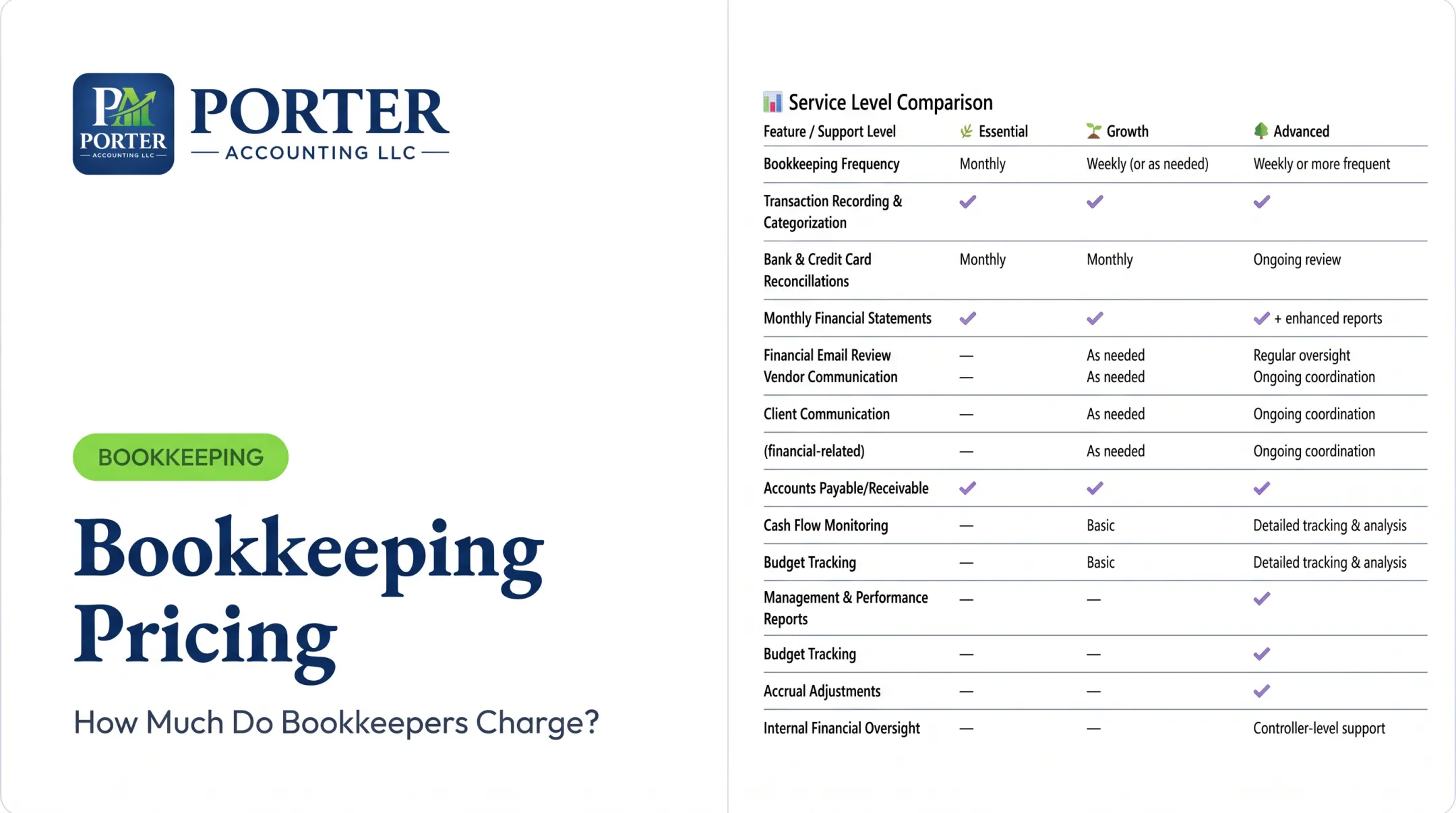
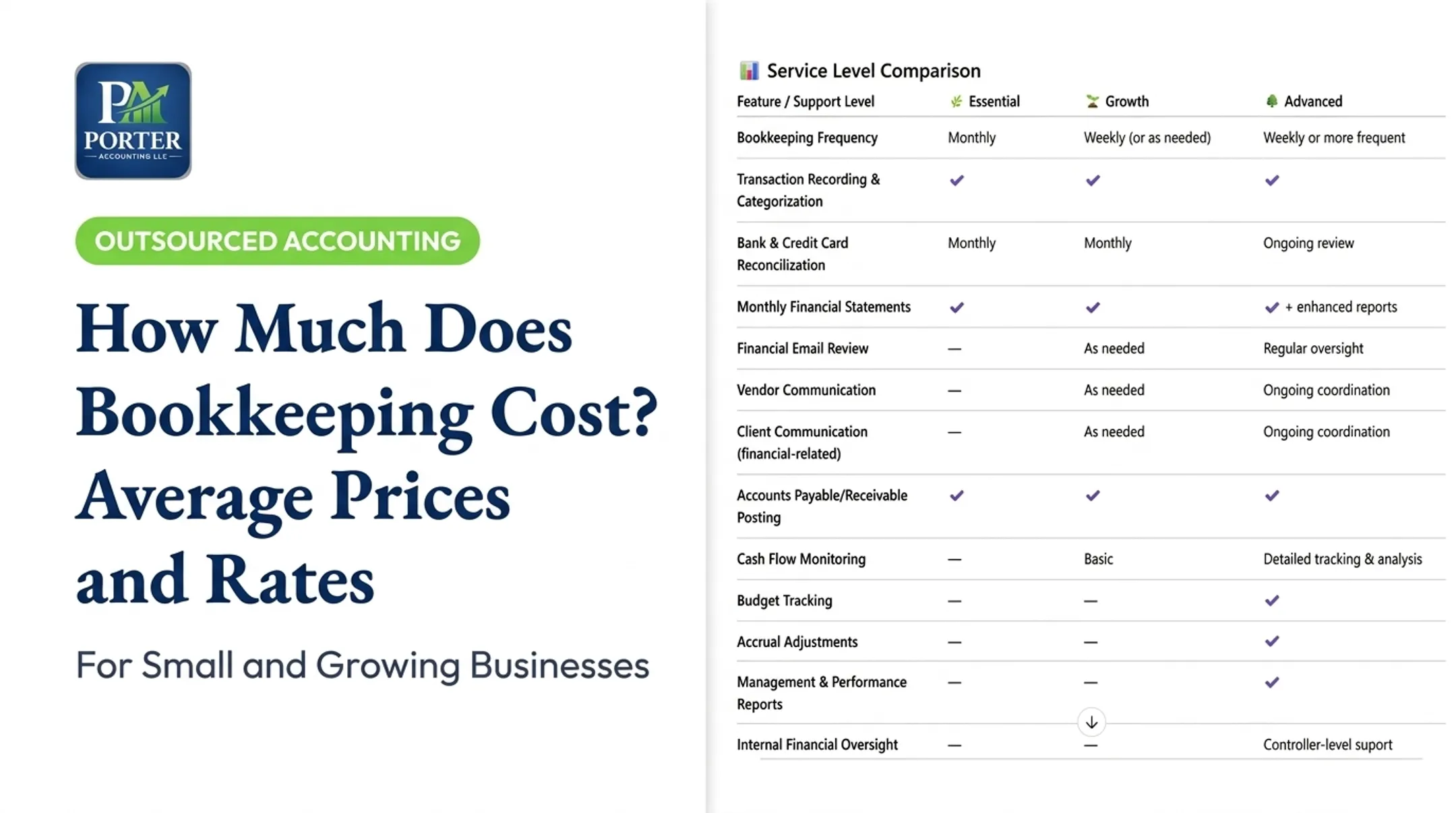
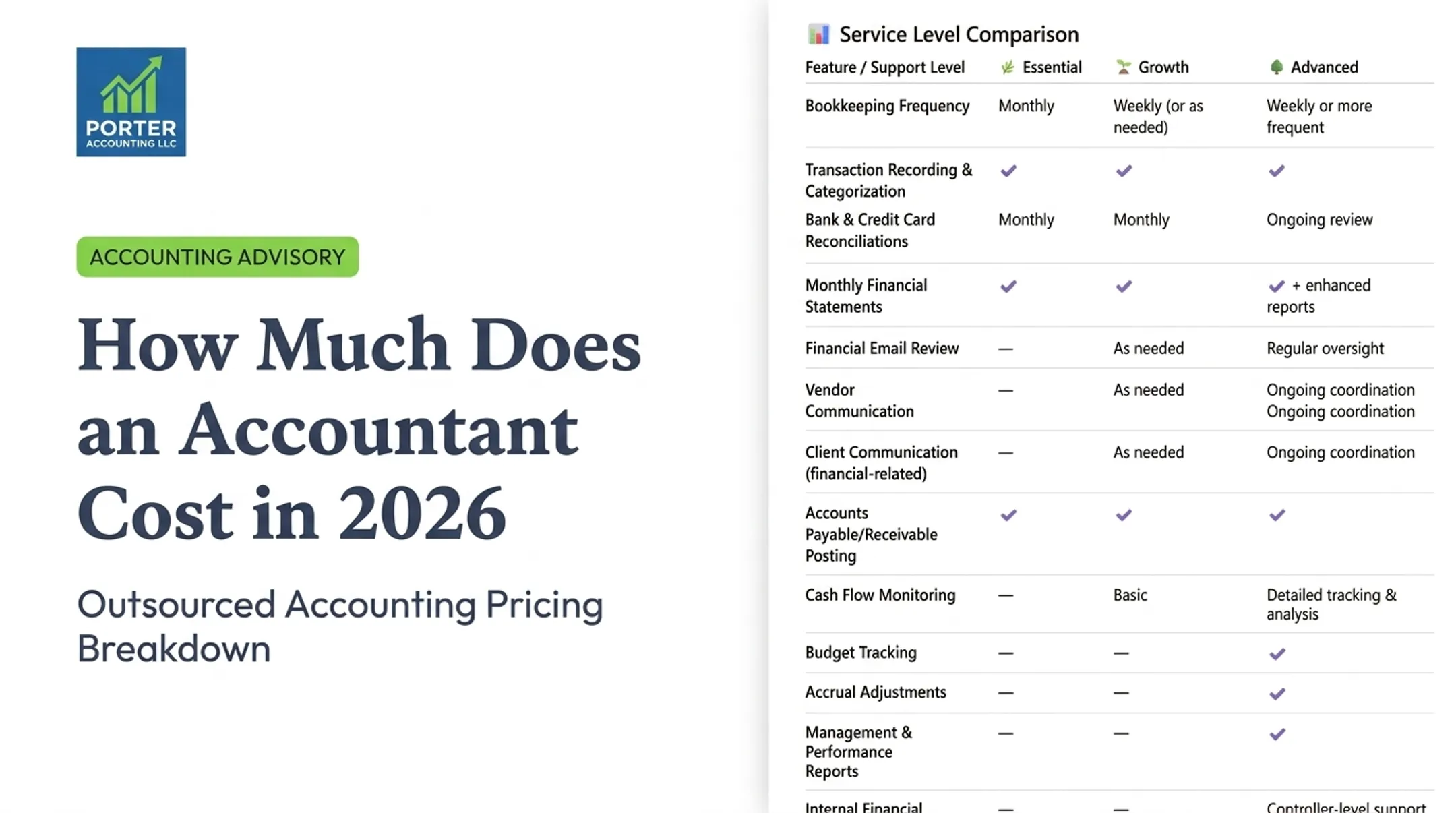
Porter Accounting LLC structures its plans similarly:
- Essential: starts at $850/month for straightforward bookkeeping and monthly statements
- Growth: starts at $1,300/month with weekly work and communication support
- Advanced: starts at $2,100/month for controller-level oversight and management reporting
Controller services start at $100/hour and fractional CFO work at $150/hour for businesses that need leadership without a full retainer.
Project and Fixed Fees
Some work doesn't fit monthly billing:
- Business tax returns: $1,200–$3,500 (S-corp) or $1,000–$5,000 (partnership)
- Cleanup/catch-up bookkeeping: $300 to $8,000+, depending on how far behind the books are
- System setup or migration: usually a flat onboarding fee, separate from ongoing bookkeeping
Published ranges are starting points, not commitments. Always request a written scope showing what's included, how billing works, and what triggers extra fees.
Key Factors That Affect Accountant Costs
Price mostly tracks the amount of work, judgment, and risk involved, not revenue or headcount. A $2M consulting firm with clean books can cost less to service than a $500K e-commerce shop juggling inventory, multiple states, and payroll.
Business Size, Transaction Volume, and Complexity
More activity means more work:
- Bank and credit card accounts requiring reconciliation
- Monthly transaction count, invoices, and bills
- Employees, contractors, and payment platforms in use
- Payroll obligations (employers remain responsible for tax deposits and filings even when processing is outsourced)
- Multiple locations, entities, or states needing consolidated reporting
Franchise operators and multi-entity businesses often need location-by-location profit-and-loss statements plus consolidated reporting, which adds coordination time.
Condition of the Books
Unreconciled accounts, uncategorized transactions, missing documentation, and incomplete payroll records create cleanup work before recurring accounting can start.
Catch-up bookkeeping costs scale directly with how far behind you are: a few hundred dollars for one to three months behind, several thousand for a year or more. S-corps, partnerships, and payroll-heavy businesses often run 30–50% higher.

Industry-Specific Accounting Needs
- E-commerce and CPG: inventory valuation, COGS tracking, and multistate sales tax
- Construction: job costing and contract-based revenue recognition
- SaaS: subscription billing and ASC 606 revenue recognition (revenue as service is delivered, not when cash arrives)
- Craft beverage: production cost tracking and long aging-inventory cycles
Services, Credentials, and Level of Advice
Each step up the service ladder adds responsibility and cost:
- Bookkeeper: records transactions
- Accountant: interprets and reconciles the books
- CPA: adds tax and attest capability
- Controller: owns reporting integrity and internal controls
- Technical accounting advisor: ASC 606 revenue recognition, GAAP policies, and audit readiness
- Fractional CFO: forecasting, capital planning, and strategic decisions
Location, Delivery Model, and Communication
Virtual delivery has narrowed geographic price gaps, but firm size, specialist availability, and expected meeting frequency still factor in. Weekly check-ins and fast turnaround usually cost more than quarterly-only contact.
What Does the Total Cost Include?
The quoted fee is often just one line in a bigger budget. Before comparing prices, split costs into three buckets.
One-time or periodic costs:
- Cleanup or catch-up bookkeeping
- Tax preparation and filing
- Software setup or chart-of-accounts redesign
- System integrations and year-end adjustments
- Audit support or special reporting projects
Recurring costs:
- Monthly bookkeeping, reconciliations, and close
- Payroll and sales-tax coordination
- Software subscriptions
- Accounts payable/receivable support
- Scheduled advisory meetings
Several items often sit outside the base quote:
- Rush requests
- Late-arriving records
- Additional entities added mid-year
- Unusual transactions or amended filings
- Meetings beyond the agreed scope
Before signing anything, ask directly: Is software included? Are tax filings part of the fee? Is payroll support bundled or billed separately?
Porter Accounting LLC folds payroll support into its Essential, Growth, and Advanced plans. Final pricing still depends on transaction volume, account count, and book condition at the start of the engagement.
How to Estimate the Right Budget for a Small Business Accountant
The right budget matches your business's actual risk and reporting needs, not the lowest hourly rate you can find.
Match the Service Level to the Need
A rough decision path:
- Owner-managed records with occasional review — you handle day-to-day entry; an accountant checks in periodically
- Recurring bookkeeping and close support — monthly reconciliations and statements, hands-off for you
- Accounting and management reporting — deeper analysis, budget tracking, cash-flow monitoring
- Controller or fractional CFO support — for complex, fast-growing, or investor-facing businesses

Hourly or project pricing suits a single tax filing, a system setup, or a one-time cleanup. Monthly retainers make more sense once you need continuity and predictable budgeting.
Prepare Information Before Requesting Quotes
Gather this upfront so quotes come back accurate the first time:
- Entity type and states of operation
- Monthly transaction volume and account count
- Payroll headcount and complexity
- Inventory or revenue model
- Current software and reporting requirements
- Tax deadlines and current book condition
Compare Proposals by Deliverables, Not Just Price
Line up quotes side by side on:
- Reconciliation frequency and close timing
- Financial statements and cash-flow reporting included
- Communication cadence and turnaround times
- What is excluded from the fee
Ask how each provider handles cleanup, growth, additional locations, or a future move to controller-level support.
Evaluate Value, Not Just the Invoice
Weigh the fee against what it recovers: owner time, fewer errors, clearer cash-flow visibility, stronger tax readiness, better decisions. A $1,300/month plan that catches a costly reporting error easily outperforms a $400/month plan that leaves you guessing.
This is where Porter Accounting LLC fits for many growing businesses. As a virtual accounting and financial advisory partner, the firm works with companies that have outgrown basic bookkeeping—franchise operators who need location-by-location reporting, SaaS companies that need ASC 606 done correctly, or mid-market firms with bookkeepers but no controller.
Led by Thao Porter, MSA, with experience across SaaS, manufacturing, construction, CPG, and franchise accounting, the firm shapes cleanup, reporting, and forecasting around what each business actually needs. Build the budget around deliverables and risk first; then choose the partner whose scope matches that plan.
When Paying for More Than Bookkeeping Makes Sense
The jump from a bookkeeping rate to a controller or CFO rate only pays off when the business actually needs the added responsibility. Common triggers are a bank asking for GAAP financial statements instead of tax-basis reports, a first external audit or investor diligence on the calendar, or customer contracts that require ASC 606 revenue recognition. At that point, a monthly plan alone may not cover the close review, accrual adjustments, and schedules the work requires. For reference, Porter Accounting LLC's plans start at $850/month (Essential), $1,300/month (Growth), and $2,100/month (Advanced, which adds month-end close oversight, accrual adjustments, and audit prep). Controller services start at $100/hour, fractional CFO services at $150/hour, and ASC 606 or one-time audit preparation projects through our technical accounting advisory team are custom-quoted. Paying for that oversight is usually cheaper than restating statements or stretching out an audit.
Conclusion
Small business accountant costs vary because the work varies. A bookkeeper reconciling a handful of accounts costs less than a controller managing multi-entity consolidations, and that's expected — price reflects responsibility.
A meaningful comparison looks past the headline number. Review the full scope:
- What's recurring versus one-time
- What's excluded from the quote
- How often you'll actually talk to your accountant
The cheapest quote that skips cleanup or reliable reporting often costs more down the road.
The right accounting investment delivers numbers you trust and the confidence to act on them. If you are weighing bookkeeping against controller, GAAP reporting, or fractional CFO support, Porter Accounting LLC can help you scope the level that fits today and grow with you from there.
Frequently Asked Questions
What are the typical accountant charges for a small business?
Charges range from roughly $50/hour for bookkeeping to $500/hour for CPA or technical work, with monthly plans running $99 to over $2,000 depending on scope. The right comparison depends on service level, complexity, and billing model.
What should an accountant charge per hour?
Hourly rates depend on experience, credentials, and task type: bookkeeping runs lower, while tax and advisory work run higher. CPA rates alone typically span $200 to $500 per hour based on complexity and location.
Do I really need an accountant for my small business?
Software or owner-managed bookkeeping can work for very simple, low-transaction businesses. Growth, messy books, payroll, inventory, multiple locations, or bigger decisions usually justify bringing in professional support.
Is a CPA worth it for a small business?
A CPA adds tax expertise and, in some cases, attest capability that bookkeepers and general accountants don't provide. Whether the added cost is worth it depends on your tax complexity, compliance risk, and audit needs.
How much does audit preparation or ASC 606 support cost?
These are usually scoped as projects because effort depends on contract volume, the condition of the books, and the audit timeline. Porter Accounting LLC custom-quotes ASC 606 and one-time audit preparation work, and its Advanced plan from $2,100/month includes ongoing audit prep.
What type of accountant is best for a small business?
It depends on the work: bookkeepers handle transactions, accountants and CPAs handle compliance and tax, controllers own reporting accuracy, and fractional CFOs handle forward-looking strategy. Choose based on what your business actually needs done, not the title alone.