
That gap between "our books are accurate" and "we know where this business is headed" is exactly what fractional CFO services are built to close. A fractional CFO gives you access to experienced financial leadership, part-time or project-based, without the six-figure commitment of a full-time hire.
This article covers what these services typically include, the signals that suggest it's time to hire one, how the role differs from a controller or bookkeeper, realistic cost ranges, and how to evaluate a provider before signing an engagement.
Key Takeaways
- Part-time or contract CFO leadership—without adding a full-time executive hire
- Scope centers on forecasting, cash flow, KPI reporting, systems, and capital support
- Match the engagement to your stage, complexity, and internal finance gaps
- Accurate bookkeeping comes first; a fractional CFO builds on it, not replaces it
What Do Fractional CFO Services Include?
Bookkeepers and accountants tell you what already happened. A fractional CFO takes that same data and tells you what to do next. According to Forbes, fractional CFO work typically covers:
- Budgeting and cash-flow review
- Strategic planning, pricing, and growth analysis
- Systems implementation
- Capital raising
Financial Planning, Forecasting, and Modeling
A fractional CFO builds budgets, rolling forecasts, and scenario models tied to real decisions. That might mean comparing the cash impact of hiring two salespeople now versus waiting a quarter. Or modeling how a shift from one-time sales to subscriptions changes revenue timing.
Cash-Flow and Working-Capital Management
Profit on paper doesn't pay vendors. This work covers:
- Cash forecasting and payment timing
- Collections and vendor terms
- Inventory and debt obligations
- Spotting funding gaps before they become emergencies
Reporting, KPIs, and Decision Support
Generic dashboards rarely fit specific business models. Relevant metrics differ by industry:
- SaaS: recurring revenue and churn
- Franchises: unit-level P&Ls
- E-commerce/CPG: inventory turns and gross margin
- Manufacturers and craft beverage producers: production costs and inventory aging
Systems, Controls, and Accounting Infrastructure
A fractional CFO often reviews close procedures, approval controls, and ERP or accounting-system workflows. Cleaner processes cut errors, clarify ownership, and put you in stronger shape for lender or audit review.
Capital, Transactions, and Special Projects
This includes fundraising support, lender conversations, due diligence, and acquisition or sale preparation. Legal, tax, valuation, and investment-banking work still require separately qualified professionals. Porter Accounting LLC structures fractional CFO engagements around these same priorities: cash-flow forecasting, budgeting, KPI tracking, and financial analysis. That work draws on Thao Porter's experience with GAAP reporting, ASC 606 revenue recognition, ERP implementations, and audit readiness for SaaS, manufacturing, and franchise clients.

When Should a Business Hire a Fractional CFO?
There's no universal revenue threshold for this decision. It's driven by complexity, risk, and whether your current team can keep up.
Rapid Growth or Operational Complexity
New locations, products, or revenue streams often outpace spreadsheets and informal processes. A fractional CFO helps management plan growth while protecting margins and liquidity as the business scales.
Fundraising, Debt, or Investor Readiness
Lenders and investors expect specific documentation. A typical SBA loan package, per Seacoast Bank's application checklist, includes:
- Three years of business tax returns
- Interim financials dated within 90 days
- A debt schedule and current AR/AP aging
- Three-year projected P&L with monthly Year 1 detail
A fractional CFO builds this package and reconciles the financial story with actual business performance.
Financial Uncertainty or Cash Pressure
Unexplained cash shortages, inconsistent margins, or delayed reporting are red flags. These issues rarely call for advanced forecasting first. Start with a financial cleanup and reporting assessment to establish a trustworthy baseline.
Audits, Transactions, and Major Milestones
Mergers, acquisitions, exits, or new accounting system implementations create a need for senior financial oversight. This can be a temporary project or an ongoing relationship, depending on scope.
When You Have Bookkeeping but No Financial Leadership
Accurate reconciliations don't produce scenario analysis or capital allocation decisions on their own. If your books are clean but you're still guessing on strategy, that's the gap fractional CFO services are meant to fill.
Ready to see where your business stands? Schedule a consultation with Porter Accounting LLC to talk through your fractional CFO, controller, and GAAP reporting needs, from clean books to audit-ready financials.
Benefits and Business Fit
The core appeal is flexibility. You get senior financial expertise, an outside perspective, and better decision-making without a full-time salary and benefits package.
Main benefits include:
- Senior-level expertise available on demand
- Capacity that scales up or down with your needs
- Outside perspective on blind spots insiders miss
- Clearer financials that support faster decisions
- No long-term executive commitment required
That same flexibility shows up in how the work is structured. Engagements can run as a recurring monthly cadence, a defined project, or a transition period before a full-time hire. Scope and availability should always be documented in the engagement agreement.
Businesses that often benefit most:
- SaaS and subscription companies
- Multi-unit franchises
- E-commerce and CPG brands
- Manufacturers and craft beverage producers
- Mid-market firms without in-house finance leadership
One clear limit: a fractional CFO can't fix messy books, replace operational accountability, or substitute for a full-time CFO once scale demands constant executive presence.
Fractional CFO vs. Other Finance Roles
Each finance role serves a different purpose. None is universally "better." They solve different problems.
| Role | Primary Focus |
|---|---|
| Bookkeeper | Records transactions, reconciles accounts |
| Accountant | Prepares financial statements, tax support |
| Controller | Manages close process, compliance, internal controls |
| Fractional CFO | Forecasts, strategy, capital decisions, business planning |
| Interim CFO | Full-time, temporary leadership during a transition |
| Full-time CFO | Permanent, continuous executive presence |
Controller vs. Fractional CFO
According to NetSuite, a controller handles day-to-day accounting, AP/AR, payroll, and tax compliance. A fractional CFO uses that data to build forecasts and guide strategic decisions.
Accountant or Bookkeeper vs. Fractional CFO
Bookkeepers and accountants maintain the records. Fractional CFO services interpret those numbers and tie them to decisions such as hiring, pricing, expansion, or financing.
Interim CFO vs. Fractional CFO
An interim CFO steps in full-time during a leadership vacancy, typically for three to six months. A fractional CFO provides ongoing part-time or project-based leadership without becoming a full-time hire.
Full-Time CFO vs. Fractional CFO
A full-time CFO offers constant internal presence. A fractional CFO offers flexibility at lower cost. Many companies start fractional, then move to full-time once financial complexity justifies the permanent seat.
Where Controller Work, GAAP Reporting, and ASC 606 Fit In
A forecast is only as reliable as the numbers underneath it. If the monthly close is loose, accruals are missing, or revenue is booked when cash arrives, a fractional CFO ends up modeling the wrong baseline. That is why strategy work usually sits on top of a controller layer that owns the close, reviews balances, and keeps reporting consistent from month to month.
For many growing companies, the next step is moving from cash-basis books to accrual-based GAAP financial statements that lenders, investors, and auditors will accept. Subscription, SaaS, and multi-element contracts add another layer: revenue has to follow the ASC 606 five-step model, with deferred revenue schedules that tie to the balance sheet. Our guide to SaaS accounting and ASC 606 walks through how that works in practice.
If a first audit, a lender review, or a financing round is on the horizon, audit readiness belongs in the CFO plan early: clean reconciliations, supporting schedules, and a close process that holds up to questions. Porter Accounting LLC can pair fractional CFO support with controller services and technical accounting help, so the forecasting, the close, and the audit preparation come from one team working alongside your external auditors.
How Much Do Fractional CFO Services Cost?
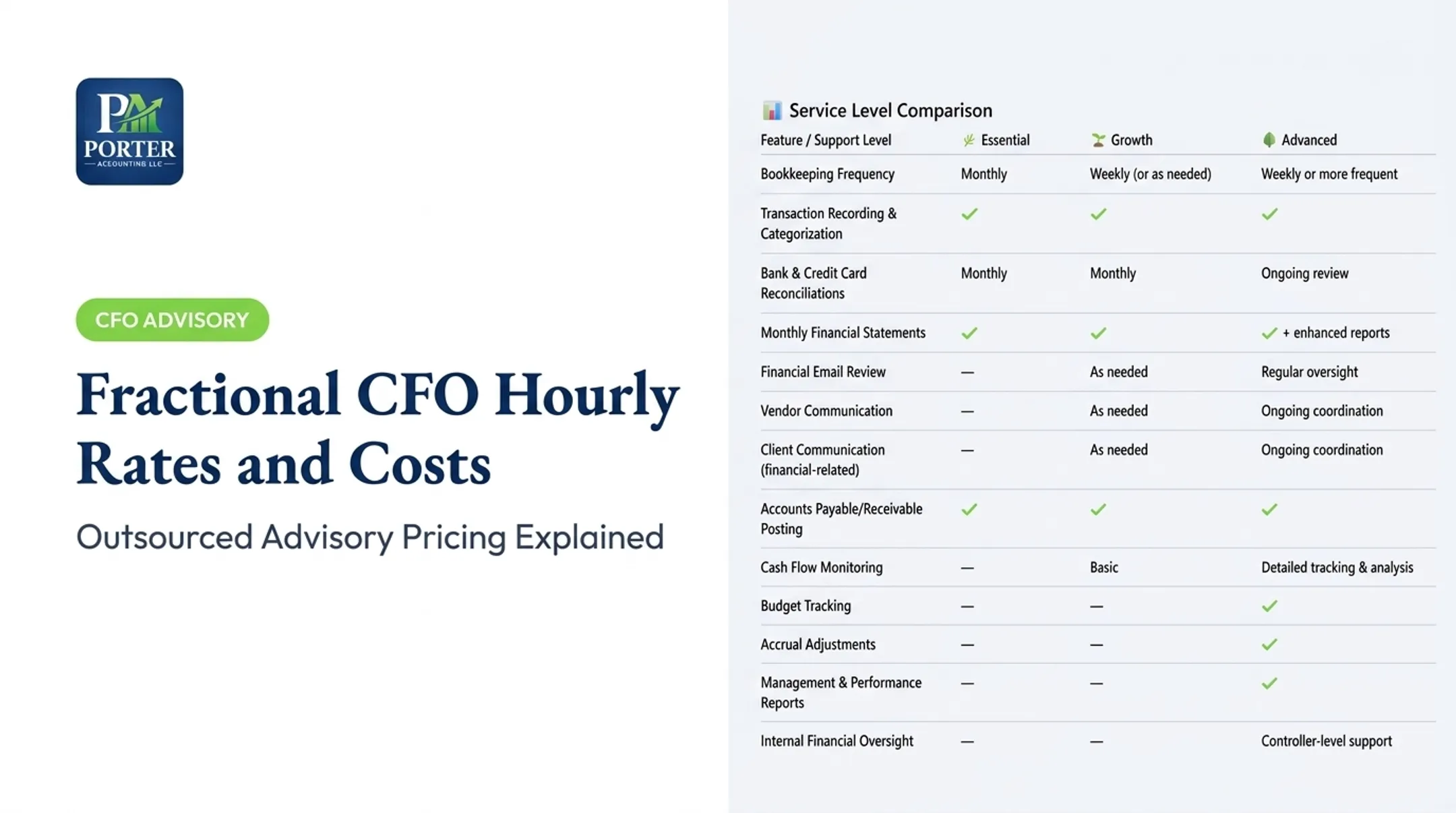
Fractional CFO services are typically priced hourly, by project, or on a monthly retainer. Your rate depends on business size, transaction volume, industry complexity, and how much cleanup work is needed upfront.
Current US market ranges reported by industry sources:
- Forbes (2024): $250-$500 per hour
- Kruze Consulting (2024): $8,000-$16,000 per month for startups
- Pilot (2025): $3,000-$12,000 per month, with messy books driving costs higher

Porter Accounting LLC's fractional CFO services start at $150 per hour, with financial strategy projects quoted individually based on scope. Controller services start at $100 per hour when you need senior oversight without full CFO-level scope.
Before signing an engagement, ask about:
- Onboarding and financial cleanup time
- Reporting frequency and forecast development
- Meeting cadence and response times
- Systems work and transaction support
- What falls outside the agreed scope
A lower-cost, defined project may fit a one-time cleanup or forecast build. Ongoing strategic leadership typically requires broader scope and a higher monthly commitment. Compare deliverables and industry experience, not just the hourly rate.
How to Evaluate and Engage a Fractional CFO
Before you interview candidates, get clear on what you need from the role. Assess your goals, accounting quality, reporting gaps, and upcoming milestones so scope talks stay concrete.
Choosing Relevant Experience
Look for experience with your specific industry and challenge, not just a title. Ask about prior work with SaaS revenue recognition, franchise unit reporting, inventory-heavy businesses, or audit readiness.
Defining Scope and Deliverables
Document expectations clearly, including:
- Baseline financial assessment and monthly reporting package
- Cash forecast, annual budget, and KPI dashboard
- Meeting cadence, data access, and confidentiality terms
- Success measures for the engagement
Checking Credentials and Working Style
Verify background and references, and ask for a sample monthly package or forecast they have produced. A strong fractional CFO explains complex issues in plain language and works cleanly with your bookkeeper, auditors, and lenders.
Planning the First Phase
Plan the engagement in stages:
- Learn the business and current finance stack
- Flag urgent risks and control gaps
- Stabilize reporting and cash visibility
- Build forecasts and prioritized recommendations

Early deliverables should create measurable clarity—not promises tied to outcomes the CFO cannot control.
Frequently Asked Questions
How much do fractional CFO services typically cost?
Typical rates run about $150–$500 per hour or $3,000–$16,000 per month. Scope, business complexity, and engagement structure drive the final number—ask providers for current, scope-specific quotes.
What is a fractional CFO salary?
Fractional CFOs charge client fees (hourly or monthly retainers) rather than earning a traditional salary. Earnings depend on experience, workload, and how many clients they serve.
How do I hire a temporary CFO?
Decide whether you need an interim CFO (full-time, short-term) or a fractional CFO (part-time, ongoing). Then assess relevant experience, verify references, and put scope, deliverables, and timing in writing.
Is hiring a fractional CFO worth it?
Yes, when you need senior financial leadership without a full-time hire. Most businesses justify the cost through clearer cash-flow visibility, stronger forecasting, and fewer costly financial surprises.
Are fractional CFOs in demand?
Outsourced advisory services are growing: CPA.com's 2024 benchmark survey found participating advisory practices reported 17% median growth in 2023. Growth-stage firms still drive much of that demand for part-time senior finance help.
Do you need a CPA to be a fractional CFO?
CPA licensure isn't universally required for CFO work, though it matters for certain regulated accounting tasks. Relevant financial leadership experience and technical knowledge typically matter more for this role.
Can a fractional CFO help us prepare for an audit?
Yes, as audit preparation and support rather than the audit itself. A fractional CFO or controller can organize reconciliations, build the schedules auditors request, tighten internal controls, and respond to auditor questions. The independent audit is still performed by your external CPA firm. See our year-end close and audit readiness guide for what that preparation involves.
Does a fractional CFO handle ASC 606 revenue recognition?
A fractional CFO should understand how ASC 606 affects revenue timing, margins, and forecasts, especially for SaaS, subscription, construction, and multi-element contracts. The detailed work of reviewing contracts and building deferred revenue schedules is often handled as a technical accounting project alongside the CFO engagement.