
Introduction
Ask five bookkeepers what they charge, and you'll get five different answers, none of which mean the same thing. An employee's hourly wage, a freelancer's billable rate, and an outsourced firm's monthly fee are three separate cost structures, not variations of the same number.
Confusing them leads to real problems: underbudgeting for a hire, comparing apples to oranges when vetting providers, or signing with someone whose skill set doesn't match your books' complexity. A quote that looks cheap on paper can balloon once cleanup, payroll, or extra communication get billed separately.
This guide breaks down current U.S. pricing across employee wages, freelance rates, and outsourced services. You'll also see what drives those rates up or down, where add-on fees usually surface, and how to build a bookkeeping budget that actually holds up.
Key Takeaways
- Employee, freelance, and outsourced bookkeeping use different pricing models—compare them carefully.
- Volume, book condition, scope, and industry complexity drive most of the price.
- The cheapest option isn't always the best value once cleanup and rework costs enter the picture.
- Compare total scope and deliverables, not just the hourly number quoted.
How Much Does a Bookkeeper Cost?
There's no single standard rate. What you pay depends on who's doing the work, how messy your books are, and what's included in the scope of work.
In-house employees earn a wage, not a client-facing fee. According to the Bureau of Labor Statistics, the May 2024 median pay for bookkeeping and accounting clerks was $23.66 per hour, or $49,210 annually. That figure covers wages only—payroll taxes, benefits, and supervision are extra.
Freelance and firm-based bookkeepers bill differently. Pilot's 2025 research puts typical hourly bookkeeping charges between $20 and $60, depending on experience and location. The same report found monthly bookkeeping fees ranging from $250 to $2,500, driven mostly by transaction volume and business size.

Here's how those benchmarks compare:
| Provider Type | Typical Rate | What's Usually Included |
|---|---|---|
| In-house employee (wage) | $23.66/hour ($49,210/year median) | Wages only; taxes, benefits, and equipment cost extra |
| Freelance/independent bookkeeper | $20–$60/hour | Transaction entry and reconciliations; scope varies widely |
| Outsourced/virtual firm | $250–$2,500/month | Bundled monthly service; tier depends on volume and complexity |
| Porter Accounting LLC monthly plans | $850–$2,100/month | Tiered service from basic reconciliations to controller-level oversight |
Which level fits your business?
- Basic recording and reconciliation works for a small, organized business with straightforward transactions.
- Ongoing bookkeeping with AP/AR and payroll coordination fits growing companies needing monthly reporting.
- Complex, audit-ready support fits businesses with inventory, multiple entities, or specialized revenue recognition.
Use these ranges as a baseline, then price the scope you actually need—transaction volume, reporting depth, and oversight level drive the final number more than any published average.
Key Factors That Affect Bookkeeper Hourly Rates and Charges
Bookkeeper hourly rates reflect time, expertise, accountability, and the tools required to keep your financials accurate.
Business Size, Transaction Volume, and Account Count
More bank accounts, credit cards, payment processors, and sales channels mean more reconciliation work. An e-commerce brand running three payment platforms across multiple states needs far more hours than a solo consultant with one checking account and a handful of monthly invoices.
Condition of the Books and Cleanup Needs
Unreconciled accounts, missing receipts, or a chart of accounts that hasn't been touched in years require catch-up work. This is typically quoted separately from ongoing monthly service. Ask for a written scope before work starts so cleanup costs don't quietly merge into your regular rate.
Services Included in the Engagement
Basic categorization and reconciliation cost less than a package that adds invoicing, bill pay, payroll support, or monthly financial statements. Tax prep, controller work, and CFO-level advisory sit in a different pricing tier entirely. They're distinct services, not add-ons to a basic bookkeeping rate.
Experience, Specialization, and Software
QuickBooks or Xero fluency speeds up the work, but software knowledge alone doesn't set the price. Bookkeepers with experience in SaaS revenue recognition, franchise royalty structures, or inventory-heavy industries like craft beverage production often command higher rates. That premium varies by provider and isn't standardized.
Frequency, Urgency, and Communication
A quoted rate might include monthly close reviews and email support—or it might not. Ask directly whether calls, urgent requests, and management meetings are billed separately.
Low-Cost vs. Higher-Cost: What Actually Changes
A lower rate isn't automatically a bad deal, and a higher one isn't automatically justified. What tends to differ:
- Lower-cost service fits standardized, low-volume work with organized records
- Higher-cost engagements more often include stronger review procedures, month-end close support, and direct communication with leadership
Not every expensive provider delivers all of that. Ask specifically what's included before assuming quality scales with price.

Total Cost Breakdown and Billing Models
The hourly rate is one line item. The full engagement tells the real story.
| Model | Billing Type | What It Typically Covers |
|---|---|---|
| Employee/in-house | Recurring | Wages plus payroll taxes, benefits, PTO, recruiting, equipment, and supervision time |
| Freelance/independent hourly | Recurring or project-based | Self-employment taxes, software, insurance, and unpaid admin time baked into the rate; minimums or rush fees may apply |
| Outsourced monthly bookkeeping | Recurring | Fixed pricing tied to transaction limits, deliverables, and close schedules |
| Cleanup, setup, and special projects | One-time or periodic | Historical cleanup, software migration, chart-of-accounts redesign, audit prep |
| Software, payroll, tax, advisory add-ons | Recurring or periodic | Tools and services billed separately from core bookkeeping |
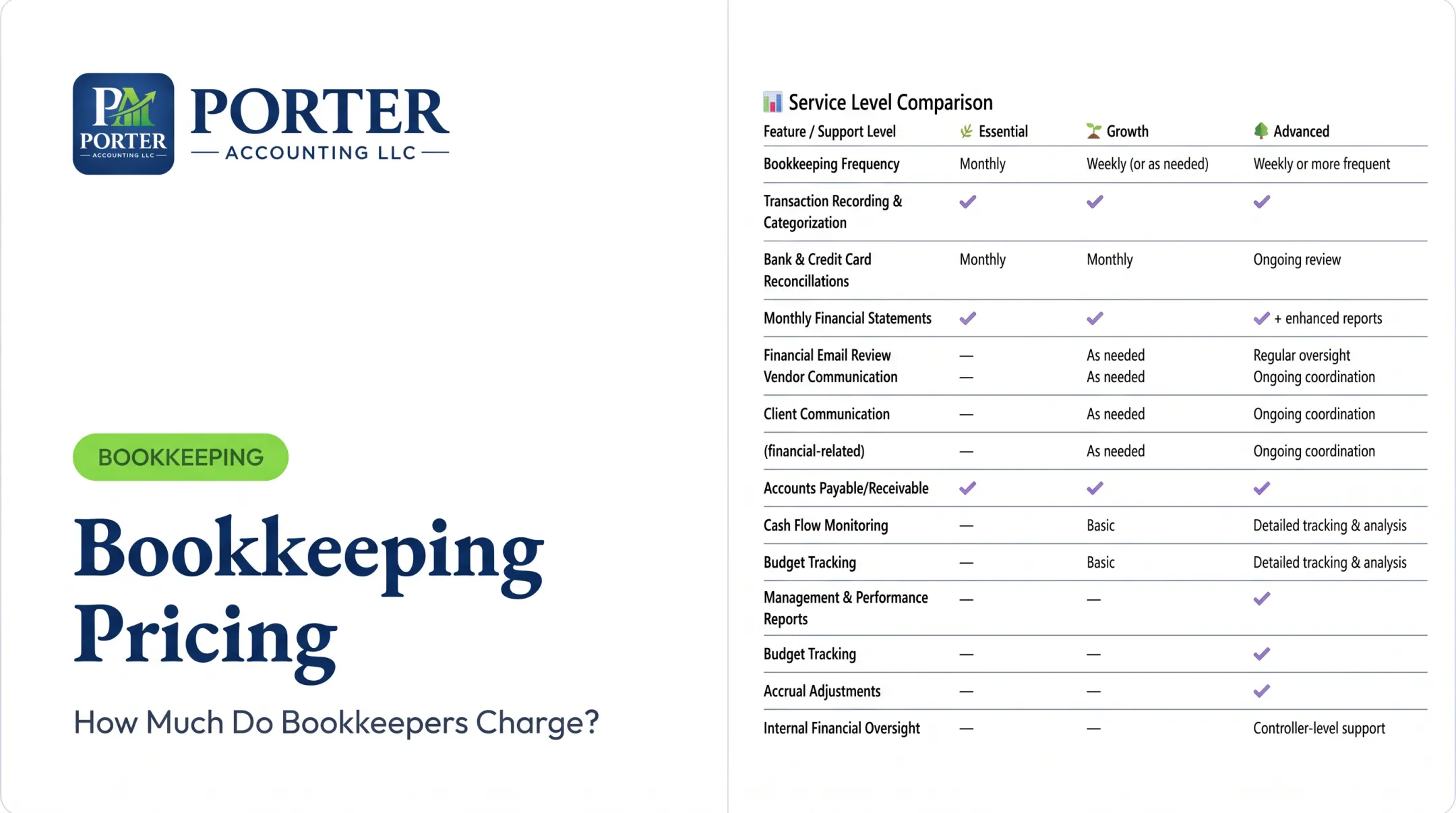
Porter Accounting LLC prices monthly bookkeeping by scope:
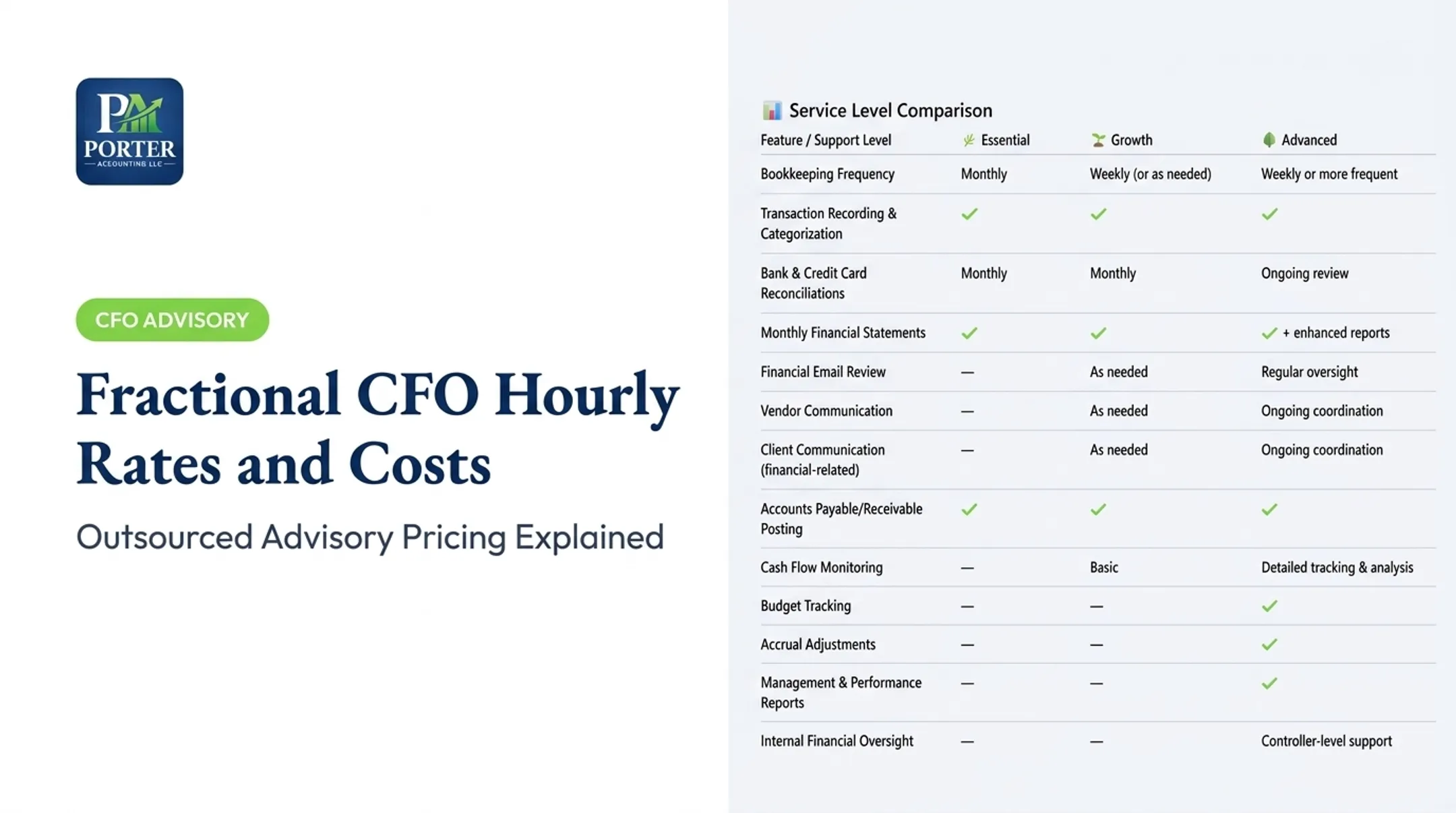
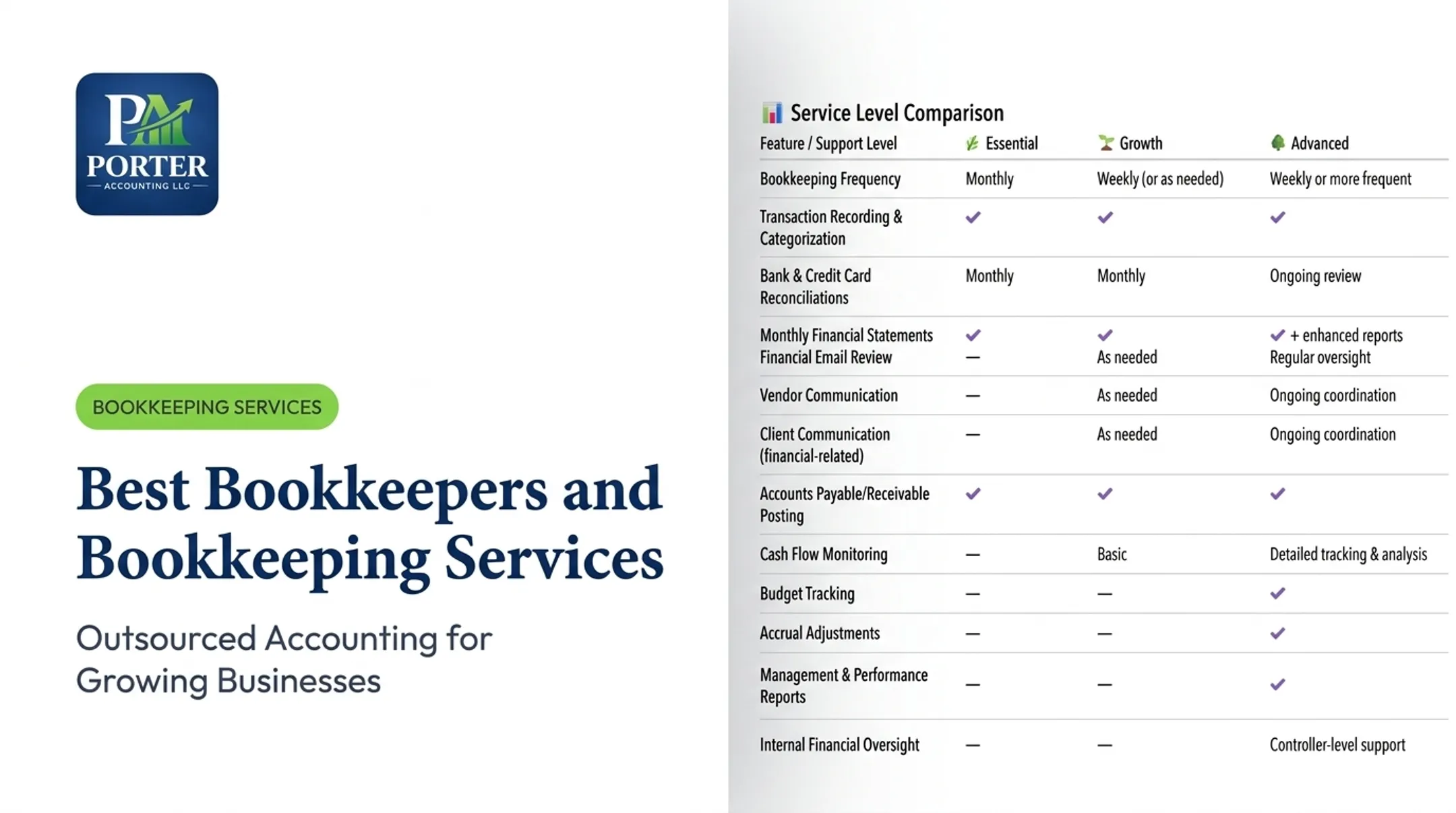
- Essential starts at $850/month for recording, reconciliation, and monthly statements
- Growth starts at $1,300/month, with weekly work, email review, and vendor communication
- Advanced starts at $2,100/month, with accrual adjustments, budget tracking, cash-flow monitoring, and controller-style oversight
Catch-up and cleanup work is priced separately—typically around 1.5 times the regular monthly rate. Fixing a year of miscategorized transactions takes more effort than keeping clean books current.
Controller services start at $100/hour. Fractional CFO work starts at $150/hour, where the focus moves from transaction processing to financial guidance.
When a Higher Hourly Rate Costs Less
A bookkeeper's hour and a controller's hour buy different things. Bookkeeping hours record and reconcile transactions; controller hours review the close, post accruals, and make sure the statements follow GAAP. Asking a bookkeeper to build an ASC 606 deferred revenue schedule or answer an auditor's request list often takes more hours at a lower rate, with more rework. Paying for technical accounting or controller time on those tasks, and keeping bookkeeping hours on the routine work, usually produces a lower total bill and numbers that hold up to outside review. The same logic applies higher up: a few hours a month of fractional CFO time on forecasting is often worth more than extra reporting hours nobody uses.
How to Estimate the Right Budget for Bookkeeping
The right budget depends on workload and risk, not just the lowest number on a quote sheet.
- Define the work first. List transaction categorization, reconciliations, invoicing, payroll coordination, AP/AR, and any cleanup needed. Note your account count, entities, locations, and monthly transaction volume.
- Pick the right pricing structure. Hourly billing suits occasional or project-based work; monthly pricing suits recurring work with a clear scope, transaction limits, and reporting schedule.
- Calculate the full cost. Use a simple formula: estimated hours × billable rate, plus setup, cleanup, and any out-of-scope work. Treat it as an estimate, not a locked-in quote.
- Evaluate the provider beyond price. Ask about industry experience, who performs and reviews the work, response times, security practices, and transition procedures if you switch providers.
- Get it in writing. A proposal should spell out included services, billing increments, minimums, overage rates, and cancellation terms.

Growing businesses working with Porter Accounting LLC often begin with this scoping step, then add virtual bookkeeping, cleanup, reporting, and cash-flow visibility as needs change.
Common Mistakes to Avoid
- Focusing on the advertised rate while ignoring minimum hours or communication charges
- Comparing an employee's wage directly to a freelancer's billable rate without accounting for taxes and benefits
- Assuming a basic rate covers cleanup, payroll, or financial statements
- Choosing the cheapest provider without checking review procedures or security practices
- Skipping plans for seasonal volume, year-end work, or future controller-level needs
Conclusion
Bookkeeper rates vary widely because provider type, workload, and service scope each change the price. A sound comparison separates wages from billable rates and weighs the full cost of accurate, timely financial records.
If your books need more than basic data entry, Porter Accounting LLC offers tiered virtual bookkeeping, cleanup, and advisory support built for growing U.S. businesses that need financial clarity they can act on. When you outgrow bookkeeping hours, the same team adds controller-level close, GAAP reporting, audit preparation, and fractional CFO guidance.
Frequently Asked Questions
What is the average hourly rate for a self-employed bookkeeper?
Self-employed bookkeepers typically charge $20–$60 per hour, according to Pilot's 2025 research. That rate sits above employee wages because freelancers cover self-employment taxes, software, and insurance themselves.
What is the hourly rate for a QuickBooks bookkeeper?
QuickBooks proficiency alone doesn't set a standard rate. Basic transaction categorization costs less than cleanup, payroll support, or reporting for a complex business, even with the same software.
How much does a bookkeeper charge per month?
Monthly bookkeeping fees generally run from $250 to $2,500, depending on transaction volume, account count, and services included. Cleanup work, payroll support, and reporting frequency all push the price up.
Is it cheaper to hire a bookkeeper hourly or monthly?
It depends on consistency of workload. Hourly pricing offers flexibility for occasional or project-based needs, while monthly pricing gives predictability when scope and deliverables are clearly defined.
Is a controller's hourly rate worth it compared to a bookkeeper's?
It is when the work requires judgment: month-end close review, accrual adjustments, GAAP financial statements, ASC 606 revenue schedules, or audit preparation. Keep routine entry at bookkeeping rates and use controller hours where errors would be costly.
What factors affect bookkeeping rates?
Experience, location, transaction volume, account complexity, industry specialization, and cleanup needs all play a role. The billing model, whether hourly, monthly, or project-based, also affects the total cost.