
The U.S. Bureau of Labor Statistics reports a $50,670 median annual wage for bookkeeping, accounting, and auditing clerks as of May 2025 — but that's an employee's paycheck, not what a contractor or firm bills a client.
What you actually pay depends on transaction volume, the number of accounts and entities you run, industry complexity, how much scope you need, the provider's experience level, your location, and whether they bill hourly or monthly. This guide breaks down current pricing ranges, what drives them, how to evaluate a quote, and how to land on a budget that fits your business.
Key Takeaways
- Outsourced bookkeepers typically bill $20–$60/hour, versus a $50,670 median in-house salary (BLS).
- Basic transaction entry costs less than reconciliations, month-end close, cleanup, payroll, or advisory work.
- Low-volume businesses often need light hourly support; multi-entity, inventory-heavy, or compliance-heavy work needs more.
- Pay for the accuracy and reporting quality you need, not the lowest number on the quote.
How Much Does a Bookkeeper Cost?
Bookkeeping has no single sticker price. Before comparing any two quotes, confirm exactly what work each one covers. Otherwise you're comparing apples to invoices.
There are four common pricing arrangements:
- In-house employee: A salaried or hourly wage, plus payroll taxes, benefits, and equipment.
- Freelance or contract bookkeeper: A billable hourly rate, often $20 to $60 per hour per Pilot's 2025 bookkeeping cost breakdown.
- Traditional bookkeeping firm: Hourly billing or an estimated-hours quote for a defined scope of work.
- Virtual or outsourced provider: A fixed monthly fee tied to transaction volume, account count, and service tier.
Freelance rates still shift with state, experience, and transaction volume.
Three Practical Cost Bands
| Band | Typically Includes | Best Fit |
|---|---|---|
| Basic/light | Transaction categorization, bank and credit-card reconciliations, limited reporting | Low-volume, single-entity businesses |
| Standard recurring | Month-end close, general ledger maintenance, standard financial statements | Growing businesses with regular activity |
| Complex/higher-touch | Multiple entities, inventory, payroll, AP/AR, controller-level review | Multi-location, inventory-heavy, or compliance-sensitive companies |
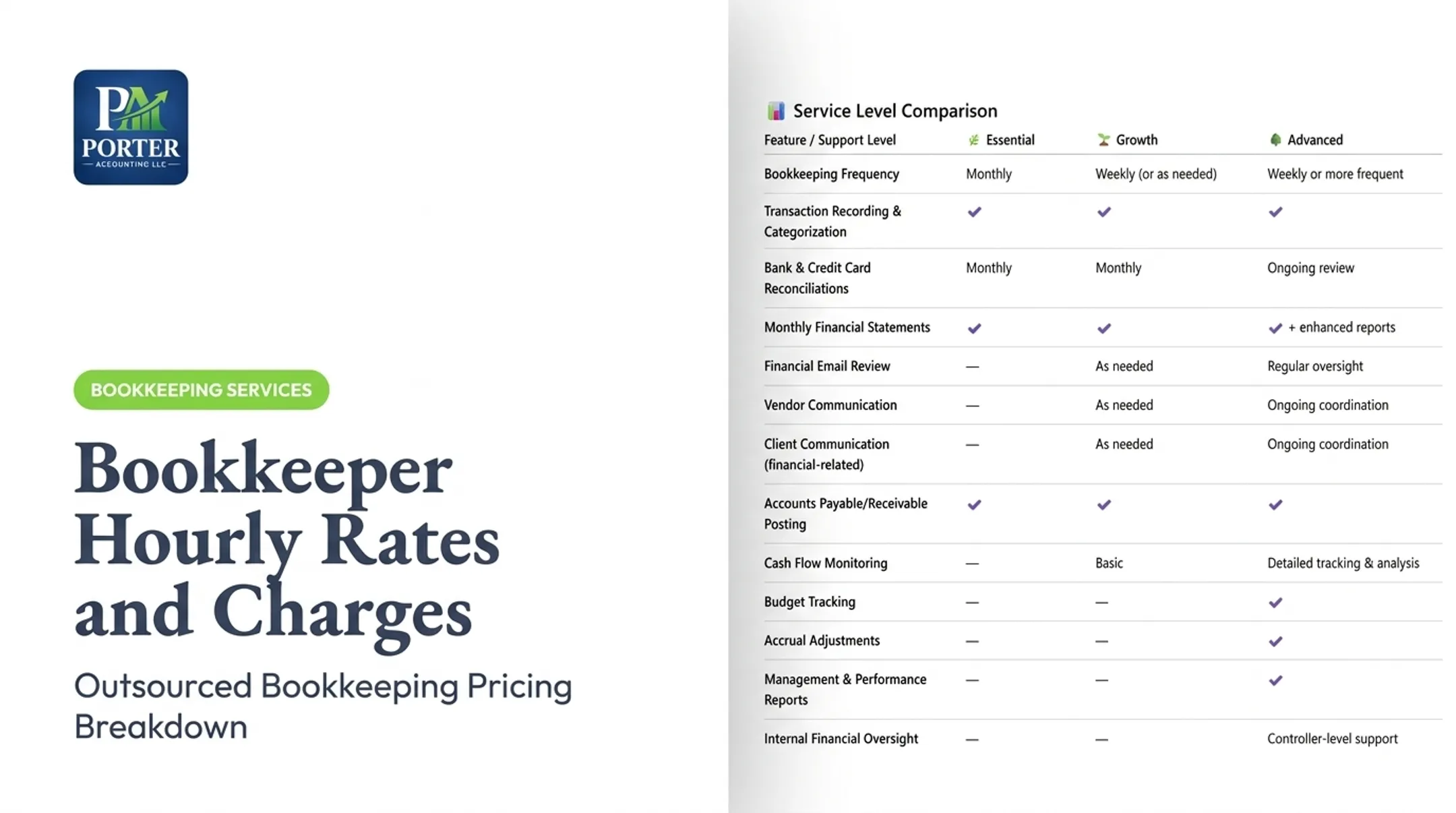
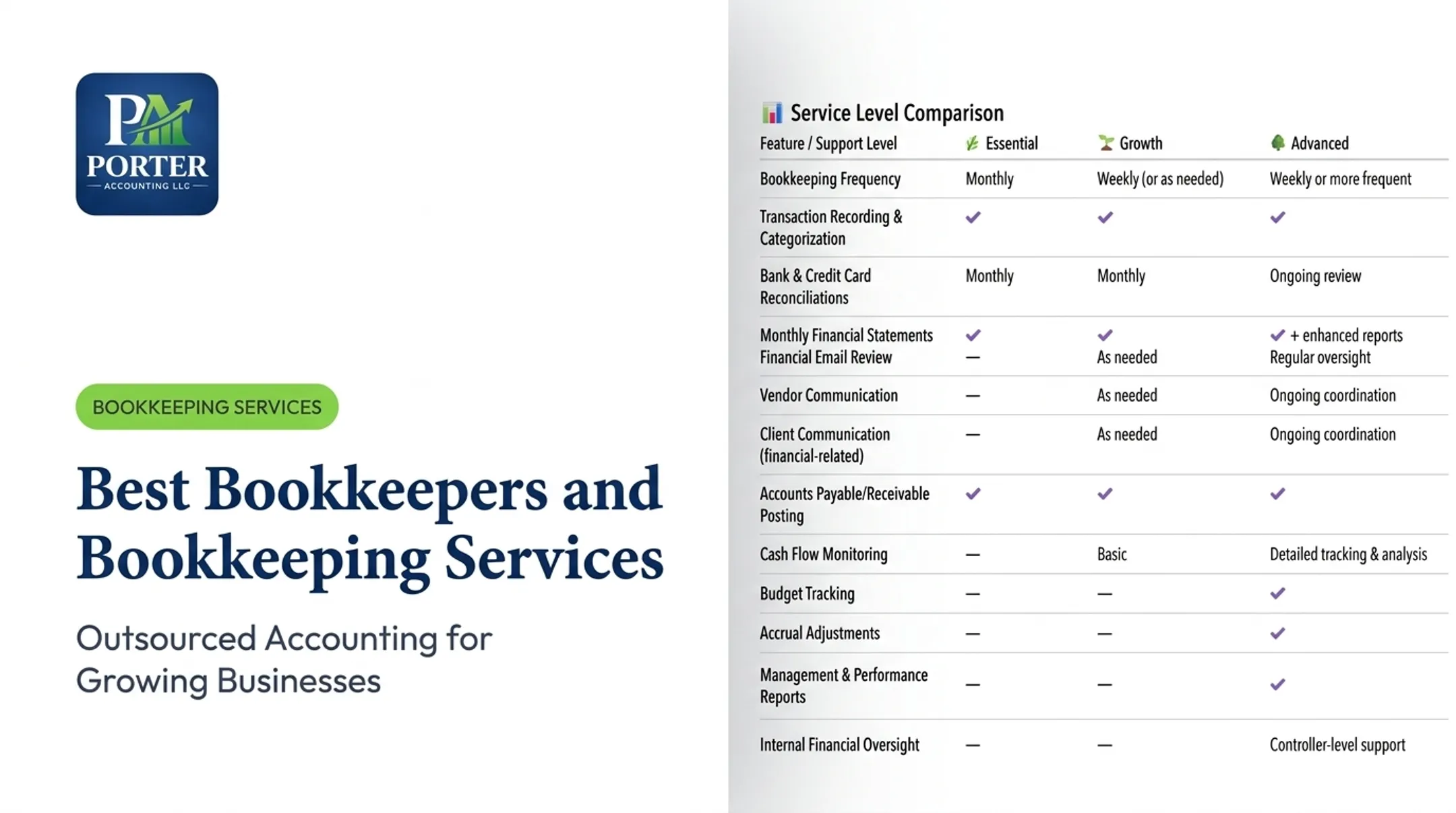
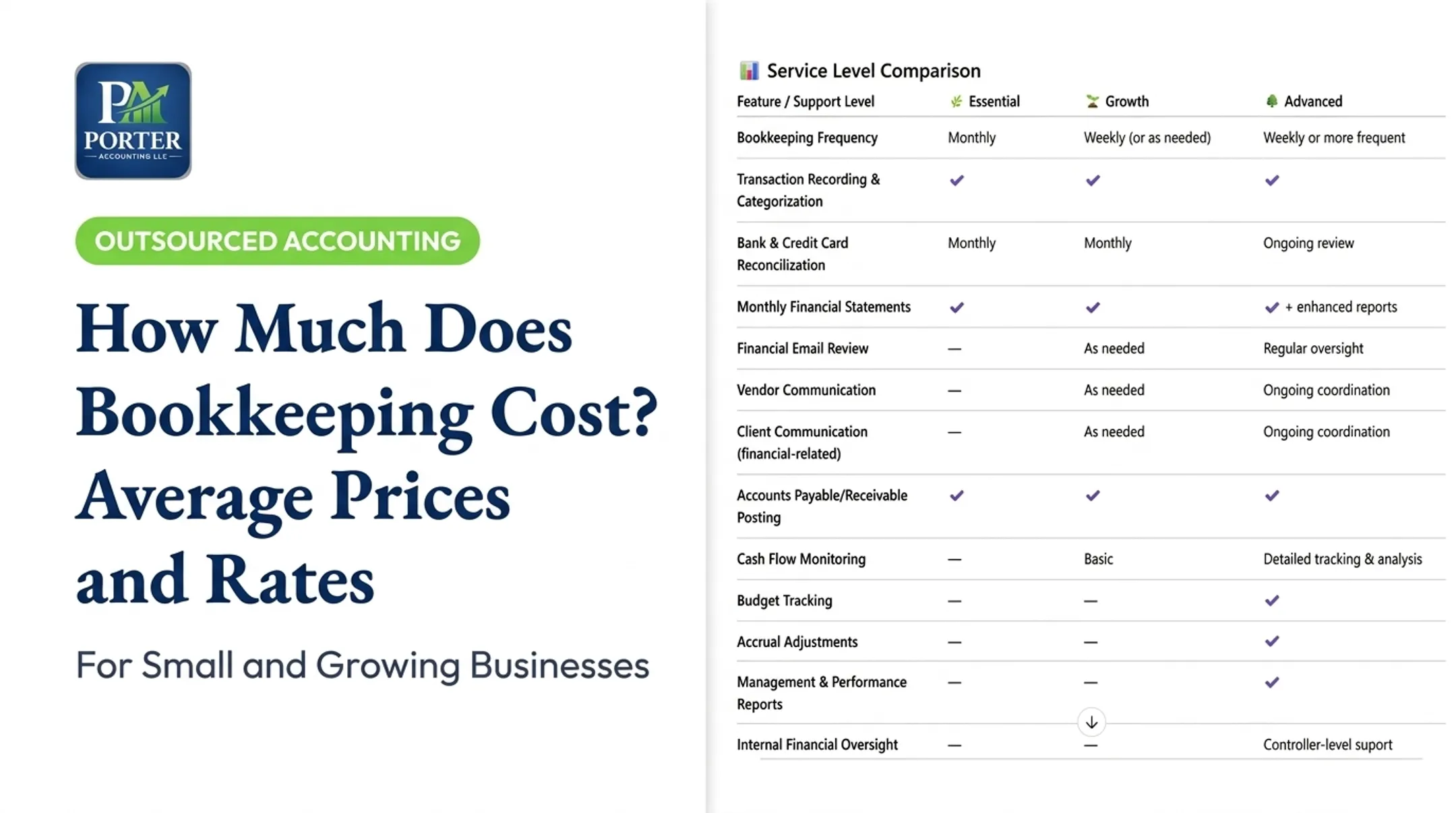
At Porter Accounting, those bands map to three monthly tiers:
- Essential from $850/month for very small businesses with simple activity
- Growth from $1,300/month when you need weekly work and more communication
- Advanced from $2,100/month for established businesses that need close oversight, accrual adjustments, and stronger internal controls
Hourly vs. monthly pricing is a trade-off. Hourly billing pays only for time used, which looks efficient until scope creep turns a 10-hour estimate into 18 billed hours because nobody defined what "cleanup" meant upfront.
Monthly fixed pricing trades some flexibility for a predictable budget. Vague scope can still trigger change orders when transaction volume outgrows the plan.

What Determines Bookkeeping Pricing?
The final fee reflects workload, technical risk, and the value of reliable numbers, not simply hours logged.
Business Size, Transaction Volume, and Account Complexity
More monthly transactions, more bank and credit-card accounts, more payment processors, more sales channels: all of it adds up. A provider needs to track loans, payroll accounts, and multiple entities or locations separately. That's why a multi-unit franchise or a fast-growing e-commerce brand often requires more bookkeeping work than a similarly sized service business with one bank account and a handful of clients.
Industry and Accounting Requirements
Certain industries carry built-in complexity:
- Inventory-based businesses need accrual accounting for purchases, sales, and ending inventory value, per IRS Publication 583.
- Construction combines job costing with the general ledger for project-level visibility.
- SaaS and subscription companies face revenue recognition complexity under ASC 606, requiring judgment calls on performance obligations.
- Franchises juggle royalty accounting, decentralized location data, and consolidated reporting.
Scope of Services and Reporting Expectations
Basic transaction entry and reconciliations cover the foundation. Cleanup, payroll, AP/AR, sales tax support, cash-flow reporting, and management dashboards expand the engagement. Before comparing quotes, define your close deadline, reporting frequency, meeting cadence, and correction policy. These details change the price more than most people expect.
Setup, Cleanup, Software, and Ongoing Maintenance
Historical cleanup, chart-of-accounts redesign, and system migration are typically one-time costs sitting outside the recurring fee. Porter Accounting prices catch-up and cleanup work at roughly 1.5× the standard monthly bookkeeping rate, reflecting the extra effort of untangling months (or years) of uncategorized transactions. Always confirm whether software licenses, payroll tools, and integrations are included or billed separately.
Experience, Location, and Level of Oversight
Rates vary geographically. Pilot's research shows state-level bookkeeper wages ranging from $18.81/hour in Michigan to $28.69/hour in California, with metro areas like San Francisco and New York typically running higher than smaller markets. Experience, certifications, and senior review add cost, too.

This is where many growing businesses hit a ceiling with basic bookkeeping. A business scaling past $5 million in revenue often needs more than someone entering transactions. It needs experienced accounting leadership who can spot process gaps, tighten cash-flow visibility, and prepare financials that hold up to lenders or investors.
How to Compare Low-Cost and Higher-Cost Bookkeeping Options
A cheap quote isn't automatically a bad deal, and an expensive one isn't automatically thorough. The difference usually comes down to what's actually included.
| Dimension | Lower-Cost Option | Higher-Cost Option |
|---|---|---|
| Scope | Data entry, basic reconciliations | Full month-end close, management reporting |
| Complexity | One simple entity | Inventory, multiple entities or locations |
| Oversight | Limited processing | Documented review, stronger controls |
| Communication | Reactive, ad hoc | Scheduled meetings, defined response times |
| Business value | Records maintained | Insight into performance and cash flow |
Quote-Review Checklist
Before signing anything, confirm:
- Included accounts and transaction limits: what happens when you exceed them?
- Reconciliation frequency: monthly, weekly, or on request?
- Cleanup, payroll, and AP/AR: bundled or billed separately?
- Reports provided: P&L, balance sheet, cash flow, or custom dashboards?
- Turnaround times and out-of-scope fees: what triggers an extra charge?
Paying more often makes sense when inaccurate books could affect tax filings, loan applications, investor reporting, or audit readiness. A $200/month savings isn't much of a bargain if it costs you a financing round or a failed audit later.
Many growing businesses land between these tiers: they need more than basic recordkeeping, but they are not ready for a full-time controller. Porter Accounting LLC serves that middle ground as a virtual partner for bookkeeping, financial reporting, cleanup, and process improvement.
How to Estimate the Right Bookkeeping Budget
Start with your actual workload, not a generic price list.
Step 1: List your workload. Note the drivers that shape scope and price:
- Entities and legal structure
- Bank and credit-card accounts
- Monthly transaction count
- Sales channels
- Payroll activity
- Inventory tracking
- Historical cleanup needed
Step 2: Decide which outcomes matter. Tax-ready records? Timely monthly close? GAAP reporting? Investor-ready statements? Each requirement shifts the price.
Step 3: Build a total-cost estimate, including:
- Recurring monthly fee
- One-time cleanup or setup cost
- Software and integration costs
- Payroll or sales-tax add-ons
- Occasional advisory or controller time
- Your own time gathering documents and approvals
Step 4: Compare proposals apples-to-apples.
- Request several quotes for the identical scope
- Calculate the effective monthly or hourly cost
- Check references and industry experience
- Ask how fees change as volume grows

What Most People Miss When It Comes to Bookkeeping Cost
Most budgeting mistakes happen before the first invoice arrives:
- Focusing only on the headline rate. A $500/month quote and an $850/month quote aren't comparable until you check deliverables, review process, and reporting depth.
- Forgetting one-time costs. Cleanup, onboarding, software setup, payroll integration, and catch-up work often sit outside the monthly fee and should be quoted separately.
- Choosing the cheapest option without weighing risk. Errors, delayed closes, and weak controls carry a real cost — sometimes the price of hiring someone else to fix the books later.
When Your Budget Should Cover More Than Bookkeeping
At some point, the question stops being "how much does a bookkeeper cost" and becomes "who reviews the books." Bookkeeping records and reconciles transactions; a controller reviews the balance sheet, books accruals and deferrals, and signs off on the close. If lenders or investors expect accrual-basis GAAP financial statements, or a customer contract calls for an audit, that review layer is what makes the numbers hold up. Many businesses add it part-time through a fractional controller rather than a full-time hire, and bring in ASC 606 or audit preparation help only when a specific deadline appears. Our year-end close and audit readiness guide shows what auditors typically ask for, which is a useful checklist when you scope a quote.
Conclusion
Bookkeeping costs vary with workload, complexity, scope, and the provider's experience — published ranges are a starting point, not a final answer. Choose the engagement that delivers accurate records, useful reporting, and the financial clarity to make confident decisions as your business grows—not simply the lowest price on paper.
If you want bookkeeping that can grow into controller-level close, GAAP reporting, and fractional CFO support without switching providers, talk with Porter Accounting LLC about which plan fits your current workload.
Frequently Asked Questions
How much do bookkeepers charge?
Outsourced bookkeeping typically runs $20–$60 per hour, with monthly plans from about $400 to over $2,000. Price depends on transaction volume, industry, and whether cleanup or payroll is included.
What does a bookkeeper charge per hour?
Freelance and outsourced bookkeepers generally charge $20–$60 per hour. By comparison, in-house bookkeepers earn a median $50,670 a year per BLS data, and specialized or advisory work often costs more.
How much does a bookkeeper cost per month?
Basic monthly plans often start around $400-$850, standard plans run $800-$1,500, and complex engagements with payroll, AP/AR, or controller oversight can exceed $2,000. Cleanup and add-on services typically cost extra.
Is it cheaper to hire a bookkeeper or outsource bookkeeping?
An in-house hire adds payroll taxes, benefits, software, and management time on top of wages, while outsourced providers bundle those costs into one fee. For most small and mid-sized businesses, outsourcing offers more predictable total cost and flexibility.
What is included in a bookkeeping service?
Core services usually include transaction recording, bank and credit-card reconciliations, and monthly financial statements. Payroll, AP/AR, inventory accounting, cleanup, and advisory support are often separate add-ons.
When should a small business hire a bookkeeper?
Hire when volume grows, errors keep recurring, reconciliations slip, or you need clean records for financing or taxes. Limited owner time and a need for clearer financial visibility are strong signals too.