
The US Bureau of Labor Statistics reports a median annual wage of $50,670 for bookkeeping, accounting, and auditing clerks as of May 2025 — a useful benchmark if you're weighing an in-house hire against an outsourced service.
The right fit depends on your size, industry complexity, software, and whether you need basic records or broader accounting and advisory support. This guide compares leading US bookkeeping options, explains how to evaluate a provider, and lists the questions to ask before you sign anything.
Key Takeaways
- Expect full-service bookkeeping to cover categorization, reconciliations, AP/AR, payroll support, monthly close, and reporting.
- Match the provider to your industry, transaction volume, software, and growth stage — not just price.
- Growing businesses often need GAAP reporting, cash-flow visibility, controller support, or fractional CFO guidance.
- Compare deliverables, not just the monthly fee, since pricing depends on volume, payroll, and cleanup needs.
- Confirm current pricing, credentials, and security practices directly with each provider before deciding.
Overview of Bookkeepers and Bookkeeping Services in the US Market
Bookkeeping is the recurring process of organizing, recording, reconciling, and reporting your business's financial transactions so the numbers stay accurate and usable. The level of service you need still changes as the business grows.
Four Levels of Financial Support
- Basic bookkeeping — transaction recording, categorization, and bank reconciliation
- Outsourced accounting — adds monthly financial statements, AP/AR management, and payroll coordination
- Controller services — oversees close processes, accrual accounting, internal controls, and reporting accuracy
- Fractional CFO support — forward-looking work: forecasting, budgeting, KPIs, and strategic guidance for investors, lenders, or growth planning
Good bookkeeping feeds the outputs your business runs on:
- Financial statements and tax readiness
- Cash-flow monitoring and payroll accuracy
- Budget tracking
- Reports lenders or investors will request
How specialized that work must be depends on your industry.
Why Industry Context Changes What You Need
A generic bookkeeper isn't always equipped for specialized reporting. For example, Sage notes that franchisors need consistent, standardized reporting to recognize revenue, reconcile royalty fees, and compare performance across every location — something a single-location bookkeeping approach won't deliver.

Other examples of industry-specific needs:
- SaaS companies need subscription revenue tracking and ASC 606 revenue recognition expertise
- E-commerce and CPG brands need inventory tracking and gross-margin visibility across sales channels
- Craft beverage producers (wineries, distilleries) need cost accounting that follows production from raw materials through aging inventory
- Manufacturers need job costing and work-in-process tracking
The providers below are organized as "best for" recommendations, not a universal ranking. Confirm each provider's current services, pricing, and geography before signing anything — offerings change.
Top Bookkeepers and Bookkeeping Services in the US
We evaluated providers on service scope, industry fit, reporting quality, technology integrations, transparency, security, and their ability to grow with a client. Each profile below uses a consistent "Best for" structure so you can compare directly.
| Provider | Best For | Starting Price |
|---|---|---|
| Porter Accounting LLC | Growing businesses needing bookkeeping plus advisory | $850/month |
| Pilot | Startups and venture-backed companies | $0–$99/month (Essentials) |
| Bookkeeper360 | E-commerce, SaaS, and service businesses | $399/month |
| inDinero | Complex or scaling businesses needing full-stack support | $750/month |
| Supporting Strategies | Law firms, healthcare, and nonprofits | Custom quote |
Porter Accounting LLC — Best for Growing Businesses That Need Bookkeeping Plus Financial Guidance
Porter Accounting LLC is a virtual accounting and financial advisory partner serving growing businesses across the United States, with in-person appointment support available around Santa Rosa, San Francisco, San Jose, Windsor, and Palm Coast.
The firm is built for owners who've outgrown basic bookkeeping but don't want the overhead of a large accounting firm.
Thao Porter, MSA, leads the practice with more than a decade of accounting experience across SaaS, manufacturing, construction, CPG, retail, and franchise businesses. Her work covers GAAP reporting, ASC 606 revenue recognition, ERP implementations, and audit readiness.
Service tiers include:
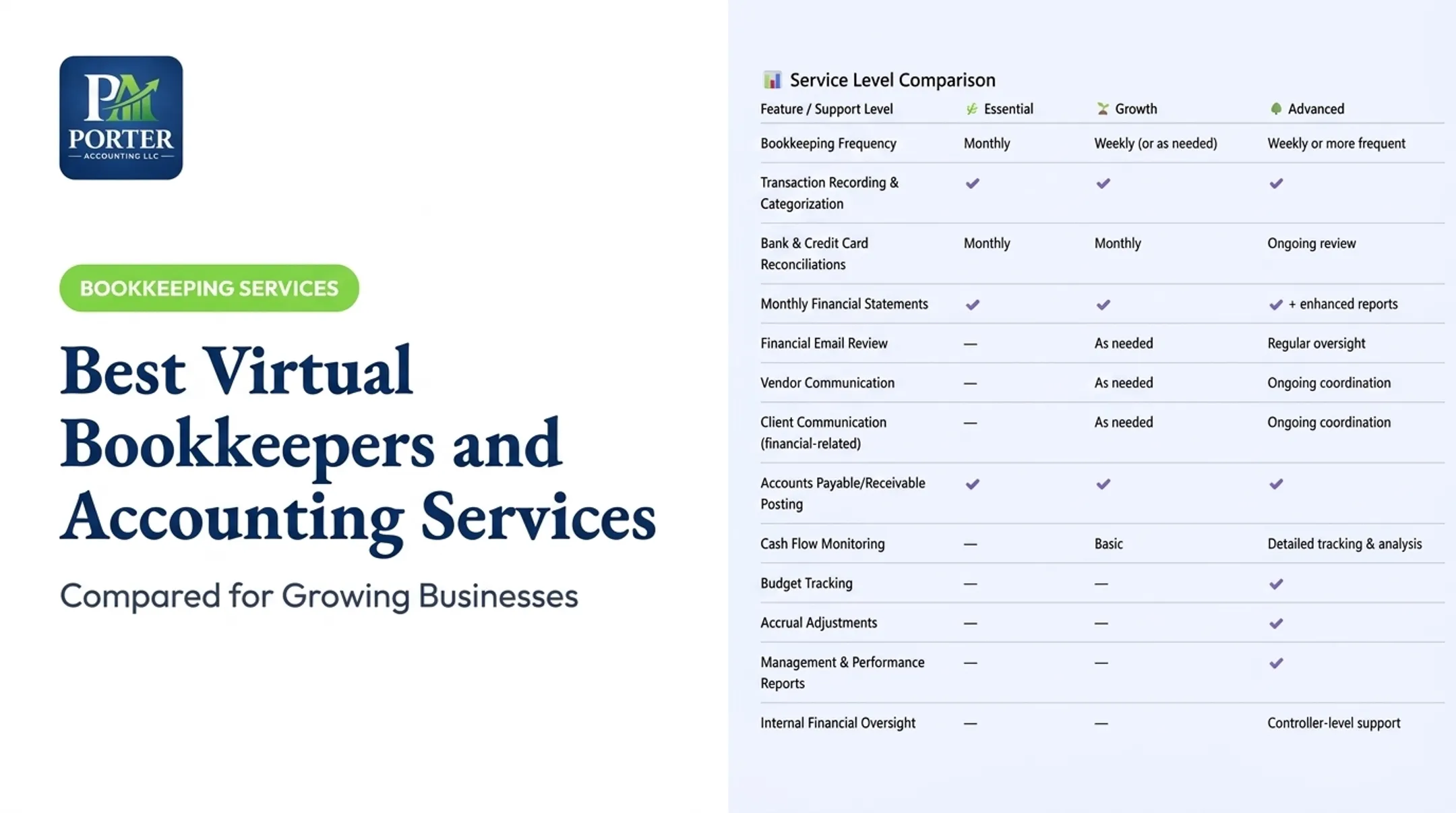
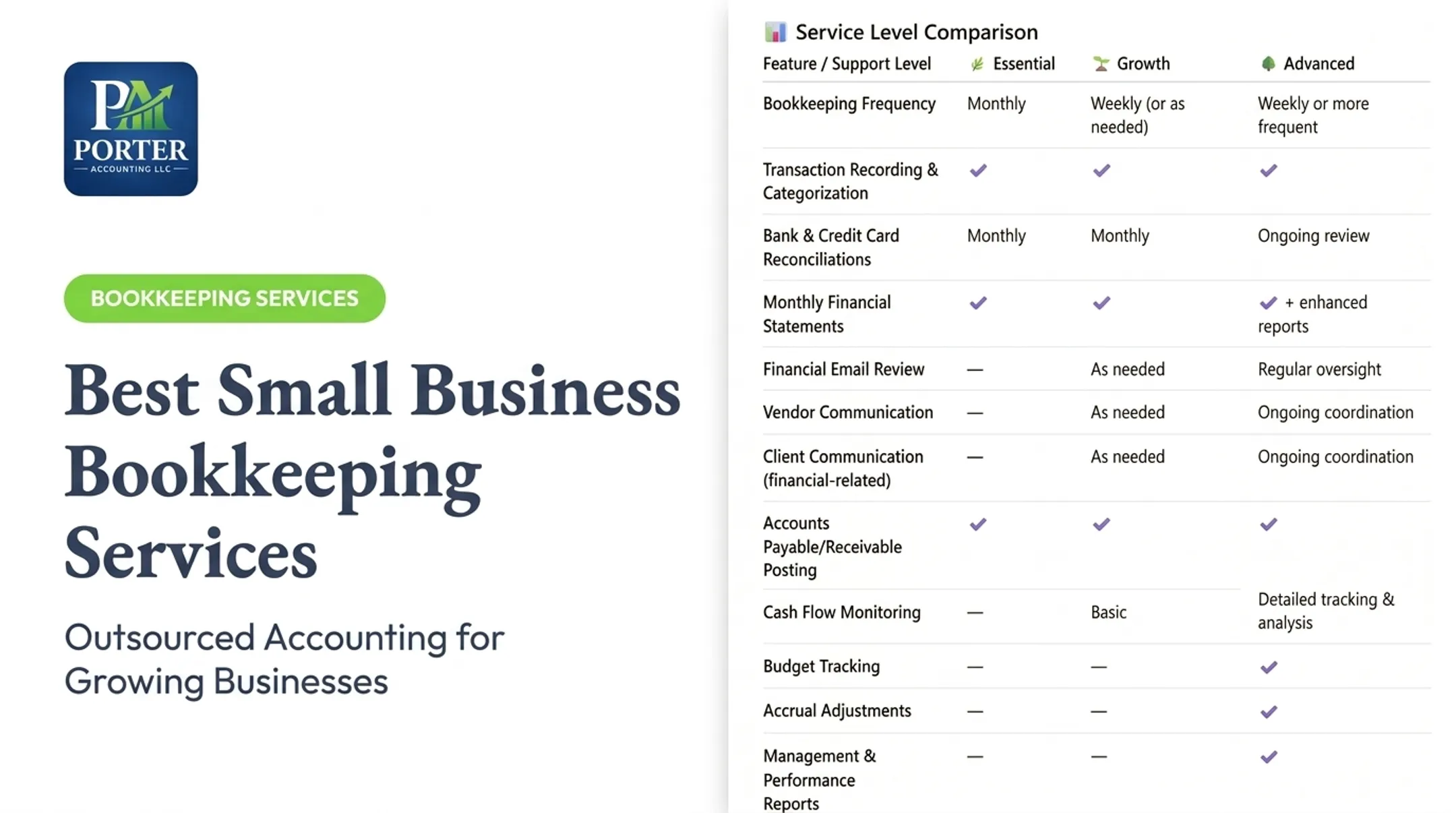
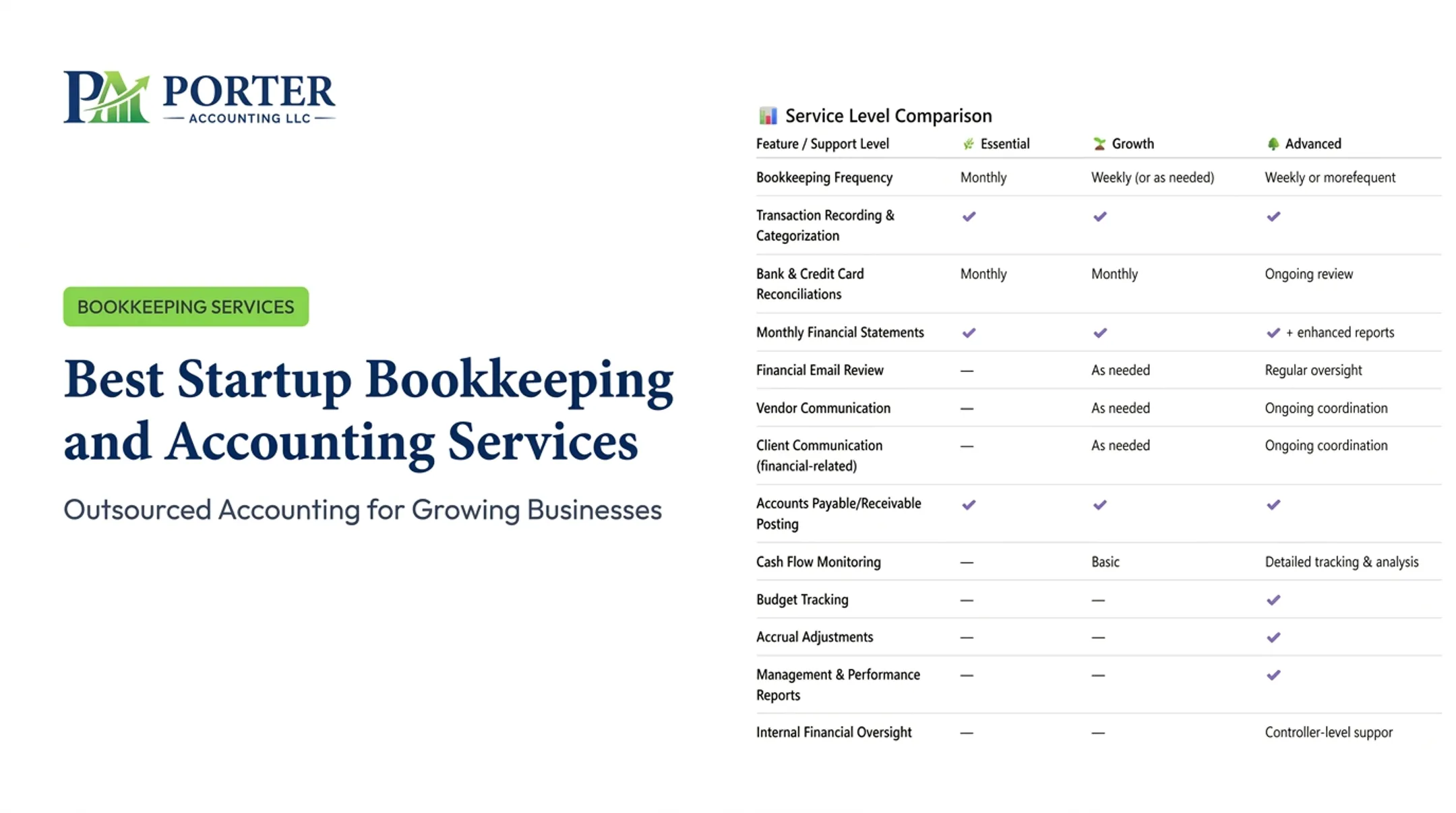
- Essential: $850/month, for very small businesses with simple transaction activity
- Growth: $1,300/month, adds weekly work, financial-email review, and vendor communication
- Advanced: $2,100/month, adds accrual adjustments, budget tracking, cash-flow monitoring, and controller-level oversight
Controller services start at $100/hour and fractional CFO services at $150/hour. Catch-up and clean-up bookkeeping is typically priced at 1.5x the regular monthly rate. ERP setup covers QuickBooks, Xero, NetSuite, and Acumatica.
Final pricing depends on transaction volume, account count, payroll complexity, and cleanup scope. Confirm your specific quote through a consultation before assuming any published rate applies to your business.
Where Porter differs from bookkeeping-only providers is what sits above the monthly books. The same team can prepare GAAP financial statements for a lender or investor, apply ASC 606 to subscription or contract revenue, and get your records audit-ready while working alongside your external auditor. That makes it a fit for businesses that expect to need controller or CFO-level work within the next year or two and would rather not switch providers when they do.

Pilot — Best for Startups and Venture-Backed Companies
Pilot is built around startups that need clean books plus a path to CFO-level support as they raise capital or scale. Its Essentials plan runs $99/month for cash-basis books, a standard chart of accounts, and a year-end tax package, capped at $100,000 in monthly expenses.
The Core plan starts at $0/month billed annually and includes a US-based bookkeeper, data pulled from banks, cards, payroll, and payment platforms, and monthly close with reports delivered by the 10th business day.
CFO plans start at $1,750/month and scale to $5,250/month for board reporting, projections, and capital-raise support. Pilot holds a 4.9/5 rating on Capterra from 29 reviews.
Bookkeeper360 — Best for E-commerce, SaaS, and Service Businesses
Bookkeeper360 assigns a dedicated US-based accountant and supports e-commerce, SaaS, professional services, healthcare, real estate, and nonprofit clients.
Accrual accounting tracks deferred revenue, accrued expenses, and inventory, with named integrations for Gusto, Expensify, and Bill.com, plus migration support to Xero or QuickBooks Online.
Pricing starts at $399/month for standard bookkeeping, $599/month for weekly service, and $2,000/month for fractional CFO work. Onboarding typically takes one to two weeks. Its Trustpilot score sits at 2.5/5 from a small sample of six reviews. That limited data makes a direct conversation worthwhile before you commit.
inDinero — Best for Complex or Scaling Businesses Needing Bookkeeping Plus Controller and CFO Support
inDinero, based in San Francisco, packages bookkeeping, controller, and CFO services into three tiers. Essential starts at $750/month, Growth at $1,250/month, and Executive is custom-quoted. Every tier includes dedicated accountants, monthly reconciliations, revenue recognition, AR/AP, payroll support, and QuickBooks Online or NetSuite compatibility.
The Growth tier adds accrual accounting managed by controllers, while CFO features across plans include board reporting, financial models, KPIs, and support for capital raises. inDinero holds a 4.9/5 rating on Clutch from 17 reviews, though its G2 score of 3.9/5 from 33 reviews suggests mixed experiences worth researching further.
Supporting Strategies — Best for Law Firms, Healthcare Practices, and Nonprofits
Supporting Strategies structures its offering around six service areas: Essentials, Insights, Compliance, Revenue, Expenses, and People. This covers bookkeeping accuracy, AP workflow, AR and collections, payroll administration, and controller-level oversight, with reporting options including weekly cash flash reports and monthly review calls.
The firm publishes official industry pages for law firms, healthcare practices, and nonprofits, and states clearly that it is not a CPA firm. Packages are customized at a predictable monthly cost, though exact pricing and software integrations aren't publicly listed, so ask directly. Its Clutch rating is 5.0/5, but from only two reviews, so treat that as a starting point rather than proof of broad reliability.
Remember: "best" means best aligned with your business's needs, timeline, and budget, not necessarily the provider with the lowest headline price or the loudest marketing.
How We Chose the Best Bookkeepers and Bookkeeping Services
We confirmed each provider's current US availability, reviewed official service pages, and compared deliverables against independent customer evidence.

Service Scope and Industry Fit
We checked whether each provider covers the core work growing businesses need:
- Transaction processing and reconciliations
- Payables, receivables, and payroll coordination
- Financial statements, cleanup, and inventory tracking
- Controller or CFO-level support when required
We also assessed whether they understand your revenue model. A SaaS company needs ASC 606 fluency; a CPG brand needs inventory and margin tracking. Claims of specialized expertise had to be backed by documented experience, not marketing copy alone.
Reporting, Communication, and Security
We looked at reconciliation frequency, month-end close timing, and how each provider communicates. Ask any provider you're considering:
- When do you deliver monthly reports, and what's included in them?
- Who reviews the final numbers before they reach you?
- How is financial data protected, and who has system access?
- What happens if an error is found after books are closed?
- Can you scale with us as we add entities, employees, or locations?
Pricing and Contract Transparency
Fixed-fee, tiered, hourly, and custom-quote models all show up across this list. We compared price to deliverables rather than ranking by headline cost, and flagged onboarding, cleanup, and cancellation terms where they were disclosed.
Common Selection Mistakes
- Choosing a provider without relevant industry experience
- Never defining what "monthly deliverables" actually includes
- Underestimating cleanup work before the engagement starts
- Assuming any bookkeeper automatically provides tax filing or CFO-level strategy
- Skipping questions about data security and access controls
- Not confirming who signs off on the final numbers each month
Conclusion
The best bookkeeper for your business is the one whose expertise, service scope, reporting process, and pricing model match where you are today and where you're headed next.
Before you sign anything, request a detailed proposal that covers:
- Deliverables and deadlines
- Software access
- Cleanup responsibilities
- How the provider handles escalations
Porter Accounting LLC is a relevant option for growing US businesses that need organized books plus financial cleanup, GAAP reporting, ASC 606 revenue recognition, audit readiness, cash-flow clarity, process improvement, controller support, or fractional CFO guidance. If that sounds like where your business is right now, a short conversation can confirm whether the fit makes sense. It will not be the right choice for every business, and that is fine.
Frequently Asked Questions
How much should you pay someone to do your bookkeeping?
Cost depends on transaction volume, payroll, inventory, number of entities, cleanup needs, and reporting frequency. Compare defined deliverables across providers and get a current quote rather than relying on a flat, universal number.
How much does an accounting review cost?
An "accounting review" can mean anything from a quick records check to a full financial-statement review or advisory engagement. Cost varies by scope and how clean your existing records are. That scope is different from routine monthly bookkeeping.
What are accounting and bookkeeping services?
Bookkeeping means maintaining organized transaction records and reconciliations. Accounting services build on that with financial reporting, tax support, budgeting, cash-flow analysis, and strategic advisory work.
When does a business need more than a bookkeeper?
Usually when outside parties start relying on the numbers. A lender asking for GAAP statements, an upcoming audit, investor reporting, or revenue contracts that fall under ASC 606 all call for controller or technical accounting review on top of bookkeeping.
Is it worth getting a bookkeeper?
If you're spending hours each month chasing receipts or you can't answer basic cash-flow questions, yes. A good bookkeeper saves owner time, improves accuracy, and creates reports you can actually use for decisions.
Is a bookkeeper cheaper than an accountant?
Bookkeepers handle recurring recordkeeping, while accountants provide reporting, tax, and advisory work at a higher rate. Many outsourced firms now combine both under tiered pricing, so the line has blurred.
What are the four types of bookkeeping?
The four types pair recording method with recognition timing: single-entry or double-entry, and cash-basis or accrual. Double-entry matches debits and credits for accuracy checks; cash records when money moves, accrual when earned or incurred (IRS Publication 583).