](https://file-host.link/website/porteraccountingandadvisory-uiw1h1/assets/blog-images/82869d52-22f7-4e35-9d14-58e0e1ada6ea/1790031633175449_146585d75f1b4a948111a2b688afe3f8/2x_360.webp)
Founders face problems most small businesses never touch. You're tracking burn rate and runway while managing payroll, equity grants, and revenue recognition, often without a finance team in place. One month you're pre-revenue; six months later you're closing a Series A and fielding investor reporting requests.
This guide compares leading U.S. startup bookkeeping and accounting services and breaks down how to choose between bookkeeping-only support, full-service accounting, a controller, tax help, or a fractional CFO.
Key Takeaways
- Startup accounting delivers reconciliations, cash-flow forecasts, technical accounting, tax coordination, and investor-ready reporting.
- Choose a provider based on stage, funding model, industry, and transaction complexity.
- Compare expertise, software integrations, reporting cadence, and pricing before you sign.
- Porter Accounting LLC fits growing U.S. businesses that need virtual accounting, cleanup, and advisory beyond basic bookkeeping.
Overview of Startup Bookkeeping and Accounting Services in the U.S. Market
Bookkeeping is the recording, categorizing, and reconciliation of financial activity. Accounting goes further: it interprets those records to support reporting, compliance, forecasting, and decision-making.
Startups often need specialized help with:
- Cash versus accrual accounting methods
- Equity and cap-table activity
- Recurring or deferred revenue (common in SaaS)
- Payroll, R&D spending, and inventory
- Multi-entity operations and investor due diligence
Those needs still sit on a basic compliance floor. The IRS requires books that clearly show gross income, deductions, and credits, and it accepts electronic recordkeeping systems as long as they follow standard recordkeeping principles. That baseline sounds simple. It gets complicated fast once you add subscription billing or stock compensation into the mix.
Main Service Models
Founders generally choose from:
- DIY accounting software — works for pre-revenue companies with minimal activity
- Outsourced bookkeeping — recurring transaction coding and reconciliation
- Full-service accounting firms — bookkeeping plus reporting, technical accounting, and advisory
- CPA and tax firms — compliance-focused, often limited advisory depth
- Fractional controllers — oversight of close quality and internal controls
- Fractional CFOs — forward-looking strategy, forecasting, and fundraising support

Evaluate the providers below by service scope and startup fit, not by name recognition alone. A well-known brand isn't automatically the right match for your transaction volume or industry.
Top Startup Bookkeeping and Accounting Services
Each provider below is assessed on:
- Startup and industry experience
- Service depth and technical accounting capability
- Software compatibility and reporting quality
- Scalability
- Transparency about what each plan includes
Porter Accounting LLC
Porter Accounting LLC is a virtual accounting and financial advisory partner for growing businesses across the United States. Services cover bookkeeping, GAAP-compliant reporting, cleanup, process improvement, controller work, and fractional CFO support.
Thao Porter, MSA, leads the firm with over a decade of experience across SaaS, manufacturing, construction, consumer packaged goods, retail, and franchise businesses. Her background includes GAAP reporting, ASC 606 revenue recognition, ERP implementations, and audit readiness.
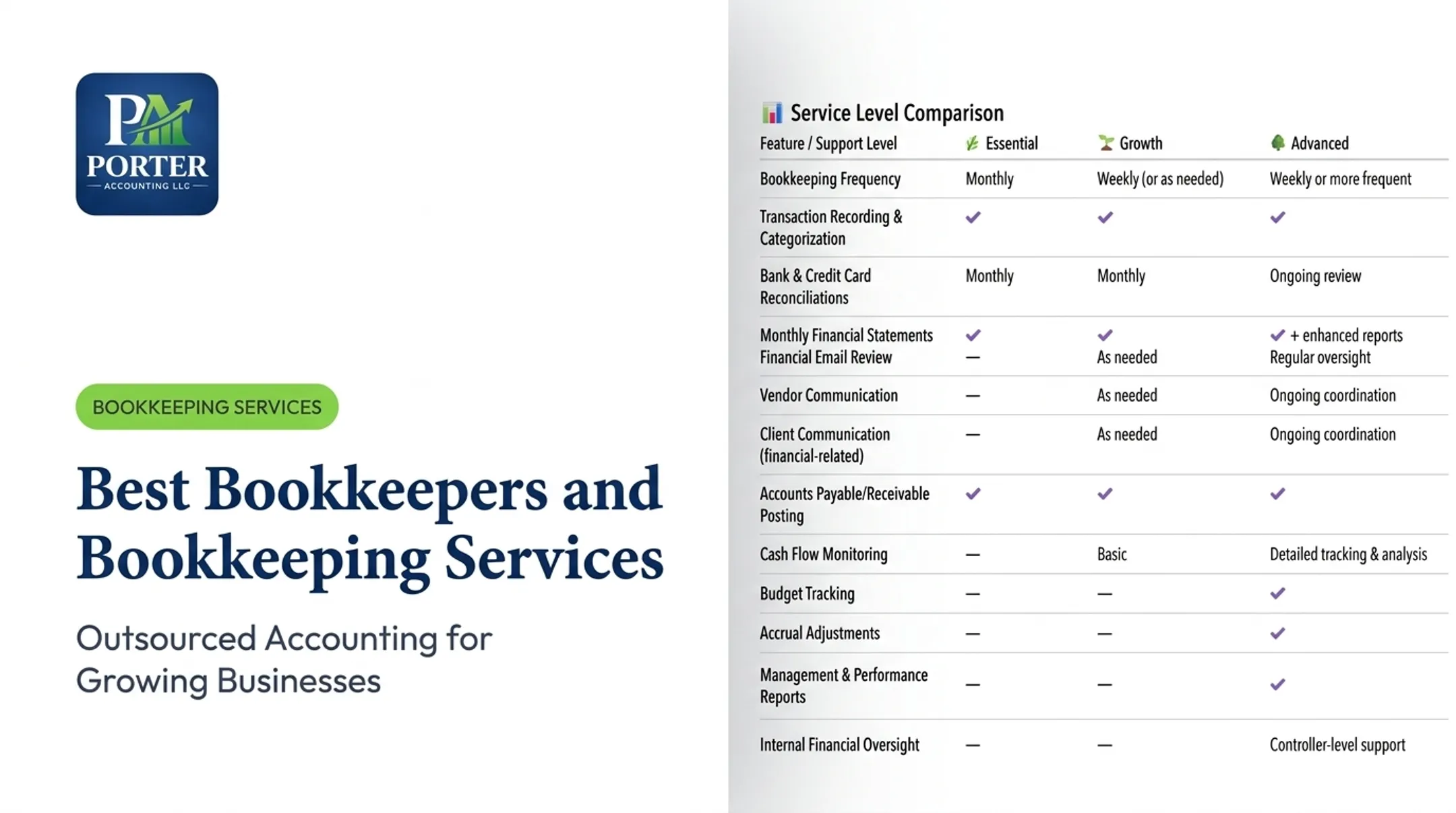
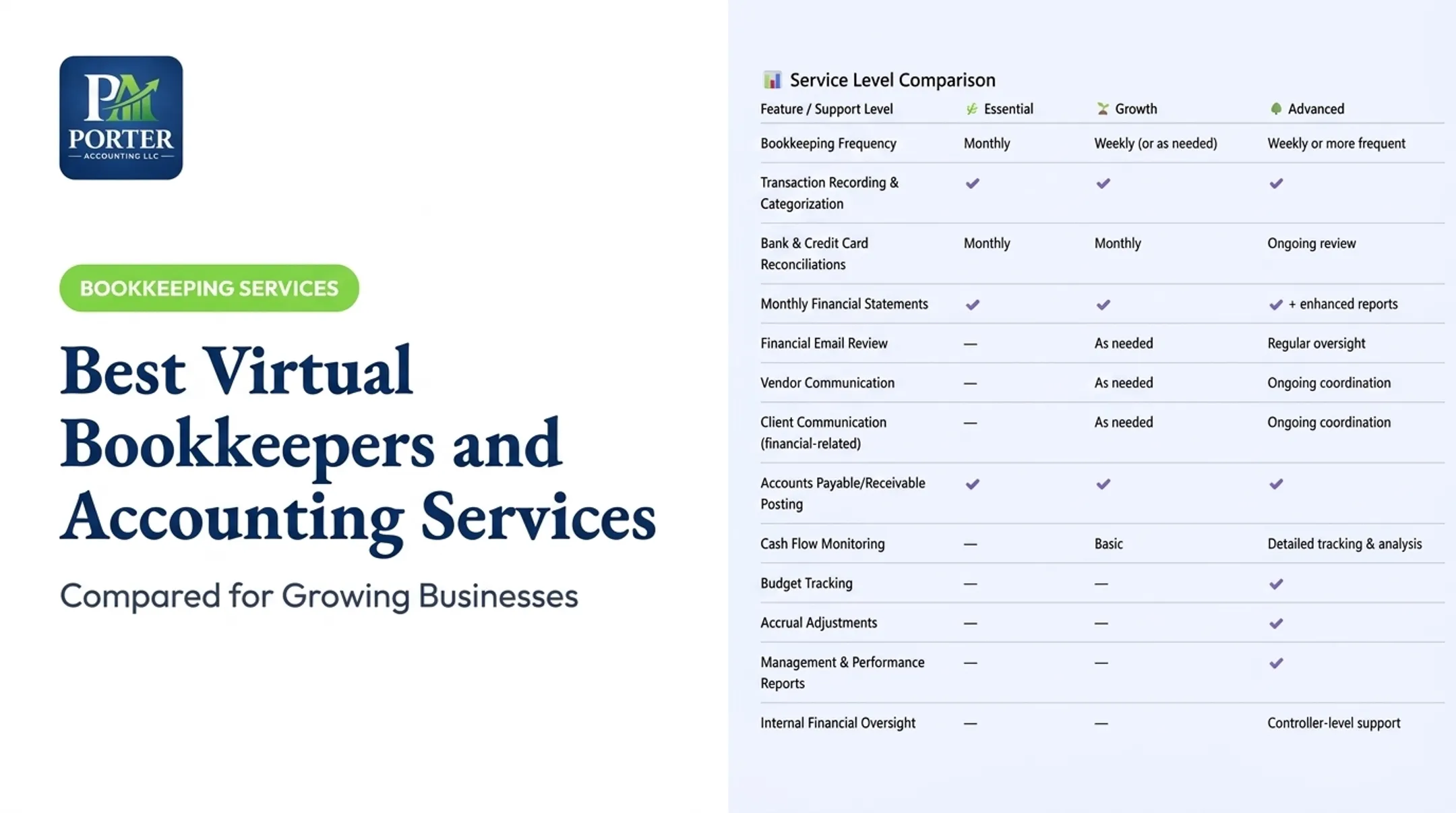
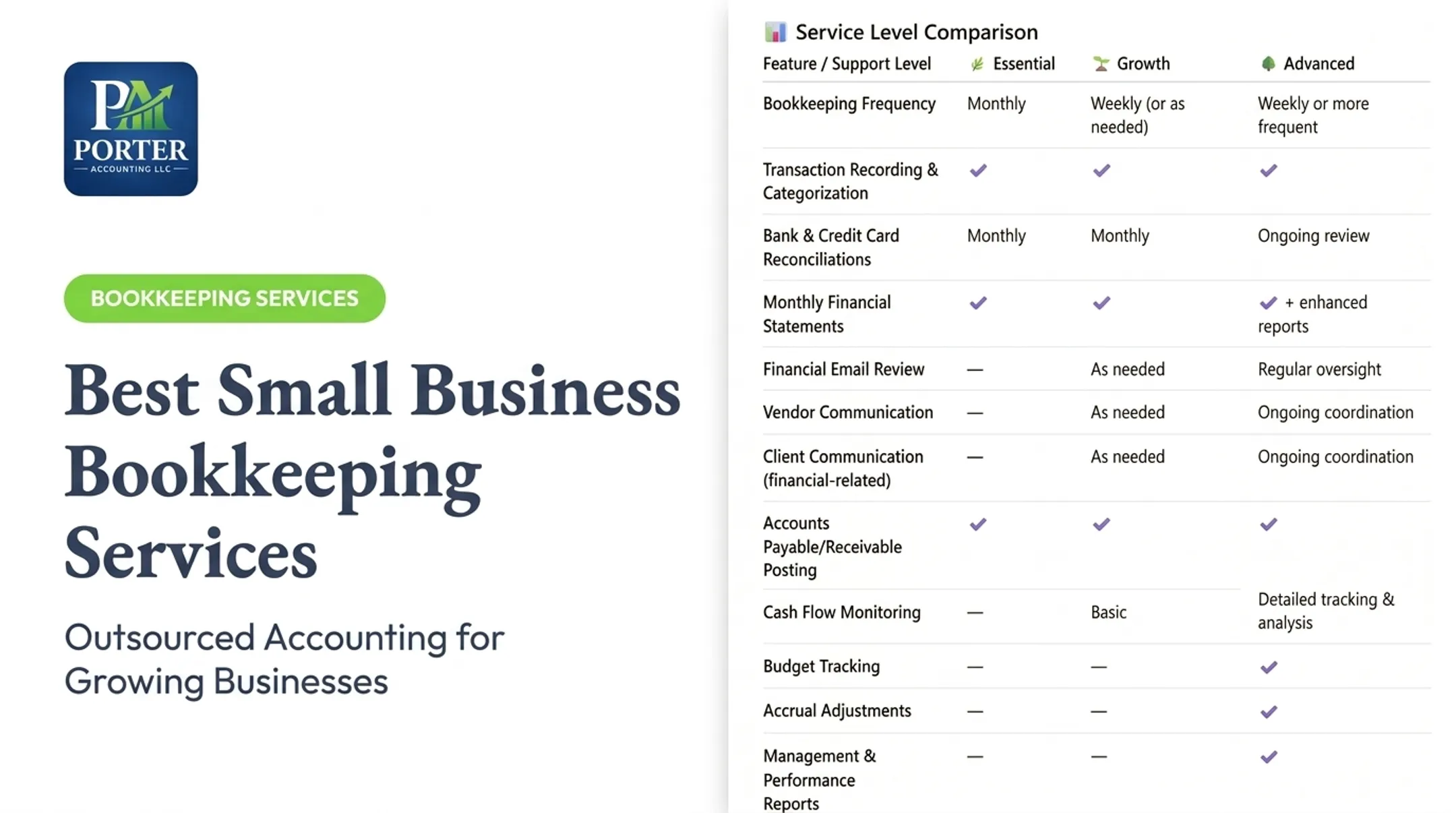
Three monthly plans:
- Essential ($850/month): transaction recording, bank and credit-card reconciliations, monthly financial statements
- Growth ($1,300/month): adds weekly service, financial-email review, and vendor communication
- Advanced ($2,100/month): adds accrual adjustments, cash-flow monitoring, financial analysis, and controller-level oversight
Controller work starts at $100/hour; fractional CFO support starts at $150/hour. Catch-up bookkeeping runs 1.5x the regular monthly rate.
| Criterion | Detail |
|---|---|
| Best fit | Startups needing bookkeeping plus reporting, cash-flow insight, or higher-level accounting guidance |
| Capabilities | GAAP reporting, ASC 606, ERP setup (QuickBooks, Xero, NetSuite, Acumatica), audit readiness, cleanup |
| Ask about | Software compatibility, reporting cadence, close responsibilities, tax-provider coordination |
Pilot
Pilot serves startups and small businesses scaling from a handful of employees to established teams. Its Bookkeeping Essentials plan starts at $99/month for companies with up to $100,000 in monthly expenses, using cash-basis data and AI-assisted categorization [15].
Tax plans start at $750/year for pre-revenue businesses; CFO plans start at $1,750/month. A $750 one-time Fin Ops setup package covers incorporation, banking, and payroll system configuration.
Pilot states it does not provide services requiring a public-accountancy license, so confirm what's covered before assuming full CPA support.
| Criterion | Detail |
|---|---|
| Best fit | Venture-backed startups wanting a broad outsourced finance ladder |
| Capabilities | Bookkeeping, tax, controller/back-office, CFO, R&D credits, fundraising support |
| Ask about | Current pricing tier, platform requirements, what stays with your internal team |
Bench
Bench targets small and micro businesses that want a dedicated bookkeeper without much complexity. Plans start at $199/month for the Light tier (businesses under $250,000 in annual revenue), with standard Bookkeeping at $399/month and Bookkeeping + Tax at $649/month.
Bench emphasizes catch-up work and quotes historical cleanup as a flat fee upfront rather than hourly billing. Most clients get modified cash-basis bookkeeping. Accrual adjustments are available but not automatic, so ask before assuming your books will be investor-ready.
| Criterion | Detail |
|---|---|
| Best fit | Early-stage businesses with relatively straightforward transaction activity |
| Capabilities | Monthly statements, catch-up bookkeeping, tax filing (upgrade tier), bank/payroll integrations |
| Ask about | Whether accrual accounting, equity, or revenue recognition require an upgrade |
Kruze Consulting
Kruze positions itself around VC-funded, high-growth startups. Bookkeeping is framed as the foundation for audit-ready, investor-facing records, with monthly fees typically running $650 to $1,500, depending on volume and complexity [4].
Beyond bookkeeping, Kruze offers tax, payroll, 409A valuations, R&D tax credits, fractional CFO work, and FP&A. If your books are simple and you're pre-revenue, that specialization may be more than you need right now.
| Criterion | Detail |
|---|---|
| Best fit | VC-backed Delaware C-Corps from pre-seed through later stages |
| Capabilities | GAAP reporting, R&D credits, revenue recognition, equity accounting, audit prep |
| Ask about | Minimum engagement size, communication cadence, data ownership |
Fondo
Fondo is built for Delaware C-Corp startups and offers monthly, quarterly, or annual bookkeeping depending on stage. Services include transaction categorization, reconciliation, and burn/runway reporting from in-house accountants.
Its TaxPass product is advertised as low as $1,450/year, covering federal filing, one state, Delaware franchise tax, and one foreign-shareholder filing. Add-ons for extra states or R&D credit studies start around $500. Bookkeeping pricing wasn't publicly listed at review time, so get a direct quote.
| Criterion | Detail |
|---|---|
| Best fit | Early-stage Delaware C-Corps wanting a structured, stage-matched bookkeeping cadence |
| Capabilities | Bookkeeping, corporate tax, R&D credit studies, burn/runway dashboards |
| Ask about | Platform restrictions, add-on fees, upgrade paths as transaction volume grows |

How We Chose the Best Startup Bookkeeping and Accounting Services
Advertised monthly prices don't tell the whole story. We compared providers on outcomes founders actually need, using these criteria.
Startup and industry expertise. Does the provider have real experience with your business model, funding stage, and revenue structure? A firm that's never touched SaaS subscription billing won't handle ASC 606 well.
Accounting quality and controls. This includes chart-of-accounts design, reconciliation coverage, accrual adjustments, and month-end close discipline. Sloppy reconciliations create bigger problems later.
Scalability and technology fit. Check integrations with:
- Banks and payment processors
- Payroll platforms
- Billing and invoicing systems
- Cap-table and equity tools
- ERP systems as you scale
Advisory depth and communication. Can the provider explain the numbers, not just deliver them? Investor due diligence often requires annual, quarterly, or even monthly financial statements.
The NVCA's model term sheet lists satisfactory financial due diligence as a standard closing condition for major investors.
Total cost and contract clarity. Confirm pricing, onboarding fees, cleanup costs, minimum commitments, and cancellation terms before signing. Ask what work still falls on you or your team.

Revenue recognition deserves specific attention if you run a subscription business. Under FASB's ASC 606 standard, revenue must be recognized to reflect the transfer of goods or services, not just when cash lands in the bank.
A provider unfamiliar with this standard can misstate your books in ways that surface during fundraising diligence.
When a Startup Needs More Than Bookkeeping
For most startups, the shift happens around a financing event. Before a priced round, cash-basis books and a burn report may be enough. During diligence, investors want accrual-basis GAAP statements, deferred revenue that follows ASC 606, and a close that produces the same numbers every month. After the round, board reporting and, for some companies, an annual audit become regular obligations. That is the point to add a fractional controller to own the close and a technical accounting review of revenue recognition; our SaaS accounting and ASC 606 guide walks through what that review covers. If an audit is coming, audit readiness and preparation work, such as reconciliations, schedules, and auditor request lists, should start well before fieldwork.
Conclusion
The best startup bookkeeping and accounting service is the one that produces dependable records and useful financial insight now, and can scale with you as the business grows.
Build a written checklist before you commit to anyone:
- Service scope and technical expertise for your industry
- Software integrations with your current stack
- Reporting deadlines and monthly cadence
- Data security and record ownership terms
- Communication style and response expectations
- Future finance needs as you add complexity
If you're a growing U.S. business that needs more than basic bookkeeping, Porter Accounting LLC offers bookkeeping, financial cleanup, controller-level close, GAAP reporting, ASC 606 revenue recognition, audit readiness, and fractional CFO support. The work centers on practical, direct guidance—reach out if you're outgrowing spreadsheets, your current bookkeeper, or preparing for investor diligence.
Frequently Asked Questions
Can an accountant help you start a business?
Yes. An accountant can help set up your accounting system, chart of accounts, tax planning approach, and early financial reporting. Legal entity formation itself typically requires an attorney, not an accountant.
What kind of accountant do I need for my small business?
Match the role to your stage and complexity. A bookkeeper owns day-to-day records; a CPA handles tax. Reporting and compliance often need a startup-focused accountant, while a controller or fractional CFO adds oversight and strategy as volume and funding grow.
What is startup accounting?
Startup accounting records, organizes, reports, and interprets a new company’s financial activity. It covers cash flow, burn rate, runway, taxes, equity, and growth planning.
What is the best accounting system for startups?
Choose based on business model, funding stage, transaction volume, and integrations. Judge the software and the professional who configures and reviews it—setup quality matters as much as the tool.
What is a tech accountant?
A tech accountant is familiar with technology-company issues like SaaS metrics, subscription revenue, ASC 606, equity compensation, and investor reporting. Treat it as a capability to verify, not just a title.