
Each role comes with a different price tag. In fact, 80% of U.S. accounting firms planned to raise fees in 2026, according to Ignition's survey of 219 U.S. accounting firms, with most planning increases of 5-10%. That means last year's quote won't necessarily hold this year.
Cost hinges on service scope, transaction volume, business complexity, and billing model — not just your revenue. This guide breaks down hourly, monthly, and project-based pricing so you can build a realistic budget.
Key Takeaways
- Monthly bookkeeping typically runs $200–$700+; controller oversight often exceeds $2,500/month.
- Hourly rates run $43 for bookkeeping, $150–$400 for CPA work, and $175–$450 for fractional CFO guidance.
- Simple tax returns start around $300; S-corp and partnership filings often exceed $1,200.
- Clean records and a narrow scope lower costs; multi-entity, inventory, and audit-ready books cost more.
- The right fee reflects deliverables and reliability, not the lowest advertised price.
How Much Does an Accountant Cost in 2026? (Pricing Overview)
There's no single "standard" price for an accountant. Published averages are planning benchmarks for budgeting, not a guaranteed quote for your business.
The Three Main Pricing Models
Hourly billing applies to consultations, cleanup work, technical accounting questions, or anything with an uncertain scope. Current U.S. ranges:
- Bookkeepers: around $43/hour on marketplace platforms, though experienced professionals charge $80+ (NerdWallet, 2026)
- Accountants and CPAs: $150-$400/hour, depending on complexity (SDO CPA, 2026)
- Fractional CFOs: $175-$450/hour

Monthly flat fees cover recurring bookkeeping, reconciliations, financial statements, and ongoing advisory. Scope and transaction volume, not revenue, drive the quote. A business processing 1,000 transactions a month will pay more than one processing 100, regardless of either company's earnings.
Annual or project-based fees cover tax returns, system setup, catch-up work, and defined reporting projects.
Pricing by Service Level
| Service Tier | Typical Range | Best For |
|---|---|---|
| Basic bookkeeping | $250-$700/month | Simple books, limited reconciliations |
| Small-business support | $850-$1,300/month | Monthly close, payroll, reporting |
| Advanced/controller support | $2,100+/month | Complex reporting, audit readiness |
| Fractional CFO | $1,400-$12,000/month | Forecasting, fundraising, strategy |
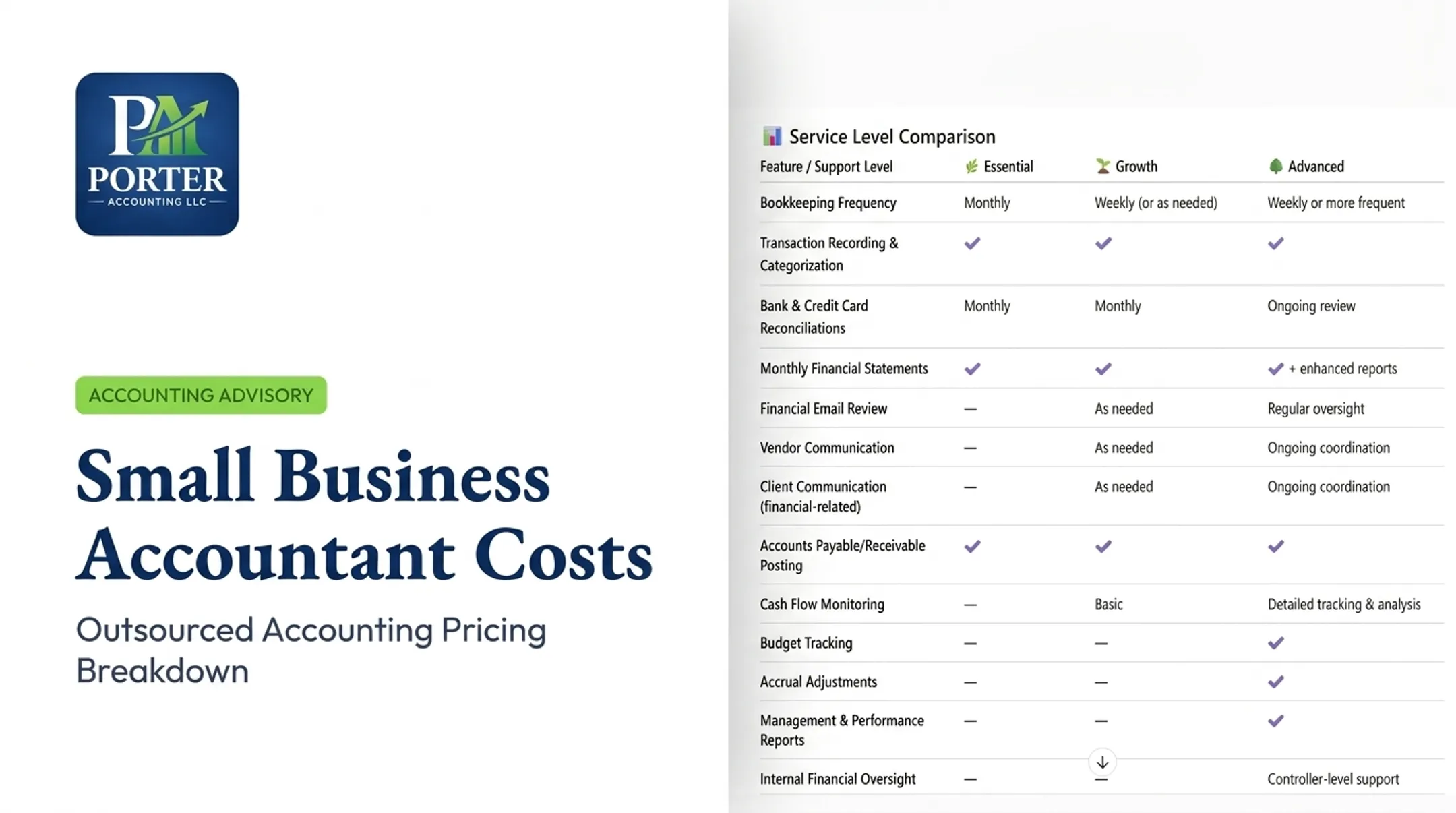
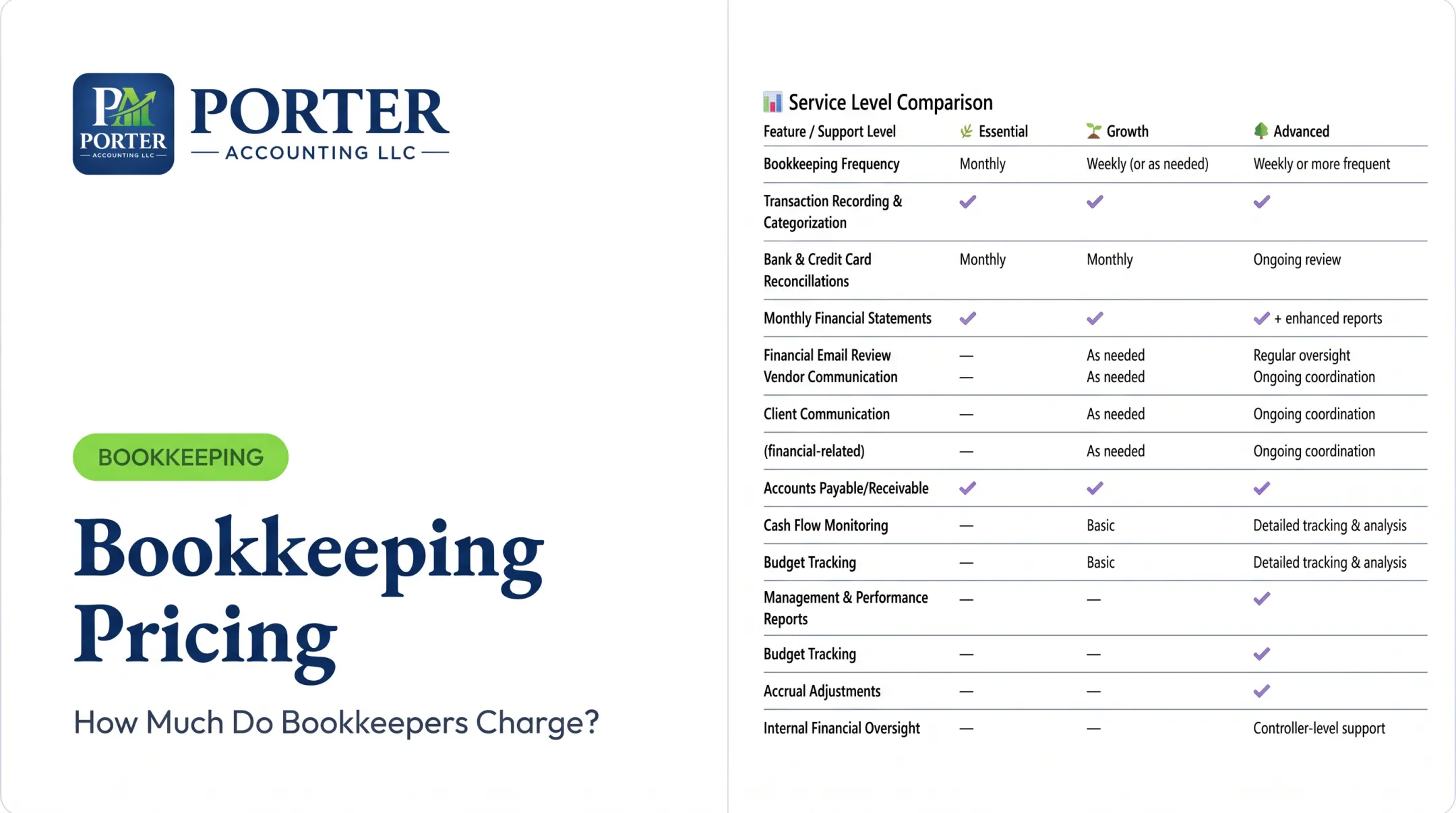
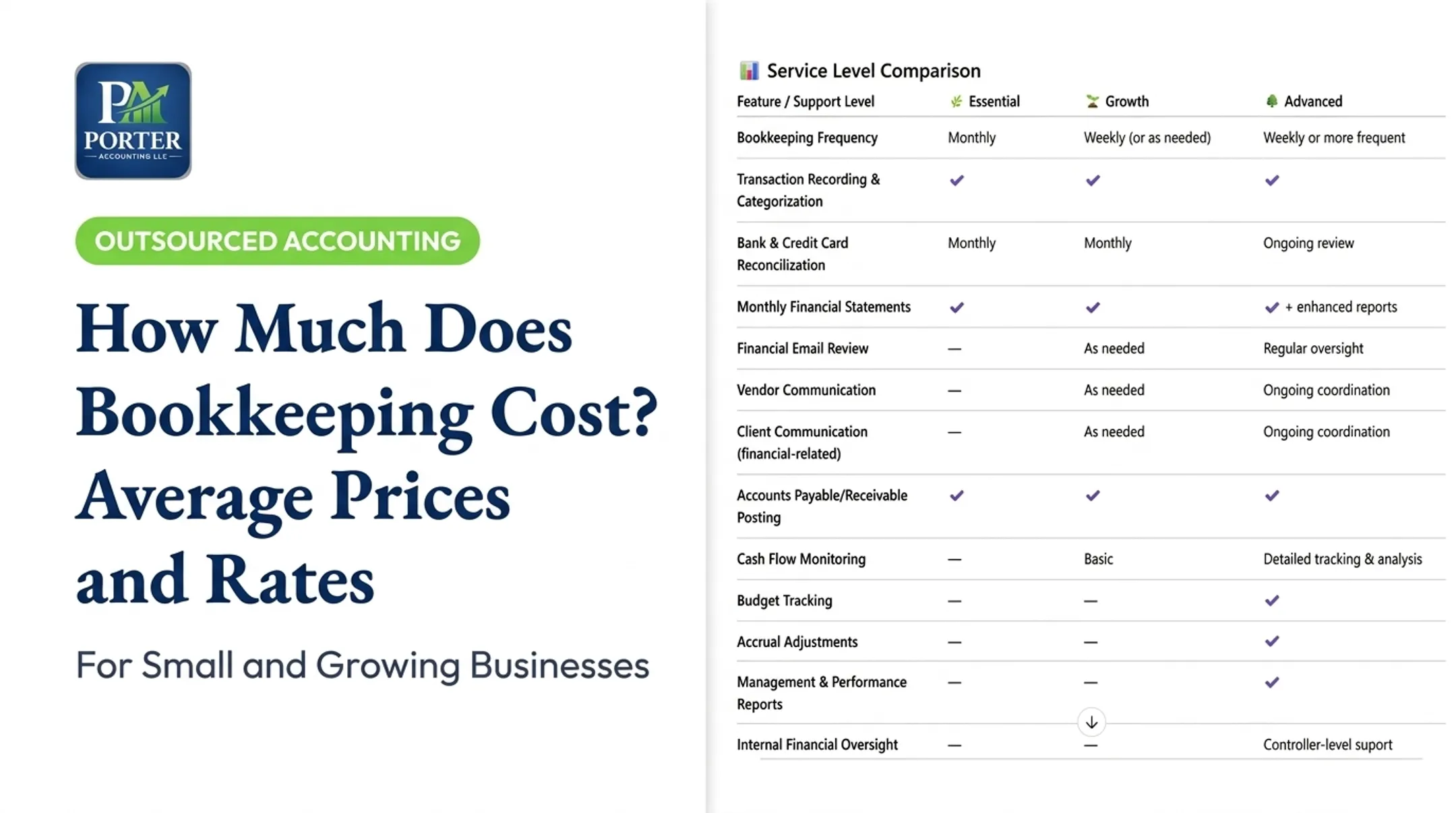
Porter Accounting LLC aligns to similar monthly tiers: $850/month for essential bookkeeping, $1,300/month when weekly attention is needed, and $2,100/month for controller-level oversight.
Business tax returns price on their own scale:
- Simple Schedule C: roughly $300-$1,500
- Form 1120-S or Form 1065: often $1,200-$3,500 (SDO CPA, 2026)
- Extra state filings: typically $200-$500+ each
Watch for unusually low quotes. They may leave out tax filing, cleanup, payroll, or advisory access. Before you compare prices, confirm exactly what is included and what is not.
Key Factors That Affect the Cost of an Accountant
Accounting fees reflect time, expertise, risk, and communication. More of any one factor generally means a higher quote.
Business Size, Transaction Volume, and Account Complexity
Monthly transactions, bank accounts, payment processors, locations, and employees all add reconciliation work. Two businesses with identical revenue can still get very different quotes. One might have three clean bank accounts; the other might run twelve accounts across two payment processors and a messy chart of accounts.
Business Model and Industry Requirements
Certain industries carry built-in complexity:
- E-commerce and CPG brands need inventory-aware bookkeeping and margin tracking
- SaaS companies require ASC 606 revenue recognition for subscription contracts
- Construction firms need job costing and progress billing
- Franchises need location-level P&Ls and royalty accounting
- Craft beverage producers need cost accounting for long aging cycles
None of these automatically doubles your bill, but each adds scope beyond basic transaction entry. Growing businesses in these models often see the gap most clearly when they move from basic bookkeeping into controller-level reporting.
Condition of the Books and Required Cleanup
Unreconciled accounts, missing documentation, and misclassified transactions all create catch-up work. According to SDO CPA's 2026 guide, 300 monthly transactions can cost 2-3 times more to clean up than 75 transactions covering the same period — and S-corps or partnerships often run 30-50% higher than sole proprietorships for the same cleanup scope.

Before hiring anyone, ask: Is cleanup included in onboarding, or billed separately? How does the accountant define "done"?
Service Level, Credentials, and Experience
- Bookkeepers handle data entry, reconciliation, and routine reports
- Accountants/CPAs add tax preparation and compliance filing
- Controllers oversee close processes, internal controls, and financial reporting accuracy
- Fractional CFOs provide forecasting, capital strategy, and executive-level guidance
Each step up typically brings a higher hourly or monthly rate. It also solves a different class of problem.
Billing Structure, Communication, and Urgency
Response time, meeting frequency, and deadline pressure all move the price. Before signing anything, ask about:
- Hourly versus flat-fee billing, and minimum charges
- How many meetings are included per month
- Turnaround times for deliverables
- Who owns software subscriptions and setup
- Rates for out-of-scope or rush requests
Cost Breakdown of Accounting Services
Total accounting cost covers four buckets: setup, recurring work, periodic compliance, and advisory support. The monthly invoice is only one piece.
Initial Setup, Onboarding, or Cleanup
Usually a one-time cost, though incomplete records can require staged work. This covers system setup, historical cleanup, opening balances, and chart-of-accounts review. Ask what's included in onboarding versus billed as a separate cleanup project, and get the completion criteria in writing.
Recurring Bookkeeping and Reporting
This is the ongoing work: transaction classification, reconciliations, month-end close, and financial statements. Tax preparation is often billed separately from monthly bookkeeping, so don't assume it's bundled in.
Tax, Payroll, Compliance, and Advisory Services
These costs are annual, periodic, or recurring depending on the service:
- Business tax returns and multi-state filings
- Tax planning and sales-tax support
- Payroll coordination and 1099 compliance
- Audit readiness and internal-controls review
- Cash-flow forecasting and controller or CFO-level oversight
Porter Accounting LLC bundles payroll recording and tax tracking into all three of its monthly plans. Controller services (starting at $100/hour) and fractional CFO services (starting at $150/hour) are billed separately when you need deeper strategic support.
Low-Cost vs High-Cost Accounting Support — What's the Difference?
Price usually tracks scope and complexity. Pay less and coverage stays narrow. Pay more and more of the financial load is handled for you.
Scope and Reporting
- Lower-cost: Basic transaction recording, limited reconciliations, standard reports, or a one-time filing
- Higher-cost: Timely month-end close, tailored management reporting, multi-entity accounting, and regular leadership reviews
Expertise and Risk Management
Lower-cost support fits simple, organized books where the owner still handles some financial administration.
Higher-cost support becomes necessary for revenue recognition, inventory accounting, audit readiness, or complex tax situations. Mistakes in that work are expensive to unwind.
Long-Term Value and Accountability
A lower-cost provider may suit a business that needs one defined task completed. A higher-cost partner is worth it when reliable numbers, faster decisions, and stronger cash-flow visibility directly support growth.
Neither path guarantees savings. Match the fee to the scope and complexity you actually need.

How to Estimate the Right Accounting Budget
Fit matters more than chasing an industry average.
Define the Required Outcomes
List what you actually need: clean books, tax-ready records, monthly statements, cash-flow visibility, or investor reporting. Separate must-have compliance work from optional advisory work so your initial budget stays realistic.
Assess Workload and Complexity
Gather your transaction volume, number of accounts, payroll details, sales-tax obligations, and current record condition. This information lets you request comparable quotes from multiple providers: apples to apples, not guesswork.
Choose the Right Professional and Pricing Model
Match the engagement to how complex your books and decisions really are:
- Software plus occasional tax help may cover a very simple sole proprietorship
- A bookkeeper or accountant fits recurring, predictable needs
- A controller or fractional CFO fits technical, strategic, or growth-stage needs
Build for One-Time and Recurring Costs
Budget separately for onboarding, monthly accounting, tax filing, payroll, software, and any special projects. Request a written scope of work covering deliverables, exclusions, billing frequency, and the process for out-of-scope requests.
Consider a Practical Virtual Accounting Partner
Porter Accounting LLC provides virtual accounting and financial advisory support across the United States for growing businesses that need more than basic bookkeeping. That can include accurate records, process improvement, cash-flow insight, controller oversight, or fractional CFO guidance.
Discuss your current books, industry, and growth plans before selecting a service tier so the scope matches what you actually need.

When It Makes Sense to Pay for More Than Bookkeeping
The jump from a bookkeeping fee to controller or advisory pricing usually follows a specific trigger, not just growth. A bank may start requiring accrual-basis GAAP financial statements with your loan renewal. An investor or large customer may ask for audited results, which means the books need reconciliations, schedules, and a clean close before auditors arrive; audit readiness and preparation is priced as its own scope for that reason. Subscription and contract-based businesses may need ASC 606 revenue recognition reviewed before any of that can happen. At Porter Accounting LLC, ASC 606 work and one-time audit preparation are custom-quoted, while the Advanced plan ($2,100/month) already includes month-end close oversight and audit prep. If you want to understand what that technical work involves, our guide to technical accounting for ASC 606, GAAP, and audit readiness is a good place to start.
What Most People Miss When It Comes to the Cost of an Accountant
Focusing only on the advertised monthly or hourly rate almost always produces an inaccurate budget.
Commonly overlooked charges include:
- Cleanup and onboarding fees
- Tax return preparation (often separate from bookkeeping)
- Payroll and sales-tax filing support
- Software subscriptions
- Special reports or rush fees
- Additional entities or year-end adjustments
Over-specifying services you don't need inflates the bill. Choosing the cheapest provider without checking accuracy, communication, and industry knowledge often costs more later: missed deadlines, unclear margins, or compliance issues that could have been caught earlier.
Delayed or unreliable financial information has a real cost, even when it never appears on an invoice:
- Weak cash-flow visibility drives reactive decisions
- Missed deadlines create penalties and cleanup work
- Poor margin insight hides which products or clients are actually profitable
Conclusion
Accountant costs in 2026 vary by service type, workload, business complexity, expertise, and pricing model. There's no flat rate that fits every business. A realistic budget covers both recurring support and one-time needs like cleanup, setup, or tax filing.
Compare deliverables and long-term value, not just the number on the quote. If you're a growing U.S. business that needs practical accounting and financial guidance matched to your workload and growth stage, from monthly bookkeeping to controller-level close, GAAP reporting, and fractional CFO support, Porter Accounting LLC is a clear next step.
Frequently Asked Questions
How much do accountants normally charge?
Hourly rates run roughly $43–$400 depending on whether you hire a bookkeeper or a CPA. Monthly support typically costs $200–$2,500+, with separate project fees for tax returns or cleanup. Your final quote depends on scope and complexity.
How much does an accountant typically charge for a tax return?
A simple Schedule C return often runs $300-$1,500, while partnership or S-corp returns typically cost $1,200-$3,500 or more. Multi-state filings add roughly $200-$500 per additional state.
How much should a small business spend on an accountant?
Budget based on transaction volume, payroll needs, industry requirements, and record condition, not a fixed percentage of revenue. A simple business might spend $850/month, while one needing controller-level oversight may spend $2,100+/month.
What are accounting costs?
Accounting costs cover bookkeeping, tax preparation, payroll, reporting, cleanup, compliance, and advisory support. Some are one-time (setup, cleanup), while others are recurring (monthly bookkeeping, payroll processing).
Is it worth paying for an accountant?
For many growing businesses, yes. Professional support saves time, improves compliance, and provides cash-flow visibility that supports better decisions. The value depends on matching service scope to what your business actually needs.