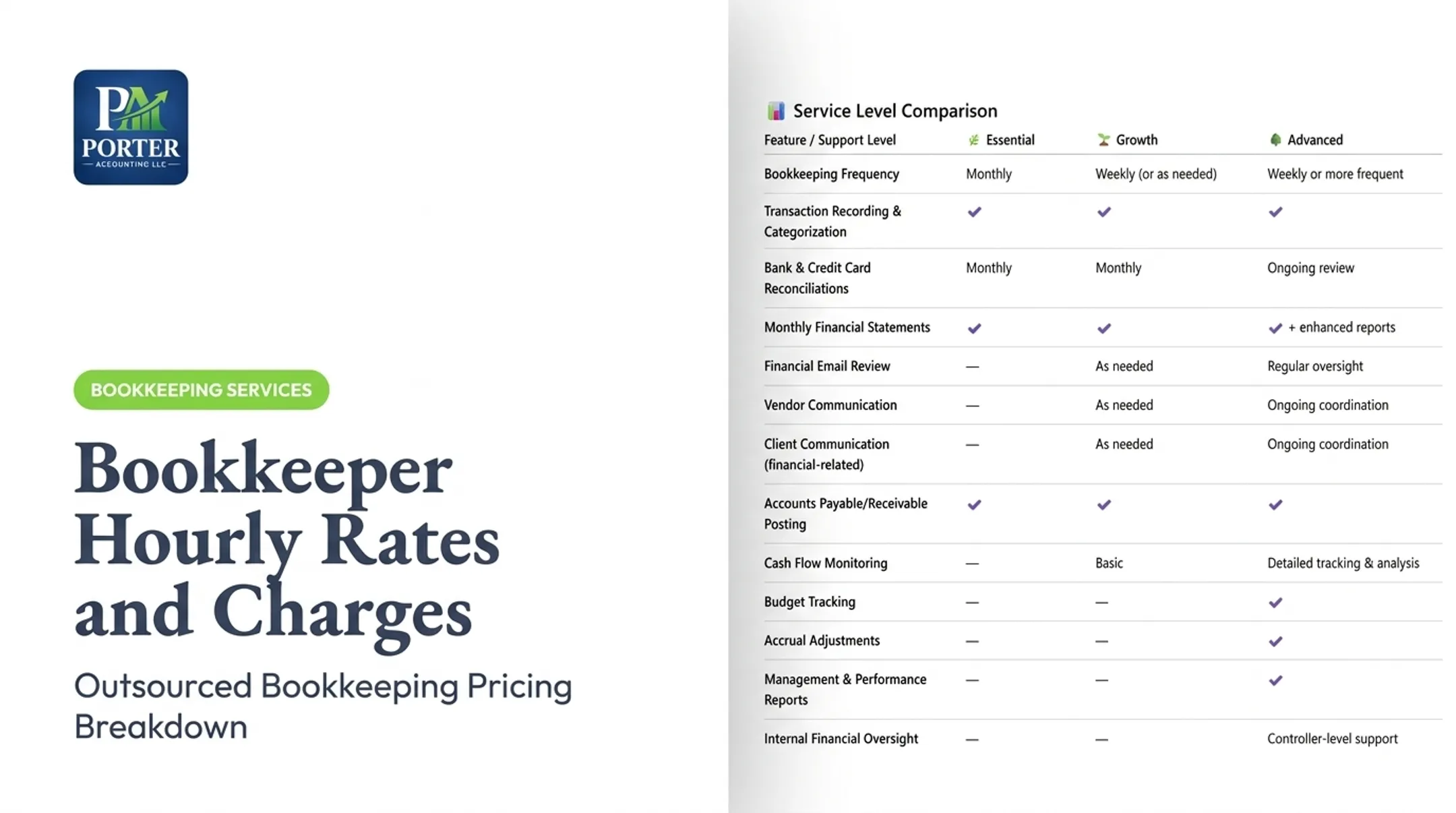

A quoted hourly rate is just the starting point. The hours required, your business's complexity, the state of your financial data, industry experience, and the type of engagement you choose all shape your final monthly bill. Two companies can be quoted the exact same hourly rate and end up with wildly different invoices.
This guide walks through current market rate ranges, how to calculate a realistic monthly budget, the pricing models available, what actually drives cost up or down, and how to decide whether fractional CFO support makes financial sense for your business right now.
Key Takeaways
- 2025–2026 US rates: fractional CFOs typically charge $175–$450/hour; experienced pros often land at $200–$350.
- Monthly cost = rate × hours, plus any setup, cleanup, or project fees.
- Hourly billing suits one-off questions; monthly retainers work better for recurring forecasting and reporting.
- The cheapest quote rarely equals the best value once you weigh seniority, deliverables, and access.
How Much Does a Fractional CFO Cost? Pricing Overview
There's no single national price tag for fractional CFO work. Rates depend on who you hire, what they do, and how often you need them. That said, current published benchmarks give you a realistic starting range.
According to K38 Consulting's 2025 fractional CFO pricing guide, hourly rates run $175 to $450, with most experienced professionals billing $200 to $350 per hour. Monthly retainers, per the same guide, typically fall between $3,000 and $15,000, with most companies paying $5,000 to $7,500 a month.

Turning an Hourly Quote Into a Monthly Budget
The math looks simple: hourly rate × expected hours = monthly cost. In practice, three questions trip people up:
- Billing increments - Is time billed in 15-minute, 30-minute, or hourly blocks?
- What counts as billable - Do meeting prep, follow-up emails, and internal review time count?
- Minimum commitments - Is there a monthly floor, even in a slow month?
Confirm these details before you sign anything. A "$200/hour" quote can quietly become $250/hour once prep and admin time get added in.
Three Practical Engagement Bands
Pricing guides generally group fractional CFO work into three tiers:
- Occasional or periodic advisory - Light-touch support for specific decisions or quarterly reviews, typically in the low thousands per month.
- Ongoing growth support - Recurring forecasting, KPI reporting, cash-flow management, and executive meetings, generally several thousand to over $10,000 monthly.
- Complex or urgent support - Fundraising, M&A, turnaround, or audit readiness, often project-based from $10,000 upward depending on scope.
What's Usually Included (and What Isn't)
Most advertised fractional CFO rates cover strategy meetings, financial analysis, forecasting, reporting, and reasonable email access. They typically exclude:
- Bookkeeping and payroll processing
- Tax preparation and filing
- Independent audit fees
- Software subscriptions
- Travel and major system implementations
Ask for a written scope. It's the only way to know what you're actually paying for.
Fractional vs. Full-Time CFO Cost
A full-time CFO isn't just a salary line. According to Salary.com, the average US CFO salary was $438,800 as of September 2026. Robert Half's 2026 guide puts starting salaries between $195,500 and $321,750.
Benefits, payroll taxes, recruiting fees, and onboarding often push total employment cost 25–30% above base salary. A fractional arrangement gives you senior expertise without that full overhead.
Key Factors That Affect Fractional CFO Hourly Rates
Rate ranges only tell part of the story. Here's what actually pushes a quote toward the higher or lower end.
Experience, Seniority, and Track Record
A CFO with fundraising, M&A, or turnaround experience typically commands a higher rate than someone doing routine monthly oversight. Credentials matter less than relevant, applied experience.
A CPA with no fundraising history won't help you close a Series A, regardless of how many letters follow their name. Match the person's actual track record to your actual need.
Industry and Technical Specialization
Specialized work costs more because it requires more than general accounting knowledge. Common examples include:
- SaaS revenue recognition (ASC 606)
- Inventory-heavy margin analysis
- Franchise unit reporting
- Construction job costing
Sector-specific fluency shortens the learning curve. At Porter Accounting LLC, Accounting Leader Thao Porter, MSA, has spent over a decade on this kind of work across SaaS, manufacturing, construction, CPG, retail, and franchise businesses, including GAAP reporting, ERP implementations, and audit readiness.
Business Complexity and Scale
Revenue size doesn't determine cost. Complexity does. Factors that add hours include:
- Multiple entities and intercompany transactions
- Several bank accounts or multi-state operations
- High transaction volume
A $5 million company with three legal entities and a debt facility may need more CFO time than a $20 million company running a single, clean operation.
Scope, Urgency, and Engagement Length
Routine monthly reporting prices differently from a compressed fundraising timeline or an urgent turnaround. Longer commitments and predictable scheduling sometimes lead to negotiated rates. Confirm any claimed discount against current published pricing rather than taking it at face value.
Financial Systems and Data Quality
Clean, current books let a CFO focus on strategy instead of forensic accounting. Messy reconciliations, delayed month-end close, or scattered spreadsheets create cleanup work billed on top of CFO-level analysis. Before engaging anyone, ask whether bookkeeping, controller work, and CFO advisory are priced as separate scopes. You shouldn't pay CFO rates to fix a chart of accounts.

Fractional CFO Pricing Models, Cost Breakdown, and Value Comparison
The right pricing model depends on whether you need recurring leadership, a one-time deliverable, or occasional expert input.
Hourly Billing
Hourly billing fits one-off reviews, short-term coverage, a specific board question, or support layered alongside your existing finance team. Before committing, confirm:
- Minimum billable increments
- Whether meeting prep counts toward billed time
- What happens to unused hours
- Whether there's a not-to-exceed cap on overages
For example, Porter Accounting LLC's fractional CFO services start at $150 per hour. That coverage includes cash-flow forecasting, budgeting, KPI tracking, and financial strategy, with custom quotes for larger strategy projects.
Monthly Retainer
A retainer bundles a recurring fee with defined scope, expected availability, and a set meeting cadence. Before signing, ask:
- Do unused hours roll over?
- What happens when a month's demand exceeds the retainer?
- Are bookkeeping or tax work included, or billed separately?
Project-Based or Fixed-Fee Work
Financial modeling, ERP implementation, audit-readiness prep, or fundraising support often get priced as standalone projects. A fixed scope gives you budget certainty, but expect a change-order process if timelines or requirements shift mid-project.
Cost Components Beyond the Quoted Rate
Watch for these additions:
- Discovery or assessment work
- Accounting cleanup
- System integration and reporting-package buildout
- Travel or on-site requirements
- Third-party professional fees
Sample budgeting formula (hypothetical numbers, not an industry average):
- 10 hours/month at $200/hour = $2,000 ongoing
- One-time $1,500 cash-flow model buildout in month one
- First month total: $3,500, then $2,000/month afterward
Lower-Cost vs. Higher-Cost Support
Don't assume a higher rate automatically buys better results. Compare providers on:
- Seniority of the person actually doing the work
- Response time and communication access
- Reporting quality and strategic depth
- Complexity they've successfully handled before
Value shows up in outcomes like clearer cash visibility, stronger controls, and reporting you can actually act on, not just the number on the invoice.
Pricing CFO Work That Involves GAAP Reporting, ASC 606, or Audit Readiness
Some of the most expensive fractional CFO invoices come from work that is not really CFO work. Closing the books, booking accruals, and reconciling deferred revenue are controller tasks. When they get done at CFO rates, or by someone learning them on the fly, the budget stretches fast.
A cleaner way to price it is to split the scope into layers:
- Controller layer: month-end close, accrual adjustments, balance sheet review, and consistent reporting. Porter Accounting LLC's controller services start at $100 per hour.
- Reporting layer: accrual-basis GAAP financial statements for lenders, investors, or a board.
- Technical accounting layer: ASC 606 revenue recognition reviews, deferred revenue schedules, and audit preparation. These are usually quoted as projects because contract volume and audit timelines vary so much.
- CFO layer: forecasting, budgeting, KPI tracking, and financial strategy, starting at $150 per hour.
If you sell subscriptions, multi-element contracts, or long-term projects, ask any provider how they handle revenue recognition before comparing rates. Our overview of technical accounting for ASC 606, GAAP, and audit readiness explains what that work covers and why it is often scoped separately.
How to Estimate the Right Fractional CFO Budget
Start with your problem, not the price tag. Common triggers include:
- Cash-flow visibility gaps
- Unreliable forecasting
- Investor or board reporting prep
- Accounting cleanup
- No senior finance leadership on the team
That answer shapes scope, seniority, and cost.
Estimate Your Required Involvement
Map the monthly workload before you request quotes:
- Recurring meetings and reporting cycles
- Analysis and preparation time
- Communication and decision support
- Upcoming project deadlines (fundraise, audit, system switch)
Occasional support may run about 5 hours a month. Ongoing growth support often lands in the 15–20 hour range. Urgent turnaround work can spike above that for a short period.
For a quick budget range, multiply expected monthly hours by the rate tier you need. At typical U.S. fractional CFO rates around $150–$350+ per hour, 10 hours is roughly $1,500–$3,500 per month before any retainer discounting.

Assess Your Readiness First
Readiness directly affects hours—and your bill. Before engaging anyone, review:
- Timeliness of your monthly close
- Reliability of bank and account reconciliations
- Chart of accounts structure
- Current accounting software and existing staff
If basic records are behind, expect cleanup hours before strategic CFO work. According to Forbes, rapid growth and persistent cash-flow problems are two of the clearest signals a business needs this level of support.
Provider-Comparison Checklist
| Compare | Ask About |
|---|---|
| Rate structure | Hourly, retainer, or project-based |
| Minimums | Monthly floor or not-to-exceed cap |
| Seniority | Who does the actual work |
| Industry fit | Relevant sector experience |
| Contract terms | Length, termination, data security |
When you compare providers, match the checklist to your actual gap. Porter Accounting LLC, for example, works virtually with growing U.S. businesses that need fractional CFO or controller support tied to financial cleanup, GAAP reporting, ASC 606, ERP setup, or audit readiness—useful benchmarks if those items drive your scope.
Review the Engagement Periodically
Revisit fit within the first 90 days. Score the engagement on:
- Reporting timeliness
- Forecast usefulness
- Cash visibility
- Completion of agreed deliverables
Keep the review tied to those operating outcomes. Skip unsupported ROI percentages some providers advertise.
Conclusion
A fractional CFO's hourly rate is just a starting point. Your real budget reflects experience, specialization, complexity, scope, and data quality, plus how the engagement is structured. A transparent proposal spells out deliverables, exclusions, billing rules, and how additional work gets approved, so you can compare value instead of just chasing the lowest number.
If your business has outgrown basic bookkeeping, virtual fractional CFO support may fit your current stage. Porter Accounting LLC offers practical fractional CFO services for growing businesses, delivered virtually across the U.S., with controller, GAAP reporting, ASC 606, and audit readiness support from the same team so each piece of work is priced at the right level.
Frequently Asked Questions
What is a good hourly rate for a fractional CFO?
A good rate depends on seniority, specialization, and the complexity of your business. Published US benchmarks range from $175 to $450 per hour; treat that range as your starting point.
How much should I pay my CFO?
Budget expected hours times the hourly rate, then add any project or cleanup fees for your engagement model. Even in the $175 to $450 range, that total usually stays well below the fully loaded cost of a full-time CFO, including salary, benefits, and recruiting.
What is included in virtual CFO services?
Typical services include forecasting, cash-flow analysis, KPI reporting, financial modeling, and strategic planning. Bookkeeping, payroll, tax preparation, and independent audit fees are usually separate, billable scopes.
Can you be a part-time CFO?
Yes. A fractional CFO is an external finance leader who works part-time, either on a set schedule or a specific project, without the cost or commitment of a full-time executive hire.
What size company needs a fractional CFO?
Company size matters less than growth stage, financial complexity, and cash-flow risk. A business raising funding or lacking senior finance leadership often needs this support regardless of revenue.
What does a fractional CFO actually do?
A fractional CFO turns raw financial data into forecasts, KPI insights, and stronger controls. They help leadership teams make better decisions about cash, growth, and strategy.
Is ASC 606 or audit preparation billed at fractional CFO rates?
Not always. ASC 606 revenue recognition work and one-time audit preparation are often quoted as fixed-scope projects, while ongoing close and reconciliation work fits controller-level rates. At Porter Accounting LLC, ASC 606 and one-time audit prep are custom-quoted, controller services start at $100 per hour, and fractional CFO services start at $150 per hour.